GB/T 1033.1-2008 English PDF
Price & Delivery
US$105.00 · In stock · Download in 9 secondsGB/T 1033.1-2008: Plastics -- Methods for determining the density of non-cellular plastics -- Part 1: Immersion method, liquid pycnometer method and titration method
Delivery: 9 seconds. True-PDF full-copy in English & invoice will be downloaded + auto-delivered via email. See step-by-step procedure
Status: Valid
GB/T 1033.1: Historical versions
| Standard ID | USD | BUY PDF | Delivery | Standard Title (Description) | Status |
| GB/T 1033.1-2008 | 105 | Add to Cart | Auto, 9 seconds. | Plastics -- Methods for determining the density of non-cellular plastics -- Part 1: Immersion method, liquid pycnometer method and titration method | Valid |
| GB/T 1033-1986 | 399 | Add to Cart | 3 days | Test method for density and relative density of plastics | Obsolete |
Click to Preview this PDF
Similar standards
GB/T 1033.1-2008: Plastics -- Methods for determining the density of non-cellular plastics -- Part 1: Immersion method, liquid pycnometer method and titration method
---This is an excerpt. Full copy of true-PDF in English version (including equations, symbols, images, flow-chart, tables, and figures etc.), auto-downloaded/delivered in 9 seconds, can be purchased online: https://www.ChineseStandard.net/PDF.aspx/GBT1033.1-2008
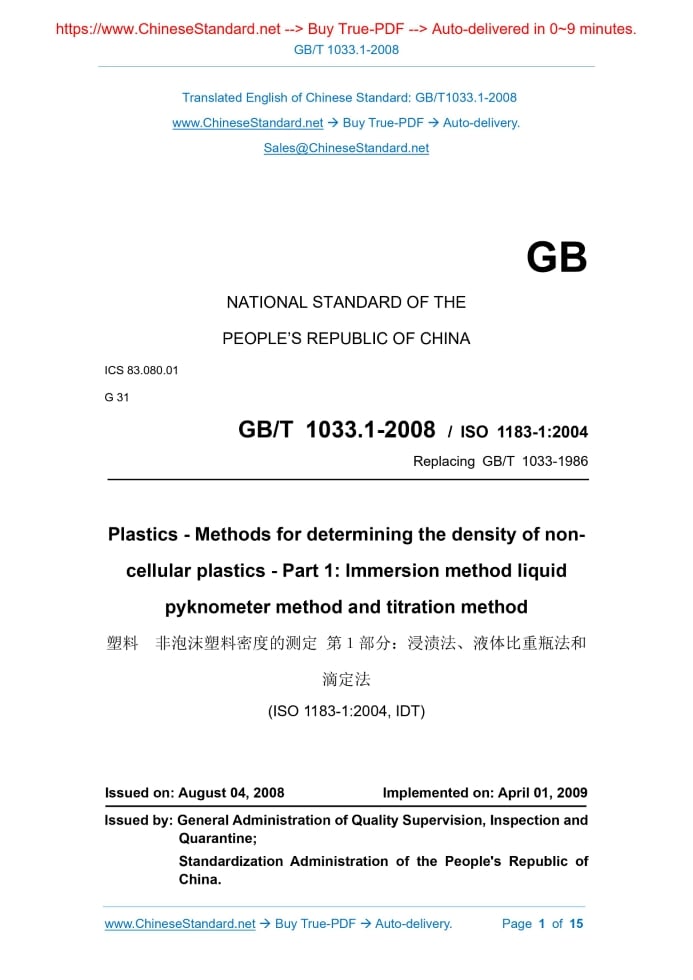
GB NATIONAL STANDARD OF THE PEOPLE’S REPUBLIC OF CHINA ICS 83.080.01 G 31 GB/T 1033.1-2008 / ISO 1183-1.2004 Replacing GB/T 1033-1986 Plastics - Methods for determining the density of non- cellular plastics - Part 1.Immersion method liquid pyknometer method and titration method (ISO 1183-1.2004, IDT) Issued on. AUGUST 04, 2008 Implemented on. APRIL 01, 2009 Issued by. General Administration of Quality Supervision, Inspection and Quarantine; Standardization Administration of the People's Republic of China.
Table of Contents
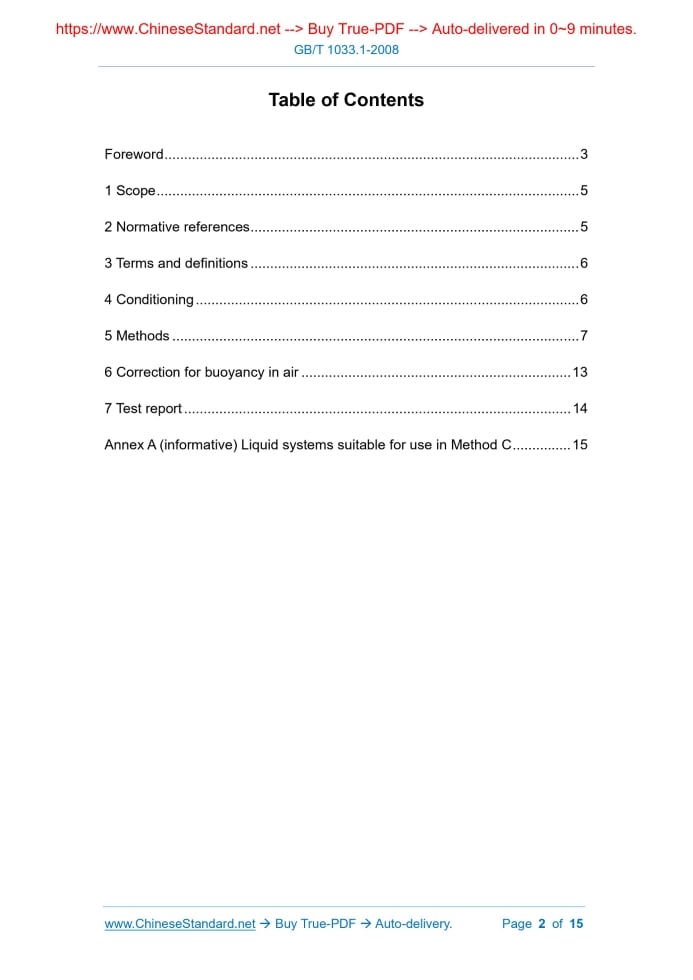
Foreword... 3 1 Scope... 5 2 Normative references... 5 3 Terms and definitions... 6 4 Conditioning... 6 5 Methods... 7 6 Correction for buoyancy in air... 13 7 Test report... 14 Annex A (informative) Liquid systems suitable for use in Method C... 15Foreword
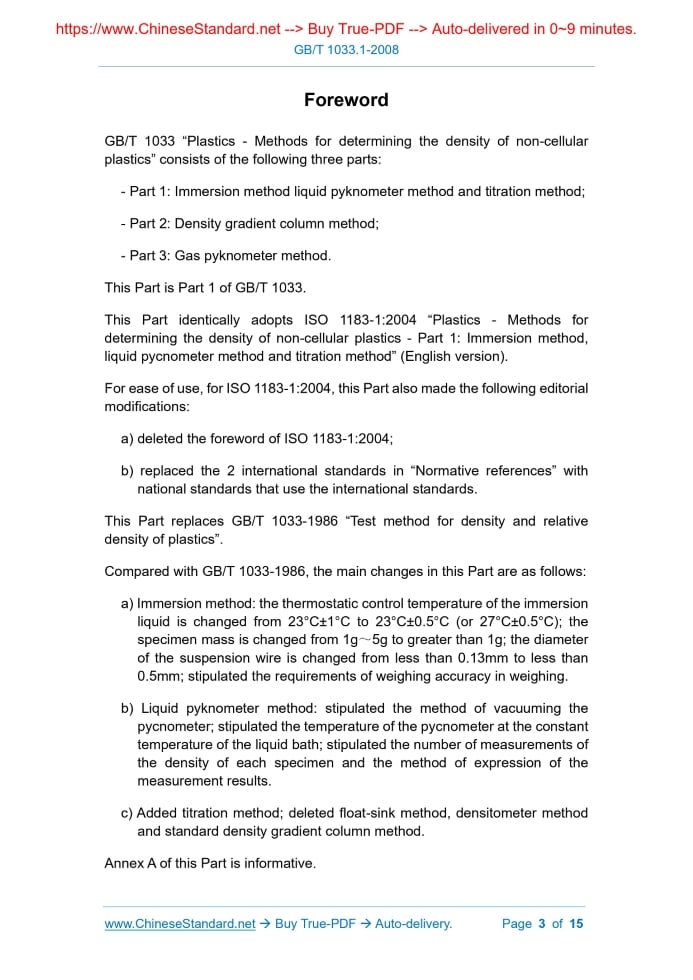
GB/T 1033 “Plastics - Methods for determining the density of non-cellular plastics” consists of the following three parts. - Part 1.Immersion method liquid pyknometer method and titration method; - Part 2.Density gradient column method; - Part 3.Gas pyknometer method. This Part is Part 1 of GB/T 1033. This Part identically adopts ISO 1183-1.2004 “Plastics - Methods for determining the density of non-cellular plastics - Part 1.Immersion method, liquid pycnometer method and titration method” (English version). For ease of use, for ISO 1183-1.2004, this Part also made the following editorial modifications. a) deleted the foreword of ISO 1183-1.2004; b) replaced the 2 international standards in “Normative references” with national standards that use the international standards. This Part replaces GB/T 1033-1986 “Test method for density and relative density of plastics”. Compared with GB/T 1033-1986, the main changes in this Part are as follows. a) Immersion method. the thermostatic control temperature of the immersion liquid is changed from 23°C±1°C to 23°C±0.5°C (or 27°C±0.5°C); the specimen mass is changed from 1g~5g to greater than 1g; the diameter of the suspension wire is changed from less than 0.13mm to less than 0.5mm; stipulated the requirements of weighing accuracy in weighing. b) Liquid pyknometer method. stipulated the method of vacuuming the pycnometer; stipulated the temperature of the pycnometer at the constant temperature of the liquid bath; stipulated the number of measurements of the density of each specimen and the method of expression of the measurement results. c) Added titration method; deleted float-sink method, densitometer method and standard density gradient column method. Annex A of this Part is informative. This Part was proposed by China Petroleum and Chemical Industry Association. This Part shall be under the jurisdiction of National Technical Committee on Plastics of Standardization Administration of China (SAC/TC 15). Main drafting organizations of this Part. National Chemical Building Materials Testing Center (Materials Testing Department) of Sinopec Beijing Chemical Research Institute. The drafting organizations of this Part. National Synthetic Resin Quality Supervision and Inspection Center, Beijing Yanshan Petrochemical Resin Institute, National Petrochemical Organic Raw Material Synthetic Resin Quality Inspection Center, Guangzhou Kingfa Technology Co., Ltd., National Plastics Quality Inspection Center (Beijing). Main drafters of this Part. Gui Hua, Hu Xiaoyi, You Huan, Chen Hongyuan, Wang Chaoxian, Zhao Ping, Ye Nanbiao, Weng Yunxuan. This Part was issued in December 1986 for the first time. This is the first revision. Plastics - Methods for determining the density of non- cellular plastics - Part 1.Immersion method liquid pyknometer method and titration method1 Scope
This Part of GB/T 1033 specifies three methods for the determination of the density of non-cellular plastics in the form of void-free moulded or extruded objects, as well as powders, flakes and granules.2 Normative references
The provisions in following documents become the provisions of this Standard through reference in this Part of GB/T 1033.For dated references, the subsequent amendments (excluding corrigendum) or revisions do not apply to this Standard, however, parties who reach an agreement based on this Standard are encouraged to study if the latest versions of these documents are applicable. For undated references, the latest edition of the referenced document applies.3 Terms and definitions
For the purposes of this document, the terms and definitions defined in GB/T 2035-2008 as well as the followings apply to this Part of GB/T 1033. the ratio of the mass m of a sample to its volume V (at the temperature t), expressed in kg/m3, kg/dm3 (g/cm3) or kg/L4 Conditioning
The test atmosphere shall be in accordance with GB/T 2918-1998.In general, conditioning specimens to constant temperature is not required, because the determination itself brings the specimen to the constant temperature of the test.5 Methods
Use freshly distilled or deionized water or another suitable liquid containing not more than 0.1% of a wetting agent to help in removing air bubbles. The liquid or solution with which the specimen comes into contact during the measurement shall have no effect on the specimen. Add more of the denser liquid until the heaviest pieces of specimen remain at a constant level within the liquid for at least 1 min.6 Correction for buoyancy in air
Where weighings are made in air, the values of the "apparent masses" obtained shall be corrected to compensate for the effect of the air buoyancy on the specimen and on any weights used. This will be the case if the accuracy of the results is to be between 0.2% and 0.05%.7 Test report
The test report shall include the following information.Annex A
(informative) Liquid systems suitable for Method C Liquid system suitable for Method C of this Part is given in table A.1. WARNING - some of the following chemicals may be hazardous. ......Source: Above contents are excerpted from the full-copy PDF -- translated/reviewed by: www.ChineseStandard.net / Wayne Zheng et al.