GB 5009.93-2017 English PDF
Price & Delivery
US$70.00 · In stock · Download in 9 secondsGB 5009.93-2017: National food safety standard - Determination of selenium in foods
Delivery: 9 seconds. True-PDF full-copy in English & invoice will be downloaded + auto-delivered via email. See step-by-step procedure
Status: Valid
GB 5009.93: Historical versions
| Standard ID | USD | BUY PDF | Delivery | Standard Title (Description) | Status |
| GB 5009.93-2017 | 70 | Add to Cart | Auto, 9 seconds. | National food safety standard - Determination of selenium in foods | Valid |
| GB 5009.93-2010 | 319 | Add to Cart | 3 days | National food safety standard -- Determination of selenium in foods | Obsolete |
| GB/T 5009.93-2003 | 279 | Add to Cart | 3 days | Determination of selenium in foods | Obsolete |
Click to Preview this PDF
Similar standards
GB 5009.93-2017: National food safety standard - Determination of selenium in foods
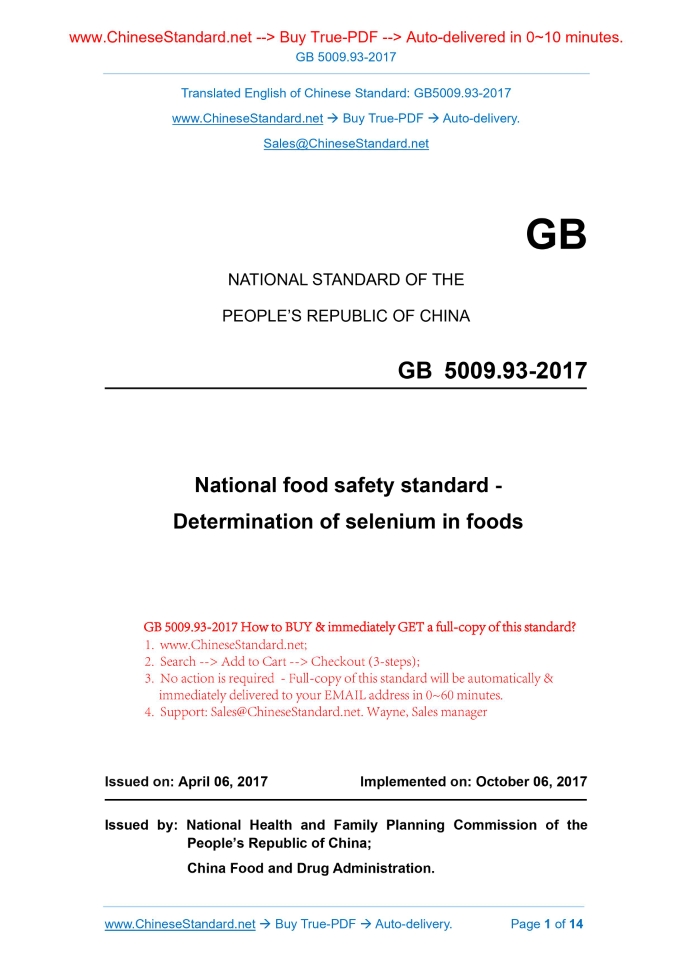
---This is an excerpt. Full copy of true-PDF in English version (including equations, symbols, images, flow-chart, tables, and figures etc.), auto-downloaded/delivered in 9 seconds, can be purchased online: https://www.ChineseStandard.net/PDF.aspx/GB5009.93-2017GB NATIONAL STANDARD OF THE PEOPLE’S REPUBLIC OF CHINA National food safety standard - Determination of selenium in foods Issued on. APRIL 06, 2017 Implemented on. OCTOBER 06, 2017 Issued by. National Health and Family Planning Commission of the People’s Republic of China; China Food and Drug Administration.
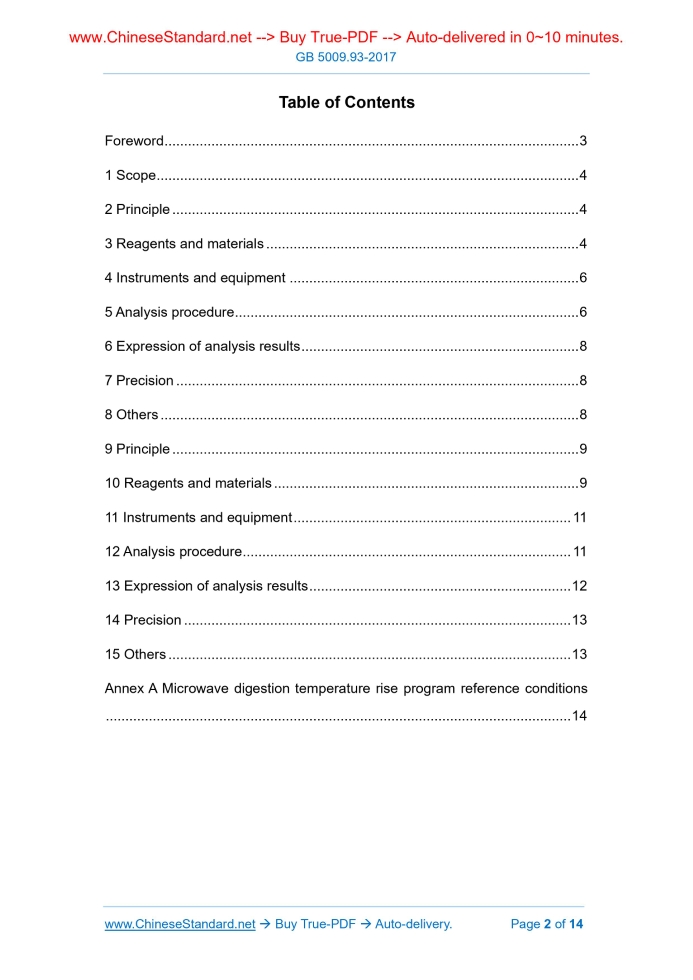
Table of Contents
Foreword... 3 1 Scope... 4 2 Principle... 4 3 Reagents and materials... 4 4 Instruments and equipment... 6 5 Analysis procedure... 6 6 Expression of analysis results... 8 7 Precision... 8 8 Others... 8 9 Principle... 9 10 Reagents and materials... 9 11 Instruments and equipment... 11 12 Analysis procedure... 11 13 Expression of analysis results... 12 14 Precision... 13 15 Others... 13 Annex A Microwave digestion temperature rise program reference conditions ... 14Foreword
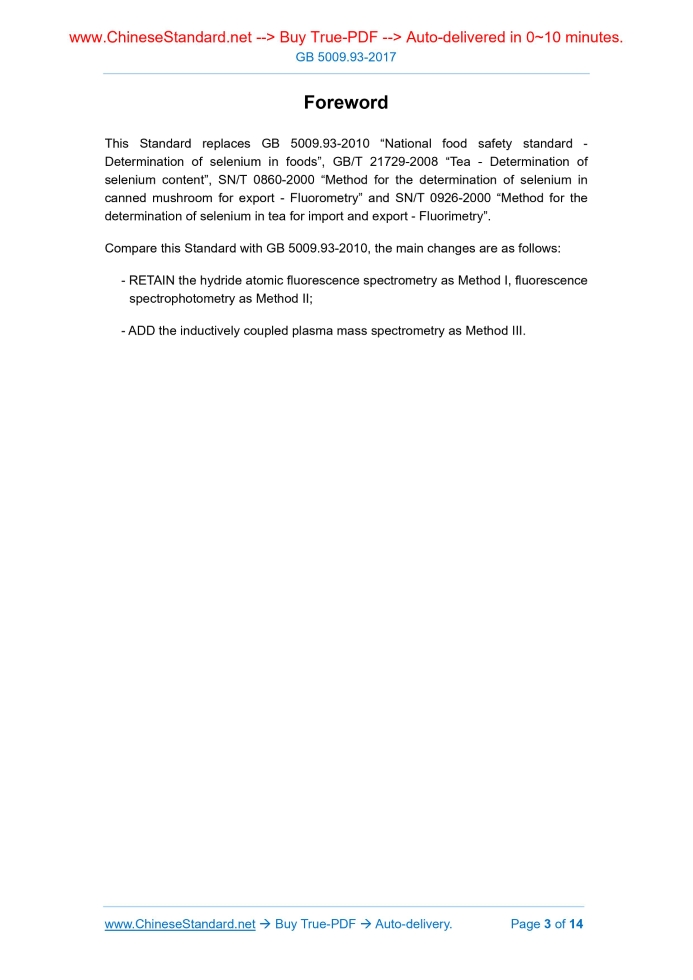
This Standard replaces GB 5009.93-2010 “National food safety standard - Determination of selenium in foods”, GB/T 21729-2008 “Tea - Determination of selenium content”, SN/T 0860-2000 “Method for the determination of selenium in canned mushroom for export - Fluorometry” and SN/T 0926-2000 “Method for the determination of selenium in tea for import and export - Fluorimetry”. Compare this Standard with GB 5009.93-2010, the main changes are as follows. - RETAIN the hydride atomic fluorescence spectrometry as Method I, fluorescence spectrophotometry as Method II; - ADD the inductively coupled plasma mass spectrometry as Method III. National food safety standard - Determination of selenium in foods1 Scope
This Standard specifies the determination of selenium content in foods by hydride atomic fluorescence spectrometry, fluorescence spectrometry and inductively coupled plasma mass spectrometry. This Standard applies to the determination of selenium in all types of foods. Method I -- Hydride atomic fluorescence spectrometry2 Principle
After the sample is acid-heated and digested, in the 6 mol/L hydrochloric acid medium, the hexavalent selenium in the sample is reduced to tetravalent selenium. Sodium borohydride or potassium borohydride is used as the reducing agent to reduce the tetravalent selenium in the hydrochloric acid medium to hydrogen selenide, which is introduced by carrier gas (argon) into the atomizer for atomization.3 Reagents and materials
Unless otherwise indicated, the reagents used in this method are analytical regents, and the water is the Grade 2 water as specified in GB/T 6682. 3.1 Reagents 3.1.1 Nitric acid (HNO3). excellent regent. 3.1.2 Perchloric acid (HClO4). excellent regent. 3.1.6 Sodium borohydride (NaBH4). excellent regent. 3.1.7 Potassium ferricyanide [K3Fe(CN)6]. 3.2 Preparation of reagents 3.2.1 Nitric acid - perchloric acid mixed acid (9 + 1). MIX 900 mL of nitric acid with 100 mL of perchloric acid. 3.2.2 Sodium hydroxide solution (5 g/L). WEIGH 5 g of sodium hydroxide; DISSOLVE in 1000 mL of water; MIX well. 3.3 Standard Selenium standard solution. 1000 mg/L, or selenium standard solution at a certain concentration certified by the state and awarded the standard substance certificate. 3.4 Preparation of standard solutions 3.4.1 Selenium standard intermediate solution (100 mg/L). accurately PIPETTE 1.00 mL of selenium standard solution (1000 mg/L) in a 10 mL volumetric flask; ADD hydrochloric acid solution (5 + 95) to the mark; MIX well.4 Instruments and equipment
NOTE. All glassware and polytetrafluoroethylene digestion inner tank must be soaked in nitric acid solution (1 + 5) overnight, washed repeatedly with tap water, and finally rinsed with water. 4.1 Atomic fluorescence spectrometer. with selenium hollow cathode lamp. 4.4 Microwave digestion system. with polytetrafluoroethylene digestion inner tank.5 Analysis procedure
5.1 Sample preparation NOTE. Sample contamination shall be avoided during sampling and preparation processes. 5.1.1 Cereal, bean samples The sample, after the debris are removed and being crushed, is stored in plastic bottles. 5.2 Sample digestion 5.2.1 Wet digestion WEIGH 0.5 g ~ 3 g (to the nearest 0.001 g) of solid sample or accurately PIPETTE 1.00 mL ~ 5.00 mL of liquid sample; PLACE in a conical flask; ADD 10 mL of nitric acid - perchloric acid mixed acid (9 + 1) and a few glass beads; COVER the surface dish for cold digestion overnight. The next day, HEAT on the electric hot plate, and timely ADD nitric acid. When the solution becomes clear and colorless and accompanied by white smoke, continue to HEAT until the remaining volume is about 2 mL. 5.2.2 Microwave digestion WEIGH 0.2 g ~ 0.8 g (to the nearest 0.001 g) of solid sample or accurately PIPETTE 1.00 mL ~ 3.00 mL of liquid sample; PLACE in the digestive tube; ADD 10 mL of nitric acid and 2 mL of hydrogen peroxide; SHAKE to mix well. DIGEST in the microwave digestion instrument, and the recommended microwave digestion conditions are shown in Annex A (set digestion conditions according to different instruments). 5.3 Determination 5.3.1 Instrument reference conditions Adjust the instruments to the best condition according to their performance. Reference conditions. negative high voltage 340 V; lamp current 100 mA; atomization temperature 800 °C; furnace height 8 mm; carrier gas flow rate 500 mL/min; shielding gas flow rate 1000 mL/min; standard curve method of measurement method; peak area of reading method; delay time 1 s; reading time 15 s; solution adding time 8 s; sample injection volume 2 mL.6 Expression of analysis results
The content of selenium in the sample is calculated according to equation (1).7 Precision
The absolute difference between two independent determination results obtained under repeatability conditions shall not exceed 20 % of the arithmetic mean.8 Others
When the sample volume is 1 g (or 1 mL) and the constant volume is 10 mL, the limit of detection is 0.002 mg/kg (or 0.002 mg/L) and the limit of quantification is 0.006 mg/kg (or 0.006 mg/L) for this method.9 Principle
The sample is digested with mixed acid to convert the selenium compound to inorganic selenium Se4+.10 Reagents and materials
Unless otherwise specified, the reagents used in this method are analytical regents, and the water is Grade 2 water as specified in GB/T 6682. 10.1 Reagents 10.1.1 Hydrochloric acid (HCl). excellent regent. 10.1.6 Cresol red (C21H18O5S). 10.1.7 Ammonia (NH3 • H2O). excellent regent. 10.2 Preparation of reagents 10.2.1 Hydrochloric acid solution (1 %). MEASURE 5 mL of hydrochloric acid; DILUTE to 500 mL with water; MIX well. 10.2.4 Hydrochloric acid solution (6 mol/L). MEASURE 50 mL of hydrochloric acid; slowly ADD to 40 mL of water; COOL; ADD water to 100 mL; MIX well. 10.2.5 Ammonia solution (1 + 1). MIX 5 mL of water with 5 mL of ammonia. 10.2.6 EDTA mixture. 10.3 Standard Selenium standard solution. 1000 mg/L, or selenium standard solution at a certain concentration certified by the state and awarded the standard substance certificate. 10.4 Preparation of standard solutions 10.4.1 Selenium standard intermediate solution (100 mg/L). accurately PIPETTE 1.00 mL of selenium standard solution (1000 mg/L) in a 10 mL volumetric flask; DILUTE with hydrochloric acid solution (1 %) to the mark; MIX well. 10.4.2 Selenium standard use solution (50.0 μg/L). accurately PIPETTE 0.50 mL of selenium standard intermediate solution (100 mg/L); DILUTE with hydrochloric acid solution (1 %) to 1000 mL; MIX well. ......Source: Above contents are excerpted from the full-copy PDF -- translated/reviewed by: www.ChineseStandard.net / Wayne Zheng et al.