GB 5009.262-2016 English PDF
Price & Delivery
US$70.00 · In stock · Download in 9 secondsGB 5009.262-2016: Method for analysis of hygienic standard of edible oils
Delivery: 9 seconds. True-PDF full-copy in English & invoice will be downloaded + auto-delivered via email. See step-by-step procedure
Status: Valid
| Standard ID | USD | BUY PDF | Delivery | Standard Title (Description) | Status |
| GB 5009.262-2016 | 70 | Add to Cart | Auto, 9 seconds. | Method for analysis of hygienic standard of edible oils | Valid |
Click to Preview this PDF
Similar standards
GB 5009.262-2016: Method for analysis of hygienic standard of edible oils
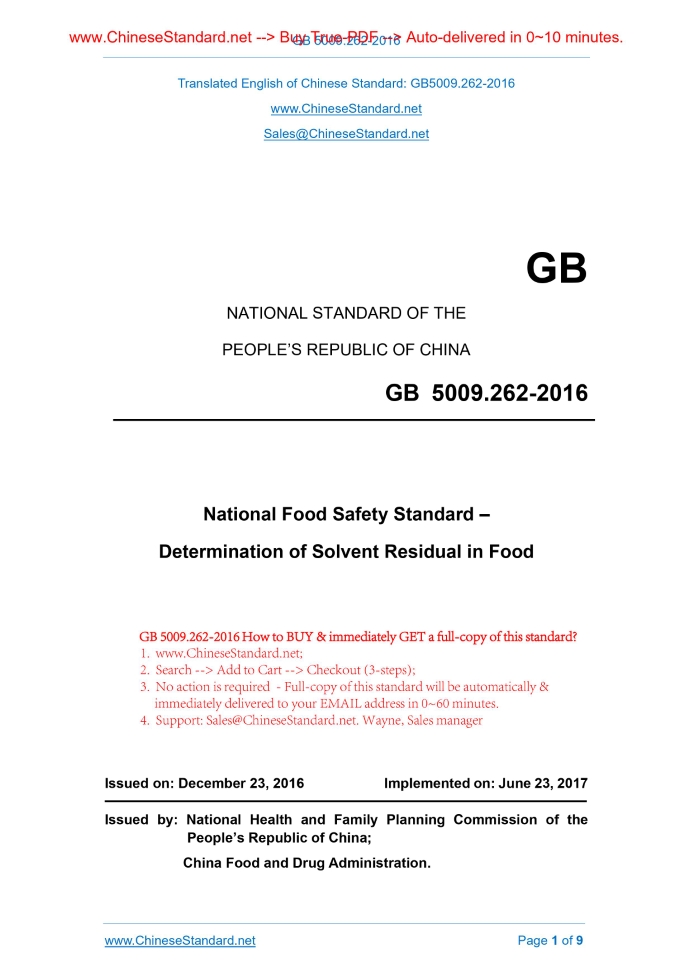
---This is an excerpt. Full copy of true-PDF in English version (including equations, symbols, images, flow-chart, tables, and figures etc.), auto-downloaded/delivered in 9 seconds, can be purchased online: https://www.ChineseStandard.net/PDF.aspx/GB5009.262-2016GB NATIONAL STANDARD OF THE PEOPLE’S REPUBLIC OF CHINA National Food Safety Standard – Determination of Solvent Residual in Food Issued on. DECEMBER 23, 2016 Implemented on. JUNE 23, 2017 Issued by. National Health and Family Planning Commission of the People’s Republic of China; China Food and Drug Administration.
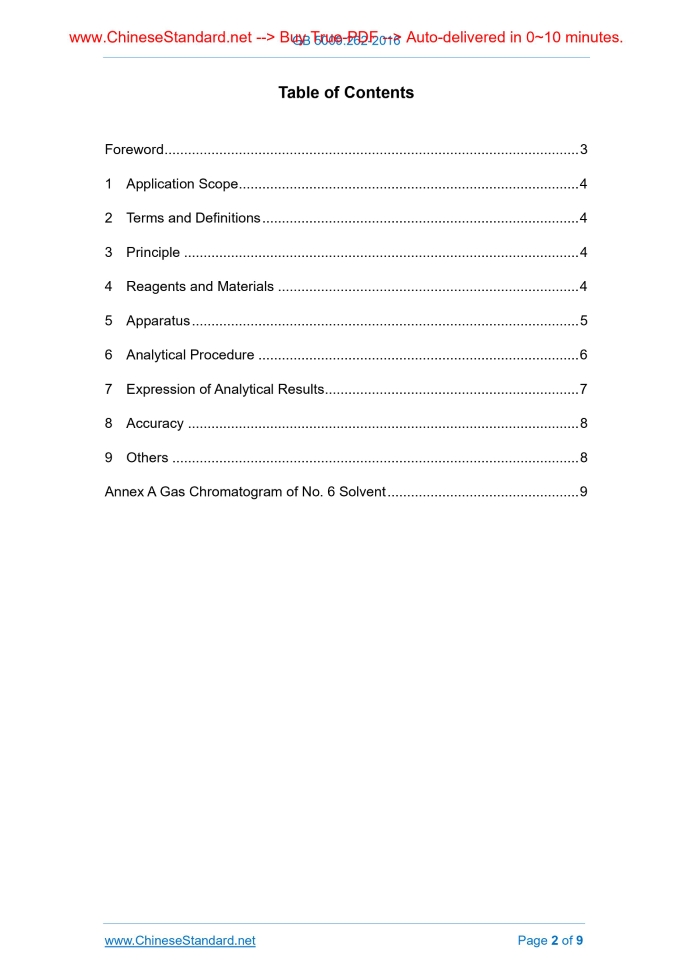
Table of Contents
Foreword... 3 1 Application Scope... 4 2 Terms and Definitions... 4 3 Principle... 4 4 Reagents and Materials... 4 5 Apparatus... 5 6 Analytical Procedure... 6 7 Expression of Analytical Results... 7 8 Accuracy... 8 9 Others... 8 Annex A Gas Chromatogram of No. 6 Solvent... 9Foreword
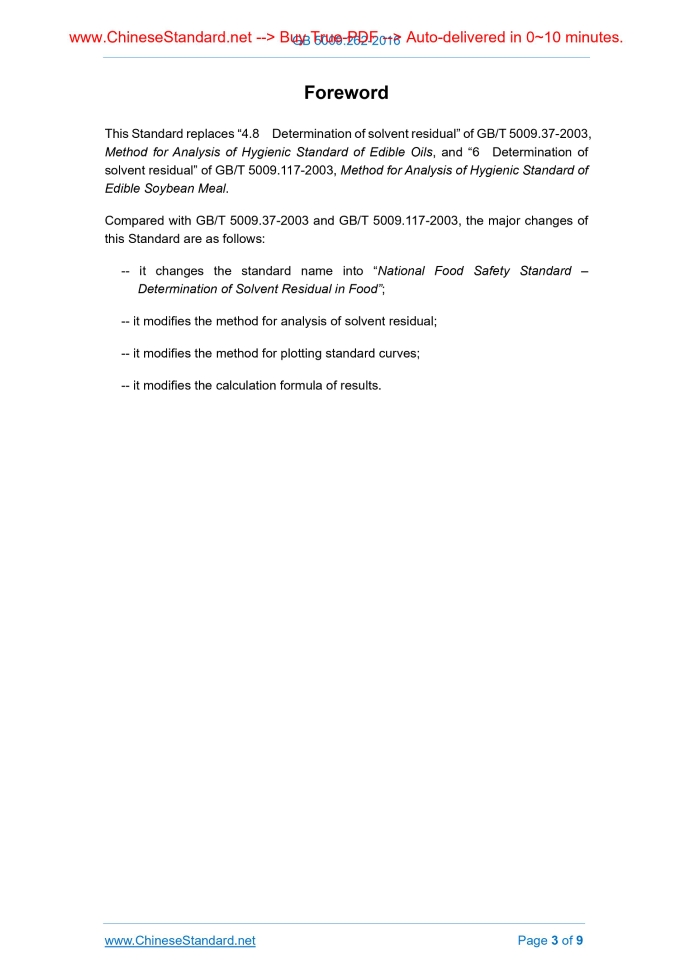
This Standard replaces “4.8 Determination of solvent residual” of GB/T 5009.37-2003, Method for Analysis of Hygienic Standard of Edible Oils, and “6 Determination of solvent residual” of GB/T 5009.117-2003, Method for Analysis of Hygienic Standard of Edible Soybean Meal. Compared with GB/T 5009.37-2003 and GB/T 5009.117-2003, the major changes of this Standard are as follows. -- it changes the standard name into “National Food Safety Standard – Determination of Solvent Residual in Food”; -- it modifies the method for analysis of solvent residual; -- it modifies the method for plotting standard curves; -- it modifies the calculation formula of results. National Food Safety Standard – Determination of Solvent Residual in Food1 Application Scope
This Standard specifies the method for determination of solvent residual in edible vegetable oils and edible soybean meal. This Standard applies to the determination of solvent residual in edible vegetable oils and edible soybean meal.2 Terms and Definitions
For the purposes of this document, the following terms and definitions apply. 2.1 Matrix vegetable oil Refined vegetable oil obtained through the refining processes including colour and odour removal, or vegetable oil produced by ultrasonic degassing at room temperature, of the same species as that of specimen to be tested. The solvent residual in matrix vegetable oil shall be lower than the detection limit.3 Principle
The solvent residual existing in specimen will diffuse to gas phase in a closed container; after a certain time, the dynamic equilibrium between the concentrations of gas phase and liquid phase can be achieved; the content of solvent residual in the upper gas phase is measured by headspace gas chromatography, i.e.4 Reagents and Materials
Unless specified otherwise, all reagents used for this method are analytically pure and the water is of grade 1 water specified in GB/T 6682. 4.1 Reagents 4.2 Preparation of reagent n-heptane standard working solution. add 1 mL of n-heptane accurately in a 10-mL volumetric flask immediately; add quickly N,N-dimethylacetamide; add dropwise to the scale. 4.3 Standard product Solvent residual standard product. “no. 6 solvent” solution of concentration 10 mg/mL; the solvent is N,N-dimethylacetamide. Or other standard products for the determination of solvent residual, which have been certified by the state or granted standard product certificates. 4.4 Preparation of standard solution 4.4.1 For vegetable oils, weigh 6 shares of 5.0 g (accurate to 0.01 g) of matrix vegetable oil to place into a 20-mL headspace specimen bottle. 4.4.2 For meals, weigh 6 shares of 3.0 g (accurate to 0.01 g) of matrix meal to place into a 20-mL headspace specimen bottle; add 400 μL of water to each headspace specimen bottle; finally use microsyringe to add quickly 0 μL, 3 μL, 9 μL, 15 μL, 30 μL and 150 μL of no. 6 solvent standard product; after sealing, obtain the matrix meal standard solutions of concentrations 0 mg/kg, 10 mg/kg, 30 mg/kg, 50 mg/kg, 100 mg/kg and 500 mg/kg.5 Apparatus
5.1 Gas chromatograph. equipped with flame ionization detector. 5.2 Headspace bottle. 20 mL, equipped with aluminium cover and sealing washer of butyl rubber or silicon resin containing no residual of hydrocarbon solutions. 5.5 Ultrasonic oscillator. 5.6 Air blowing oven. 5.7 Thermostatic oscillator.6 Analytical Procedure
6.1 Specimen preparation 6.1.1 Preparation of vegetable oil specimen. weigh 5 g (accurate to 0.01 g) of vegetable oil specimen to place into a 20-mL headspace specimen bottle; add quickly 5 μL of n-heptane standard working solution to vegetable oil specimen as internal standard; use hand to shake up before sealing. Keep headspace specimen bottle upright for analysis. During the preparation, vegetable oil specimen shall not touch sealing washer; if vegetable oil specimen touches sealing washer, the specimen shall be prepared once again. 6.2 Instrument reference conditions 6.2.1 Headspace specimen injector reference conditions The reference conditions for headspace specimen injector are as follows. 6.2.2 Gas chromatography reference conditions The reference conditions for gas chromatography are as follows. 6.3 Plotting of standard curves 6.3.1 For vegetable oils, the internal standard method is used in this method for quantitation. 6.4 Specimen determination After analyzing the prepared vegetable oil or meal specimen, measure its peak area and calculate the solvent residual in specimen in accordance with relevant standard curves.7 Expression of Analytical Results
The content of solvent residual in specimen is calculated in accordance with Formula (1).8 Accuracy
The absolute difference between the results of two independent measurements under repeatable conditions shall not exceed 10% of the arithmetic mean value.9 Others
The detection limits and quantitation limits of this method are as follows.Annex A
Gas Chromatogram of No. 6 Solvent See Figure A.1 for the gas chromatogram of no. 6 solvent. ......Source: Above contents are excerpted from the full-copy PDF -- translated/reviewed by: www.ChineseStandard.net / Wayne Zheng et al.