GB 5009.258-2016 English PDF
Price & Delivery
US$70.00 · In stock · Download in 9 secondsGB 5009.258-2016: National Food Safety Standard -- Determination of raffinose in food stuffs
Delivery: 9 seconds. True-PDF full-copy in English & invoice will be downloaded + auto-delivered via email. See step-by-step procedure
Status: Valid
| Standard ID | USD | BUY PDF | Delivery | Standard Title (Description) | Status |
| GB 5009.258-2016 | 70 | Add to Cart | Auto, 9 seconds. | National Food Safety Standard -- Determination of raffinose in food stuffs | Valid |
Click to Preview this PDF
Similar standards
GB 5009.258-2016: National Food Safety Standard -- Determination of raffinose in food stuffs
---This is an excerpt. Full copy of true-PDF in English version (including equations, symbols, images, flow-chart, tables, and figures etc.), auto-downloaded/delivered in 9 seconds, can be purchased online: https://www.ChineseStandard.net/PDF.aspx/GB5009.258-2016NATIONAL STANDARD OF THE PEOPLE’S REPUBLIC OF CHINA National Food Safety Standard – Determination of Raffinose in Foodstuffs ISSUED ON: AUGUST 31, 2016 IMPLEMENTED ON: MARCH 1, 2017 Issued by: National Health and Family Planning Commission of the People’s Republic of China
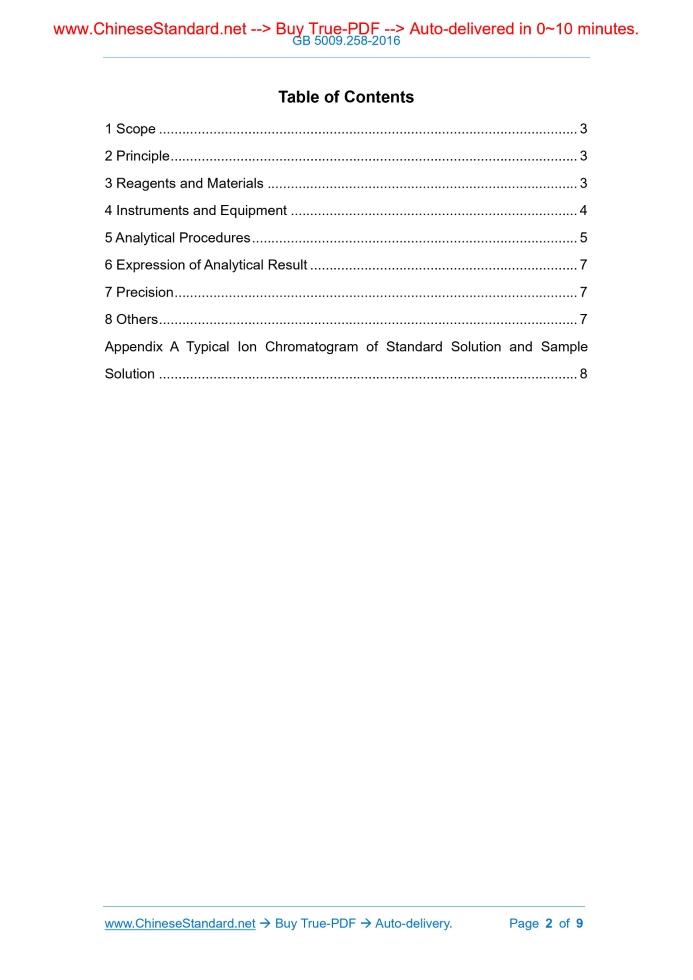
Table of Contents
1 Scope ... 3 2 Principle ... 3 3 Reagents and Materials ... 3 4 Instruments and Equipment ... 4 5 Analytical Procedures ... 5 6 Expression of Analytical Result ... 7 7 Precision ... 7 8 Others ... 7 Appendix A Typical Ion Chromatogram of Standard Solution and Sample Solution ... 8 National Food Safety Standard - Determination of Raffinose in Foodstuffs1 Scope
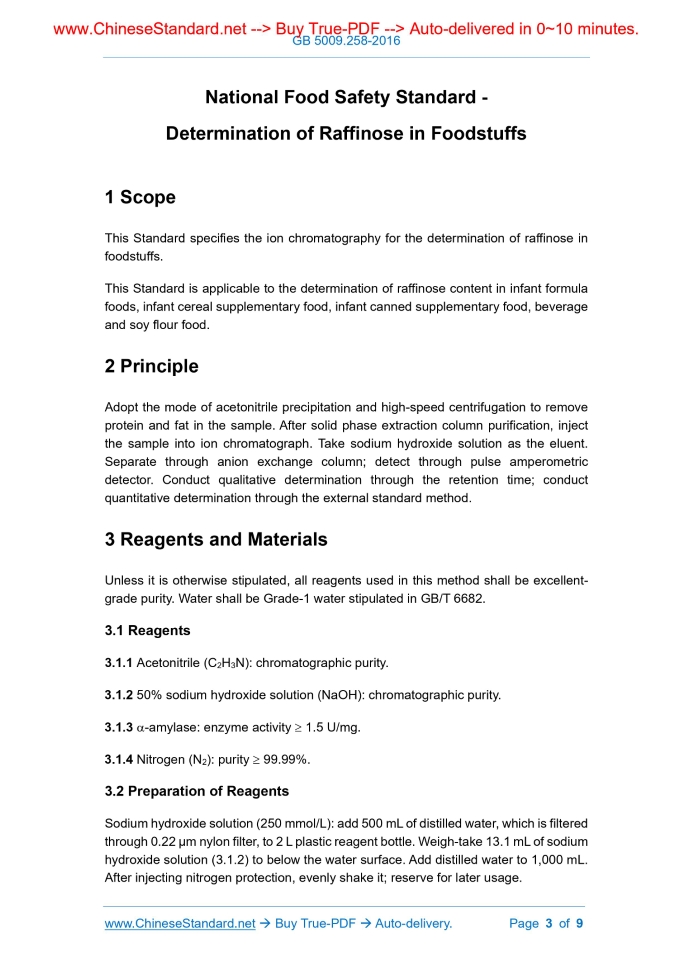
This Standard specifies the ion chromatography for the determination of raffinose in foodstuffs. This Standard is applicable to the determination of raffinose content in infant formula foods, infant cereal supplementary food, infant canned supplementary food, beverage and soy flour food.2 Principle
Adopt the mode of acetonitrile precipitation and high-speed centrifugation to remove protein and fat in the sample. After solid phase extraction column purification, inject the sample into ion chromatograph. Take sodium hydroxide solution as the eluent. Separate through anion exchange column; detect through pulse amperometric detector. Conduct qualitative determination through the retention time; conduct quantitative determination through the external standard method.3 Reagents and Materials
Unless it is otherwise stipulated, all reagents used in this method shall be excellent- grade purity. Water shall be Grade-1 water stipulated in GB/T 6682. 3.1 Reagents 3.1.1 Acetonitrile (C2H3N): chromatographic purity. 3.1.2 50% sodium hydroxide solution (NaOH): chromatographic purity. 3.1.3 -amylase: enzyme activity 1.5 U/mg. 3.1.4 Nitrogen (N2): purity 99.99%. 3.2 Preparation of Reagents Sodium hydroxide solution (250 mmol/L): add 500 mL of distilled water, which is filtered through 0.22 μm nylon filter, to 2 L plastic reagent bottle. Weigh-take 13.1 mL of sodium hydroxide solution (3.1.2) to below the water surface. Add distilled water to 1,000 mL. After injecting nitrogen protection, evenly shake it; reserve for later usage.5 Analytical Procedures
5.1 Sample Preparation 5.1.1 Sample pre-treatment 5.1.1.1 Milk powder, rice flour and soy flour samples: take around 100 g of sample (other solid samples shall be smashed and grinded first), then, fill it into a container with lid, which can hold twice the volume of the sample. Through repeatedly shaking and reversion of the container, the sample could be thoroughly mixed, till the sample becomes homogeneous. 5.1.1.2 Liquid samples: take around 100 mL of sample, then, fill it into a container with lid, which can hold twice the volume of the sample. Through repeatedly shaking and reversion of the container, the sample could be thoroughly mixed, till the sample becomes homogeneous. 5.1.1.3 Muddy flesh and other semi-solid samples: weigh-take 50.0 g of sample; weigh- take an equivalent mass of water, then, mix them up. Start vortex mixing, then, ultrasound for 20 min. 5.2 Sample Treatment 5.2.1 Starch-containing samples, for example, rice flour: weigh-take 1 g ~ 5 g (accurate to 0.1 mg, contain around 20 mg of raffinose) of thoroughly-mixed sample; place it in a centrifuge tube. Add 1 g of -amylase. Solid sample needs 50 mL of 45 °C ~ 50 °C water to be dissolved. After thoroughly mixing it, fill in nitrogen; put on the tube cap. Place it into a 60 °C ± 2 °C incubator, then, start enzymatic hydrolysis for 30 min. After cooling it down to room temperature, use water to reach the constant volume of 100 mL. 5.2.2 Other samples, such as milk powder, soy flour, beverage and muddy flesh: weigh-take 1 g ~ 5 g (accurate to 0.1 mg, contain around 20 mg of raffinose) of thoroughly-mixed sample; place it in a 100 mL beaker. Add water to dissolve it. Solid sample needs 50 mL of 45 °C ~ 50 °C water to be dissolved. Transfer it into a 100 mL volumetric flask, then, use water to dilute to a constant volume. 5.3 Purification 5.3.1 Absorb 5 mL of previously-treated sample solution, then, place it into a 50 mL conical flask with a plug. Add 10 mL of water; mix it up. Start ultrasound for 30 min. Then, transfer it into a 50 mL volumetric flask. Add 30 mL of acetonitrile; use water to dilute to a constant volume. Transfer it into a 50 mL centrifuge tube. At 10,000 r/min, start centrifugation for 10 min. Take the supernatant for later usage (in accordance with the content of raffinose in the sample solution, the dilution factor may be adjusted). ......Source: Above contents are excerpted from the full-copy PDF -- translated/reviewed by: www.ChineseStandard.net / Wayne Zheng et al.