GB 4806.16-2025 English PDF
Price & Delivery
US$140.00 · In stock · Download in 9 secondsGB 4806.16-2025: National food safety standard - Silicone rubber materials and products for food contact
Delivery: 9 seconds. True-PDF full-copy in English & invoice will be downloaded + auto-delivered via email. See step-by-step procedure
Status: Valid
| Standard ID | USD | BUY PDF | Delivery | Standard Title (Description) | Status |
| GB 4806.16-2025 | 140 | Add to Cart | Auto, 9 seconds. | National food safety standard - Silicone rubber materials and products for food contact | Valid |
Click to Preview this PDF
Similar standards
GB 4806.16-2025: National food safety standard - Silicone rubber materials and products for food contact
---This is an excerpt. Full copy of true-PDF in English version (including equations, symbols, images, flow-chart, tables, and figures etc.), auto-downloaded/delivered in 9 seconds, can be purchased online: https://www.ChineseStandard.net/PDF.aspx/GB4806.16-2025
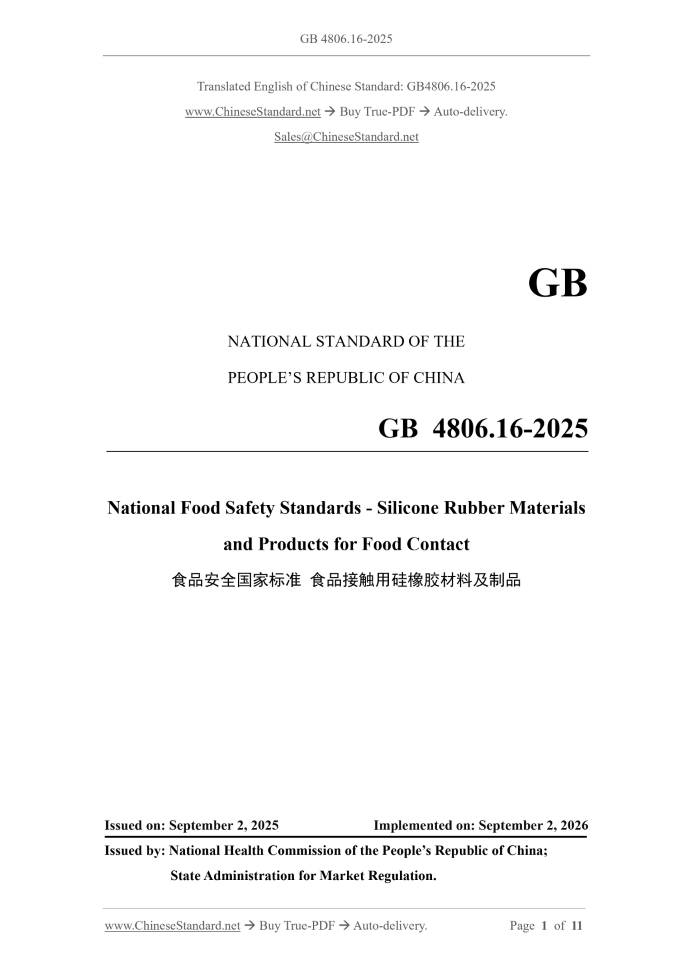
GB NATIONAL STANDARD OF THE PEOPLE’S REPUBLIC OF CHINA National Food Safety Standards - Silicone Rubber Materials and Products for Food Contact Issued on: SEPTEMBER 2, 2025 Implemented on: SEPTEMBER 2, 2026 Issued by. National Health Commission of the People’s Republic of China; State Administration for Market Regulation.
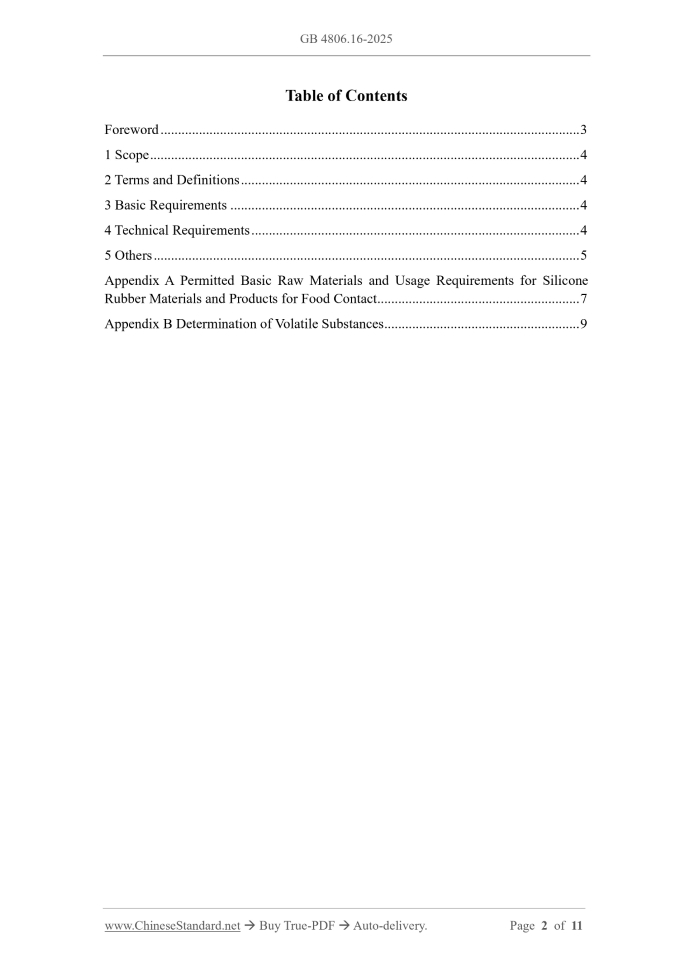
Table of Contents
Foreword... 3 1 Scope... 4 2 Terms and Definitions... 4 3 Basic Requirements... 4 4 Technical Requirements... 4 5 Others... 5 Appendix A Permitted Basic Raw Materials and Usage Requirements for Silicone Rubber Materials and Products for Food Contact... 7 Appendix B Determination of Volatile Substances... 9Foreword
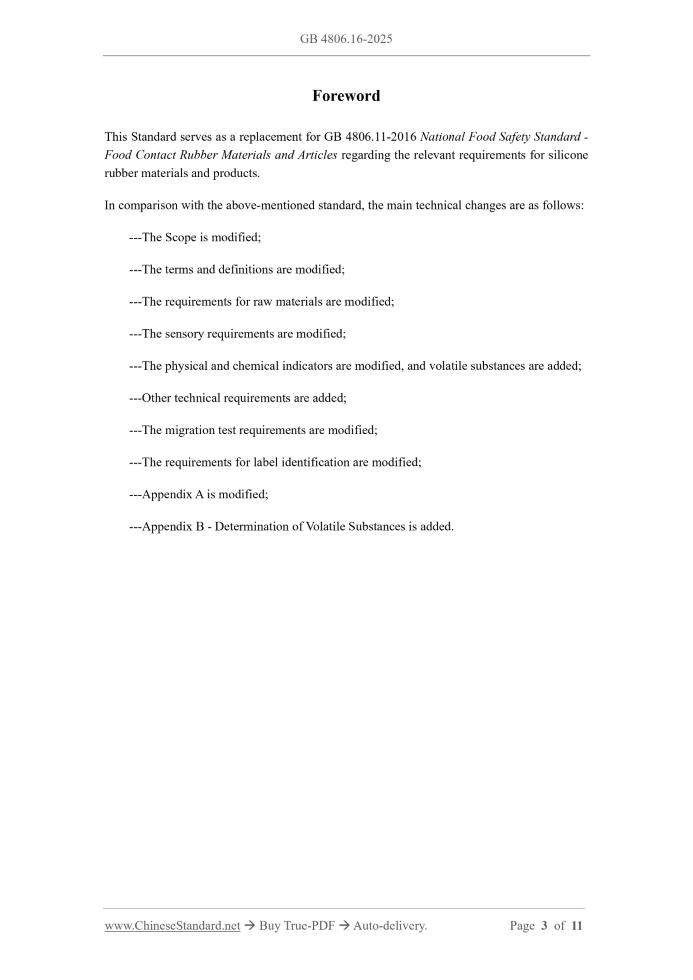
This Standard serves as a replacement for GB 4806.11-2016 National Food Safety Standard - Food Contact Rubber Materials and Articles regarding the relevant requirements for silicone rubber materials and products. In comparison with the above-mentioned standard, the main technical changes are as follows. ---The Scope is modified; ---The terms and definitions are modified; ---The requirements for raw materials are modified; ---The sensory requirements are modified; ---The physical and chemical indicators are modified, and volatile substances are added; ---Other technical requirements are added; ---The migration test requirements are modified; ---The requirements for label identification are modified; ---Appendix A is modified; ---Appendix B - Determination of Volatile Substances is added. National Food Safety Standard - Silicone Rubber Materials and Products for Food Contact1 Scope
This Standard is applicable to silicone rubber materials and products for food contact.2 Terms and Definitions
2.1 Silicone Rubber Materials and Products for Food Contact Under the intended use conditions, materials and products primarily made from organosilicon elastomers formed by the cross-linking and curing reaction of polysiloxane polymers and hydrophobic silica, which have come into or may come into contact with food or food additives, or whose components may transfer into food.3 Basic Requirements
Silicone rubber materials and products for food contact shall comply with the provisions of GB 4806.1.4 Technical Requirements
4.1 Requirements for Raw Materials 4.1.1 The use of basic raw materials for silicone rubber materials and products for food contact shall comply with the provisions of Appendix A and relevant announcements. 4.1.2 The use of additives in silicone rubber materials and products for food contact shall comply with the provisions of GB 9685 and relevant announcements. 4.2 Sensory Requirements The sensory requirements for silicone rubber materials and products for food contact shall comply with the provisions of Table 1. 4.3 Physical and Chemical Indicators 4.3.1 General physical and chemical indicators The general physical and chemical indicators of silicone rubber materials and products for food contact shall conform to the provisions of Table 2. 4.3.2 Other Physical and chemical indicators 4.3.2.1 Silicone rubber materials and products for food contact shall comply with the provisions of physical and chemical indicators in Appendix A and relevant announcements regarding the specific migration limits (SML), total specific migration limits [SML(T)] and maximum permitted quantity (QM) of the basic raw materials used. 4.3.2.2 Silicone rubber materials and products for food contact shall comply with the provisions of physical and chemical indicators in GB 9685 and relevant announcements regarding the SML, SML(T) and QM of the additives used. 4.4 Other Technical Requirements Silicone rubber materials and products for food contact that use coatings, inks and / or adhesives shall also comply with the corresponding provisions of national food safety standards for coatings, inks and / or adhesives.5 Others
5.1 Migration Test 5.1.1 General requirements The migration test shall be conducted in accordance with the provisions of GB 31604.1 and GB 5009.156.Where this Standard has special provisions, those provisions shall prevail. 5.1.2 Special requirementsAppendix A
Permitted Basic Raw Materials and Usage Requirements for Silicone Rubber Materials and Products for Food Contact A.1 Table A.1 specifies the permitted basic raw materials and usage requirements for silicone rubber materials and products for food contact. The basic raw materials listed in Table A.1 are identified by their CAS numbers; for those without CAS numbers, their Chinese names shall prevail. A.2 Substances with a relative molecular mass greater than 1,000 Da, formed by polymerization or other modes from the basic raw materials listed in Table A.1, such as monomers, other starting materials and base polymers, are also permitted as the basic raw materials for silicone rubber materials and products for food contact, and shall comply with the restrictive requirements for the corresponding monomers, other starting materials and base polymers, etc. A.3 For polymers synthesized in Table A.1, where the monomers and other starting materials are acids, alcohols or phenols, their sodium, potassium, and calcium salts (including acid salts and double salts) may also be used in the synthesis of the corresponding polymers, provided they comply with the restrictive requirements for the corresponding acid, alcohol, or phenol monomers and other starting materials. The sodium, potassium, and calcium salts (including acid salts and double salts) of the monomers and other starting materials listed in Table A.1 shall be used in accordance with the provisions of this Standard. ......Source: Above contents are excerpted from the full-copy PDF -- translated/reviewed by: www.ChineseStandard.net / Wayne Zheng et al.