GB 4806.12-2022 English PDF
Price & Delivery
US$170.00 · In stock · Download in 9 secondsGB 4806.12-2022: National food safety standard - Bamboo and wood materials and products for food contact
Delivery: 9 seconds. True-PDF full-copy in English & invoice will be downloaded + auto-delivered via email. See step-by-step procedure
Status: Valid
| Standard ID | USD | BUY PDF | Delivery | Standard Title (Description) | Status |
| GB 4806.12-2022 | 170 | Add to Cart | Auto, 9 seconds. | National food safety standard - Bamboo and wood materials and products for food contact | Valid |
Click to Preview this PDF
Similar standards
GB 4806.12-2022: National food safety standard - Bamboo and wood materials and products for food contact
---This is an excerpt. Full copy of true-PDF in English version (including equations, symbols, images, flow-chart, tables, and figures etc.), auto-downloaded/delivered in 9 seconds, can be purchased online: https://www.ChineseStandard.net/PDF.aspx/GB4806.12-2022
NATIONAL STANDARD OF THE PEOPLE’S REPUBLIC OF CHINA National food safety standard - Bamboo and wood materials and products for food contact Issued on. JUNE 30, 2022 Implemented on. DECEMBER 30, 2022 Issued by. National Health Commission of the PRC; State Administration for Market Regulation.
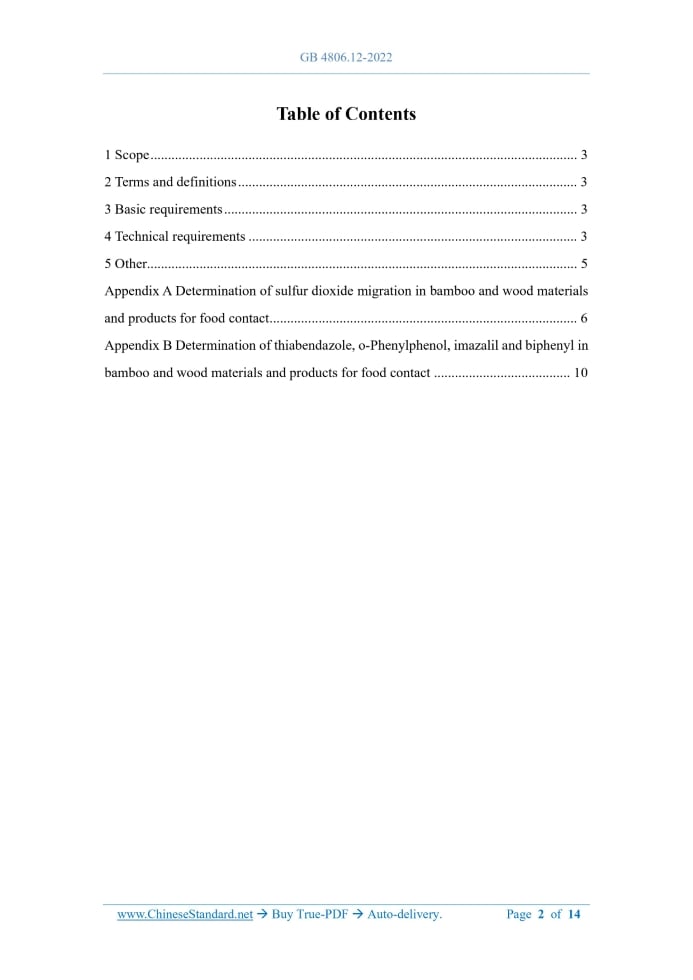
Table of Contents
1 Scope... 3 2 Terms and definitions... 3 3 Basic requirements... 3 4 Technical requirements... 3 5 Other... 5 Appendix A Determination of sulfur dioxide migration in bamboo and wood materials and products for food contact... 6 Appendix B Determination of thiabendazole, o-Phenylphenol, imazalil and biphenyl in bamboo and wood materials and products for food contact... 10 National food safety standard - Bamboo and wood materials and products for food contact1 Scope
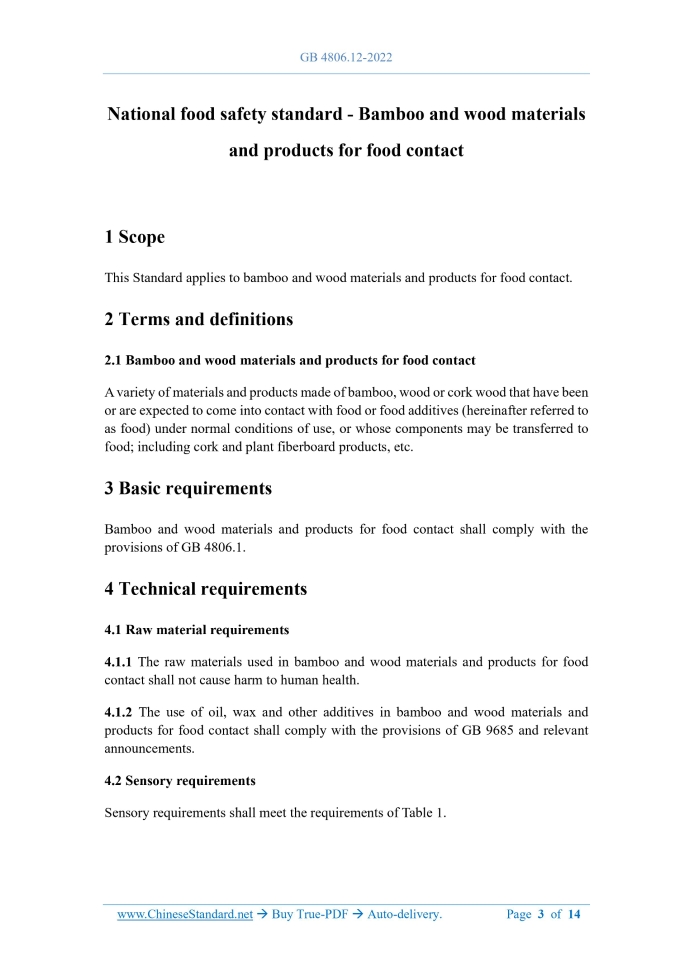
This Standard applies to bamboo and wood materials and products for food contact.2 Terms and definitions
2.1 Bamboo and wood materials and products for food contact A variety of materials and products made of bamboo, wood or cork wood that have been or are expected to come into contact with food or food additives (hereinafter referred to as food) under normal conditions of use,3 Basic requirements
Bamboo and wood materials and products for food contact shall comply with the provisions of GB 4806.1.4 Technical requirements
4.1 Raw material requirements 4.1.1 The raw materials used in bamboo and wood materials and products for food contact shall not cause harm to human health. 4.2 Sensory requirements Sensory requirements shall meet the requirements of Table 1. 4.3 Physical and chemical indicators 4.3.1 General physical and chemical indicators General physical and chemical indicators shall comply with the provisions of Table 2 and Table 3. 4.3.2 Other physical and chemical indicators Bamboo and wood materials and products for food contact shall comply with the provisions of GB 9685 and related announcements on physical and chemical indicators of oils, waxes and other additives, such as specific migration limit (SML), specific total migration limit [SML(T)] and maximum residue limit (QM). 4.4 Microbial limit Microorganisms of bamboo and wood materials and products, which are expected to come into direct contact with food and are used directly without disinfection or cleaning, shall comply with the provisions of GB 14934. 4.5 Other technical requirements Bamboo and wood materials and products for food contact, which use materials such as coatings, inks, and/or adhesives, etc., shall also comply with the corresponding national food safety standards for coatings, inks, and/or adhesives.5 Other
5.1 Migration test Migration test shall be carried out in accordance with the provisions of GB 31604.1 and GB 5009.156, unless there are special provisions in this Standard. 5.2 Label identification Label identification shall comply with the provisions of GB 4806.1.Appendix A
Determination of sulfur dioxide migration in bamboo and wood materials and products for food contact A.1 Principle Select water as the food simulant. The specimen is subjected to migration test. The sulfur dioxide in the specimen migrates to the water. In a closed device, acidify and distill the test solution, to release the sulfur dioxide therein. A.2 Reagents and materials Carry out in accordance with Clause 3 of GB 31604.32-2016 first method (titration method). A.3 Instruments and equipment Carry out in accordance with Clause 4 of GB 31604.32-2016 first method (titration method); in which the iodine volumetric flask is changed to a pear-shaped flask; the all- glass distillation device is shown in Figure A.1. A.4 Analytical procedure A.5 Results and presentation The migration of sulfur dioxide in the specimen is calculated according to formula (A.1). A.6 Precision When the amount of sulfur dioxide migration is not higher than 5 mg/kg, the absolute difference between two independent test results obtained under repeatability conditions must not exceed 20% of the arithmetic mean. A.7 Other The limit of quantification for the migration of sulfur dioxide in food simulant in this method is 1.0 mg/kg.Appendix B
Determination of thiabendazole, o-Phenylphenol, imazalil and biphenyl in bamboo and wood materials and products for food contact B.1 Principle Take a representative sample; after crushing, use methanol to extract; rotary evaporate to dryness. Use methanol to make up to volume; after filtering, use high-performance liquid chromatograph equipped with diode array detector or UV detector for detection; use external standard method to quantify. B.2 Reagents and materials B.3 Instruments and equipment B.4 Analytical procedure ......Source: Above contents are excerpted from the full-copy PDF -- translated/reviewed by: www.ChineseStandard.net / Wayne Zheng et al.