GB 4806.14-2023 English PDF
Price & Delivery
US$155.00 · In stock · Download in 9 secondsGB 4806.14-2023: National food safety standard - Ink for food contact materials and products
Delivery: 9 seconds. True-PDF full-copy in English & invoice will be downloaded + auto-delivered via email. See step-by-step procedure
Status: Valid
| Standard ID | USD | BUY PDF | Delivery | Standard Title (Description) | Status |
| GB 4806.14-2023 | 155 | Add to Cart | Auto, 9 seconds. | National food safety standard - Ink for food contact materials and products | Valid |
Click to Preview this PDF
Similar standards
GB 4806.14-2023: National food safety standard - Ink for food contact materials and products
---This is an excerpt. Full copy of true-PDF in English version (including equations, symbols, images, flow-chart, tables, and figures etc.), auto-downloaded/delivered in 9 seconds, can be purchased online: https://www.ChineseStandard.net/PDF.aspx/GB4806.14-2023GB NATIONAL STANDARD OF THE PEOPLE’S REPUBLIC OF CHINA National food safety standard - Ink for food contact materials and products Issued on. SEPTEMBER 06, 2023 Implemented on. SEPTEMBER 06, 2024 Issued by. National Health Commission of PRC. State Administration for Market Regulation.
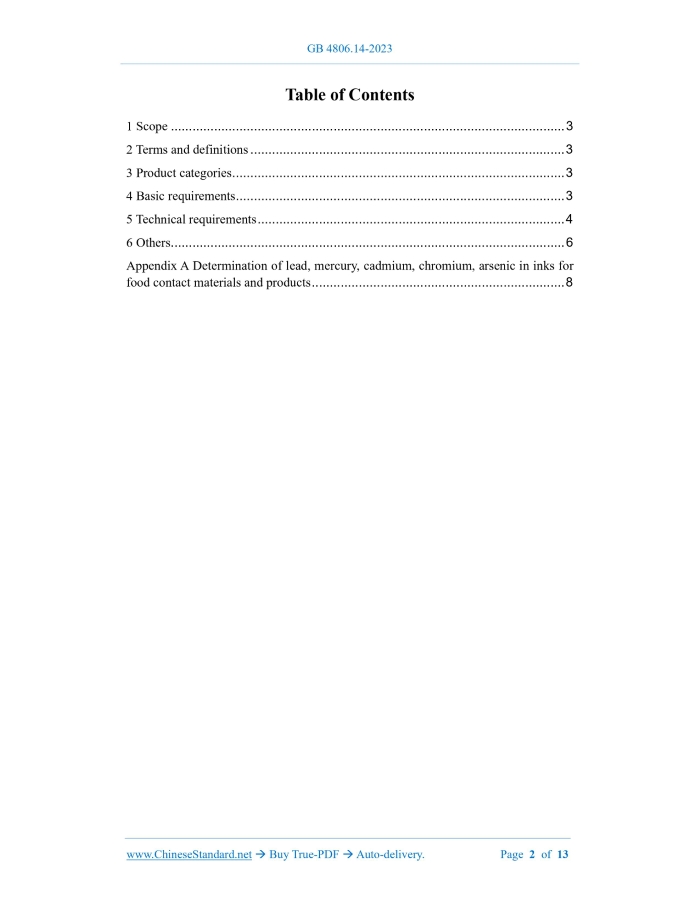
Table of Contents
1 Scope... 3 2 Terms and definitions... 3 3 Product categories... 3 4 Basic requirements... 3 5 Technical requirements... 4 6 Others... 6 Appendix A Determination of lead, mercury, cadmium, chromium, arsenic in inks for food contact materials and products... 8 National food safety standard - Ink for food contact materials and products1 Scope
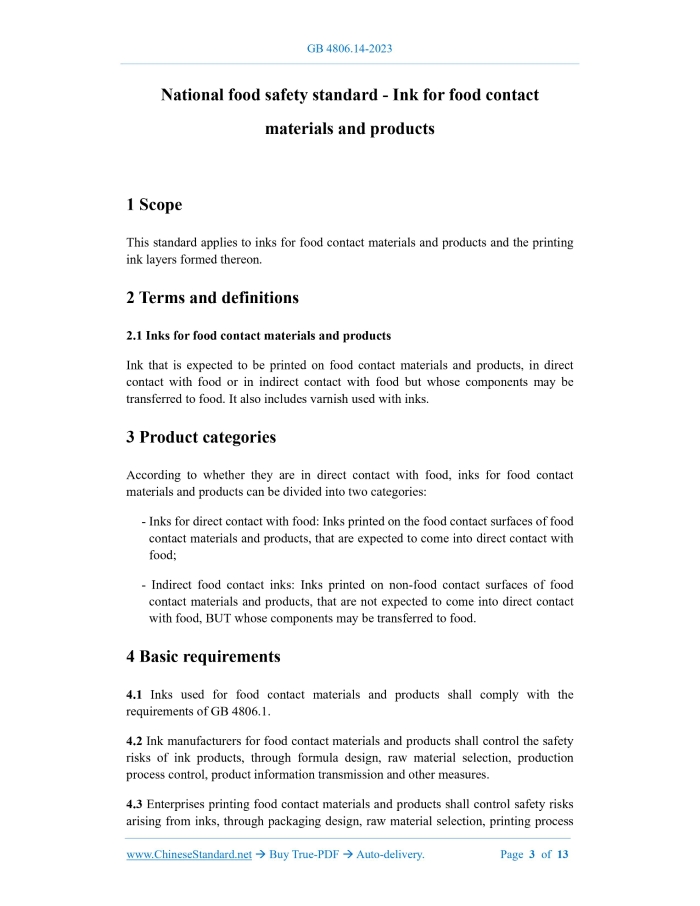
This standard applies to inks for food contact materials and products and the printing ink layers formed thereon.2 Terms and definitions
2.1 Inks for food contact materials and products Ink that is expected to be printed on food contact materials and products, in direct contact with food or in indirect contact with food but whose components may be transferred to food. It also includes varnish used with inks.3 Product categories
According to whether they are in direct contact with food, inks for food contact materials and products can be divided into two categories.4 Basic requirements
4.1 Inks used for food contact materials and products shall comply with the requirements of GB 4806.1. 4.2 Ink manufacturers for food contact materials and products shall control the safety risks of ink products, through formula design, 4.3 Enterprises printing food contact materials and products shall control safety risks arising from inks, through packaging design, raw material selection, printing process control, product information transmission and/or adding effective barrier layers.5 Technical requirements
5.1 Raw material requirements 5.1.1 Basic raw materials 5.1.2 Additives 5.2 Sensory requirements The sensory requirements of food contact materials and products printed with ink shall comply with the provisions of Table 1. 5.3 Physical and chemical indicators 5.3.1 General physical and chemical indicators 5.3.1.1 The residual amount of heavy metals in inks for food contact materials and 5.3.2 Other physical and chemical indicators 5.3.2.1 The printing ink layer that indirectly contacts food shall comply with the requirements of relevant national food safety standards and announcements for the physical and chemical indicators, such as the specific migration limit (SML), specific total migration limit [SML(T)], maximum residue (QM).6 Others
6.1 Migration test The migration test shall be carried out in accordance with the provisions of GB 31604.1 and GB 5009.156. 6.2 Label marking 6.2.1 Label marking shall comply with the provisions of GB 4806.1.Appendix A
Determination of lead, mercury, cadmium, chromium, arsenic in inks for food contact materials and products A.1 Scope This Appendix specifies the inductively coupled plasma emission spectrometry method for the determination of lead, mercury, cadmium, chromium, arsenic in inks for food contact materials and products. A.2 Principle The ink is pulverized after the coating film is dried; converted into a solution state through acid digestion. After diluting the obtained solution to a constant volume, it is measured using an inductively coupled plasma emission spectrometer. A.3 Reagents and materials Unless otherwise stated, the reagents used in this method are of superior purity or higher; the water is grade-1 water specified in GB/T 6682. A.4 Instruments and equipment Note. All glassware shall be soaked in nitric acid solution (A.3.2.2) overnight and rinsed repeatedly with water. A.4.1 Inductively coupled plasma optical emission spectrometer (ICP-OES). A.4.2 Analytical balance. The sensitivity is 0.1 mg. A.4.3 Microwave digestion instrument or pressure digester. Equipped with polytetrafluoroethylene digestion inner tank. A.4.4 Constant temperature drying oven. A.4.5 Ultraviolet light curing machine (UV curing machine). UV wavelength 365 nm or 395 nm. A.4.6 Ultrasonic water bath. A.4.7 Glass plates. A.4.8 Nylon screen. Pore diameter 4 mm (5 mesh). A.4.9 Filter membrane. Polyethersulfone material, pore size 0.45 μm. A.5 Analytical procedures A.7 Precision The absolute difference between two independent determination results, as obtained under repeatability conditions, shall not exceed 15% of the arithmetic mean. A.8 Others When the sample weight is 0.5 g and the constant volume is 25 mL, the method detection limits and quantitation limits of each element are as shown in Table A.5. ......Source: Above contents are excerpted from the full-copy PDF -- translated/reviewed by: www.ChineseStandard.net / Wayne Zheng et al.