GB 4789.7-2013 English PDF
Price & Delivery
US$115.00 · In stock · Download in 9 secondsGB 4789.7-2013: National food safety standard - Food Microbiological Examination - Vibrio parahaemolyticus
Delivery: 9 seconds. True-PDF full-copy in English & invoice will be downloaded + auto-delivered via email. See step-by-step procedure
Status: Valid
GB 4789.7: Historical versions
| Standard ID | USD | BUY PDF | Delivery | Standard Title (Description) | Status |
| GB 4789.7-2013 | 115 | Add to Cart | Auto, 9 seconds. | National food safety standard - Food Microbiological Examination - Vibrio parahaemolyticus | Valid |
| GB/T 4789.7-2008 | 559 | Add to Cart | 4 days | Microbiological examination of food hygiene -- Examination of vibrio parahaemolyticus | Obsolete |
| GB/T 4789.7-2003 | 199 | Add to Cart | 2 days | Microbiological examination of food hygiene -- Examination of Vibrio parahaemolyticus | Obsolete |
| GB 4789.7-1994 | RFQ | ASK | 3 days | Microbiological examination of food hygiene. Examination of Vibrio parahaemolyticus | Obsolete |
| GB 4789.7-1984 | RFQ | ASK | 3 days | Microbiological examination of food hygiene--Examination of vibrioparahaemolyticus | Obsolete |
Click to Preview this PDF
Similar standards
GB 4789.7-2013: National food safety standard - Food Microbiological Examination - Vibrio parahaemolyticus
---This is an excerpt. Full copy of true-PDF in English version (including equations, symbols, images, flow-chart, tables, and figures etc.), auto-downloaded/delivered in 9 seconds, can be purchased online: https://www.ChineseStandard.net/PDF.aspx/GB4789.7-2013
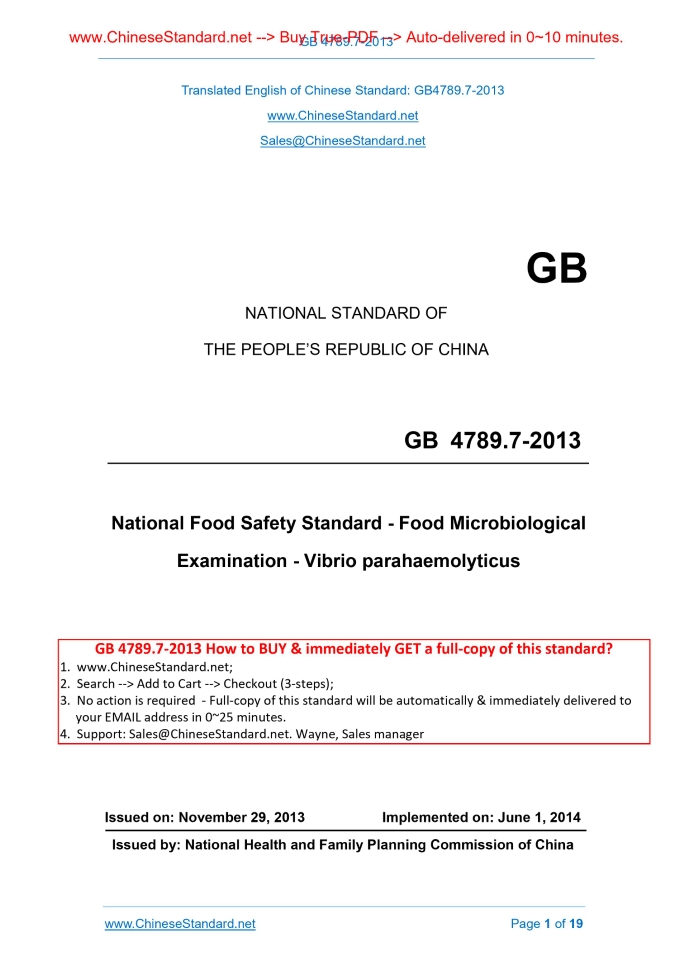
GB NATIONAL STANDARD OF THE PEOPLE’S REPUBLIC OF CHINA National Food Safety Standard - Food Microbiological Examination - Vibrio parahaemolyticus Issued on. NOVEMBER 29, 2013 Implemented on. JUNE 1, 2014 Issued by. National Health and Family Planning Commission of China
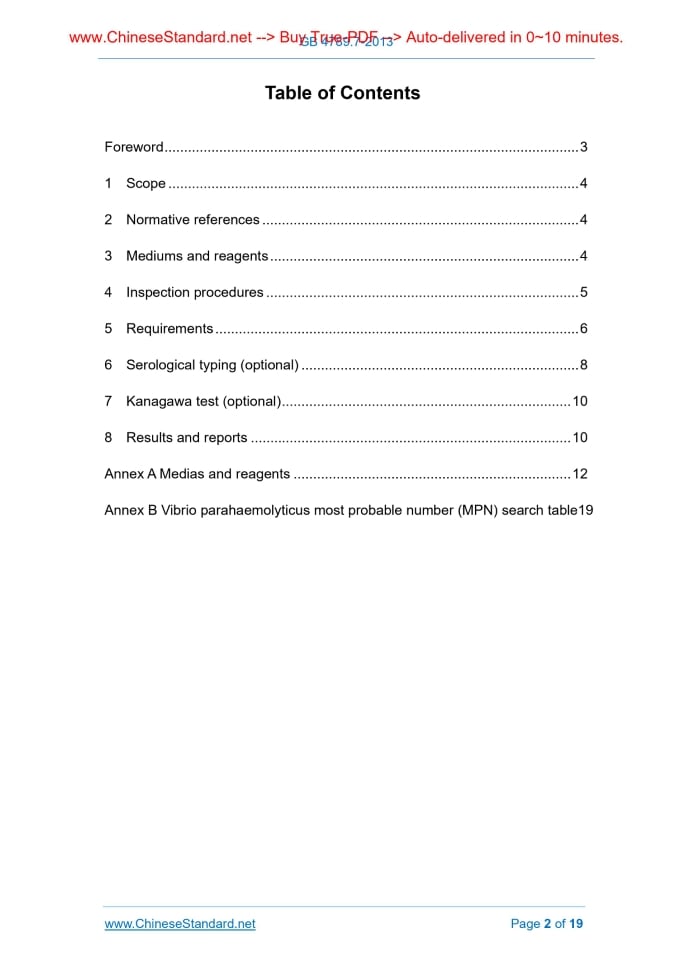
Table of Contents
Foreword... 3 1 Scope... 4 2 Normative references... 4 3 Mediums and reagents... 4 4 Inspection procedures... 5 5 Requirements... 6 6 Serological typing (optional)... 8 7 Kanagawa test (optional)... 10 8 Results and reports... 10 Annex A Medias and reagents... 12 Annex B Vibrio parahaemolyticus most probable number (MPN) search table19Foreword
This Standard replaces GB/T 4789.7-2008 Microbiological examination of food hygiene - Examination of Vibrio parahaemolyticus. Compared with GB/T 4789.7-2008, the main modifications are as follows. - modified the Chinese name of the standard; - modified the scope; - modified the equipment and materials; - modified the mediums and reagents; - modified the sample preparation process; - modified the inspection procedures. National Food Safety Standard - Food Microbiological Examination - Vibrio parahaemolyticus1 Scope
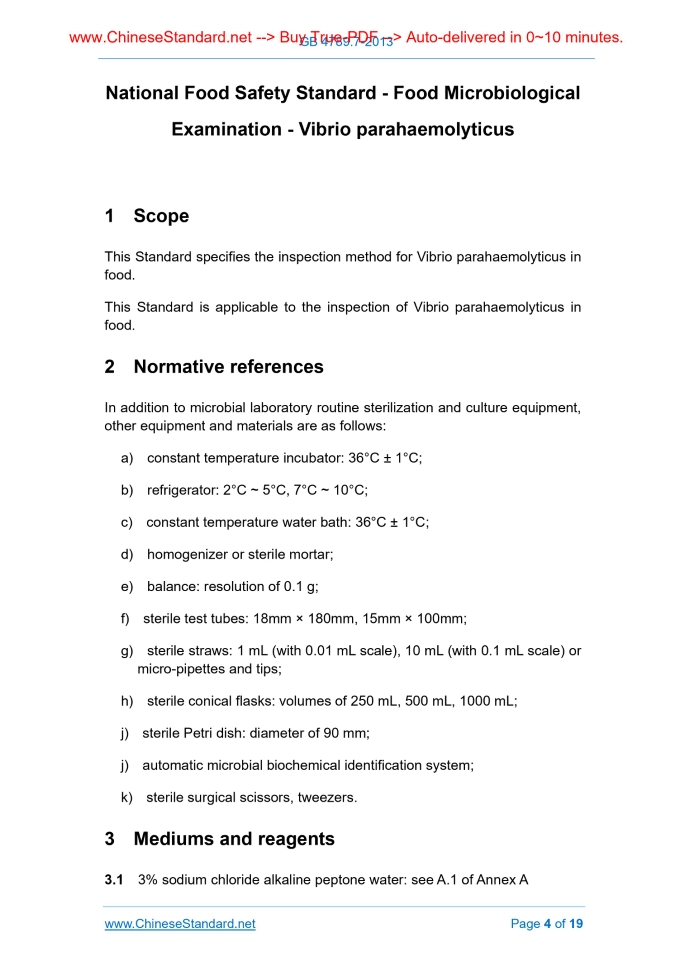
This Standard specifies the inspection method for Vibrio parahaemolyticus in food. This Standard is applicable to the inspection of Vibrio parahaemolyticus in food.2 Normative references
In addition to microbial laboratory routine sterilization and culture equipment, other equipment and materials are as follows.3 Mediums and reagents
3.1 3% sodium chloride alkaline peptone water. see A.1 of Annex A 3.2 thiosulfate-citrate-bile salt-sucrose (TCBS) agar. see A.2 of Annex A 3.3 3% sodium chloride trypsin soybean agar. see A.3 of Annex A 3.6 3% sodium chloride mannitol test medium. see A.6 of Annex A 3.7 3% sodium chloride lysine decarboxylase test medium. see A.7 of 3.8 3% sodium chloride MR-VP medium. see A.8 of Annex A 3.9 3% sodium chloride solution. see A.9 of Annex A4 Inspection procedures
See Figure 1 for Vibrio parahaemolyticus test procedures.5 Requirements
5.1 Sample preparation 5.1.1 After the collection of non-frozen sample, immediately store it in a 7°C ~ 10°C refrigerator, and carry out the early inspection as soon as possible. The frozen sample should be thawed at 45°C for not more than 15 min or at 2°C to 5°C for not more than 18 h. 5.1.2 Take surface tissue, gut or gill for fish and cephalopods. For shellfish, take all contents, including shellfish and body fluids. 5.1.3 Take 25 g (mL) of the sample aseptically. Add 225 mL of 3% sodium chloride alkaline peptone. Homogenize at 8000 r/min for 1 min with a rotary blade homogenizer. Or slap with slam homogenizer for 2 min. 5.2 Enrichment 5.2.1 Qualitative detection Incubate the 1.10 liquid sample prepared in 5.1.3 at 36°C ± 1°C for 8 h to 18 h. 5.2.2 Quantitative detection 5.3 Separation 5.3.1 For all enrichment solutions with growth, use the inoculation ring in the distance of 1 cm below the surface to take a ring of enrichment solution. Scribe and separate on TCBS plate or Vibrio color medium plate, a test tube for a flat plate. Cultivate it at 36°C ± 1°C for 18 h ~ 24 h. 5.4 Pure culture Pick up three or more suspicious colonies. Scribe 3% sodium chloride trypsin soybean agar plate. Cultivate at 36°C ± 1°C for 18h ~ 24h. 5.5 Preliminary identification 5.5.1 Oxidase test. select a single culture of pure culture for oxidase test; Vibrio parahaemolyticus shall be oxidase positive. 5.5.4 Halophilic test. pick purely cultured single suspicious colony; respectively inoculate 0%, 6%, 8% and 10% peptone water of different concentrations of sodium chloride; cultivate at 36°C ± 1°C for 24h observation; observe the liquid turbidity. Vibrio parahaemolyticus shall not grow or grow weakly in cisplatin without sodium chloride and of 10% sodium chloride. It shall grow vigorously in peptone water of 6% sodium chloride and 8% sodium chloride. 5.6 Determination of identification Take pure culture and respectively inoculate mannitol test medium containing 3% sodium chloride, lysine decarboxylase test medium, MR-VP medium.6 Serological typing (optional)
6.1 Preparation Inoculate two tubes of 3% sodium chloride trypsin soy agar test tube slope. Cultivate at 36°C ± 1°C for 18h ~ 24h. Use 5% glycerol solution containing 3% sodium chloride to wash 3% sodium chloride trypsin soy agar slant culture so as to obtain a strong bacterial suspension. 6.2 Identification of K Antigen Take a tube of 6.1 well-prepared suspension. First, use polyvalent K antiserum for detection. 6.3 Identification of O antigen Transfer another tube of bacteria suspension into the centrifuge tube for 1 h sterilization at 121°C. After sterilization, carry out the centrifugation at 4000 r/min for 15 min. Discard the upper liquid. Wash the precipitate three times with physiological saline, centrifugation at 4000 r/min for 15 min each time. After the last centrifugation, it shall stay a little upper liquid. Well mix the bacteria into a suspension.7 Kanagawa test (optional)
The Kanagawa test tests whether there is a specific hemolysin on Wagstsuma agar. The positive results of Kanagawa test shall be significantly correlated with the pathogenicity of Vibrio parahaemolyticus isolates.8 Results and reports
Report 25 g (mL) samples of which Vibrio parahaemolyticus is detected, according to the detection of suspected colony biochemical traits. If quantitative test is performed, the MPN values shall be reported on the basis of the number of test tubes that are confirmed to be positive for Vibrio parahaemolyticus and for each g (mL) of Vibrio parahaemolyticus.Annex A
Medias and reagents A.1 3% sodium chloride alkaline peptone water A.2 Thiosulfate-citrate-bile salt-sucrose (TCBS) agar A.2.1 Ingredient A.2.2 Method Dissolve the ingredients in A.2.1 in distilled water. Correct pH to 8.6 ± 0.2.Boil to full dissolution. Cool to about 50°C and pour to flat plate for standby. A.3 3% sodium chloride trypsin soybean agar A.4.1 IngredientAnnex B
Vibrio parahaemolyticus most probable number (MPN) search table The most probable number (MPN) of Vibrio parahaemolyticus in each g (mL) sample is shown in Table B.1. ......Source: Above contents are excerpted from the full-copy PDF -- translated/reviewed by: www.ChineseStandard.net / Wayne Zheng et al.