GB 31604.17-2016 English PDF
Price & Delivery
US$85.00 · In stock · Download in 9 secondsGB 31604.17-2016: National food safety standard - Food contact materials and articles - Determination of the content and migration of acrylonitrile
Delivery: 9 seconds. True-PDF full-copy in English & invoice will be downloaded + auto-delivered via email. See step-by-step procedure
Status: Valid
| Standard ID | USD | BUY PDF | Delivery | Standard Title (Description) | Status |
| GB 31604.17-2016 | 85 | Add to Cart | Auto, 9 seconds. | National food safety standard - Food contact materials and articles - Determination of the content and migration of acrylonitrile | Valid |
Click to Preview this PDF
Similar standards
GB 31604.17-2016: National food safety standard - Food contact materials and articles - Determination of the content and migration of acrylonitrile
---This is an excerpt. Full copy of true-PDF in English version (including equations, symbols, images, flow-chart, tables, and figures etc.), auto-downloaded/delivered in 9 seconds, can be purchased online: https://www.ChineseStandard.net/PDF.aspx/GB31604.17-2016
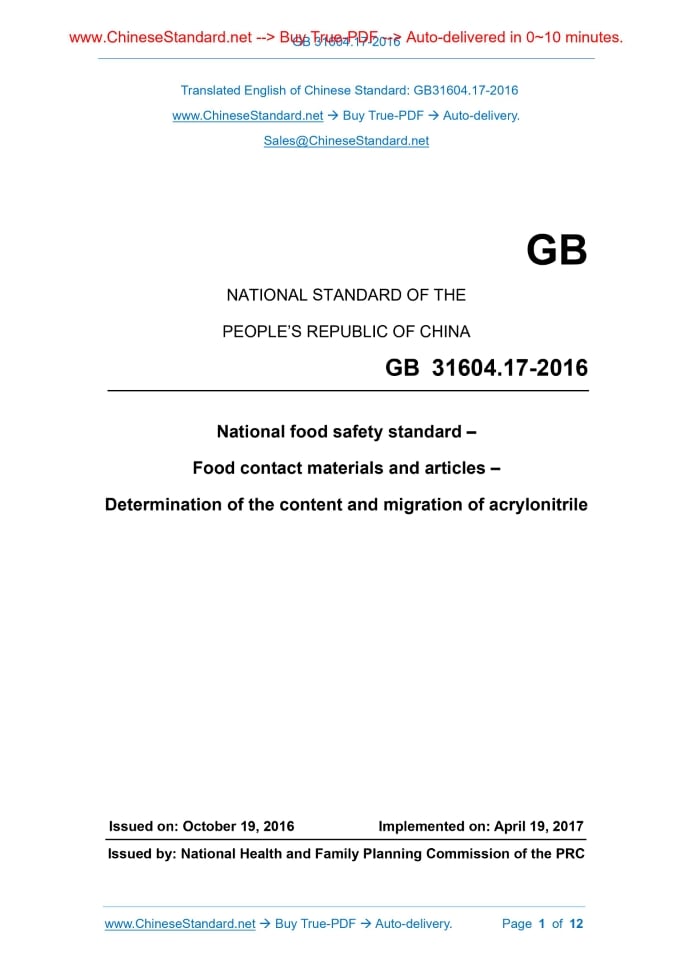
GB NATIONAL STANDARD OF THE PEOPLE’S REPUBLIC OF CHINA National food safety standard – Food contact materials and articles – Determination of the content and migration of acrylonitrile Issued on. OCTOBER 19, 2016 Implemented on. APRIL 19, 2017 Issued by. National Health and Family Planning Commission of the PRC
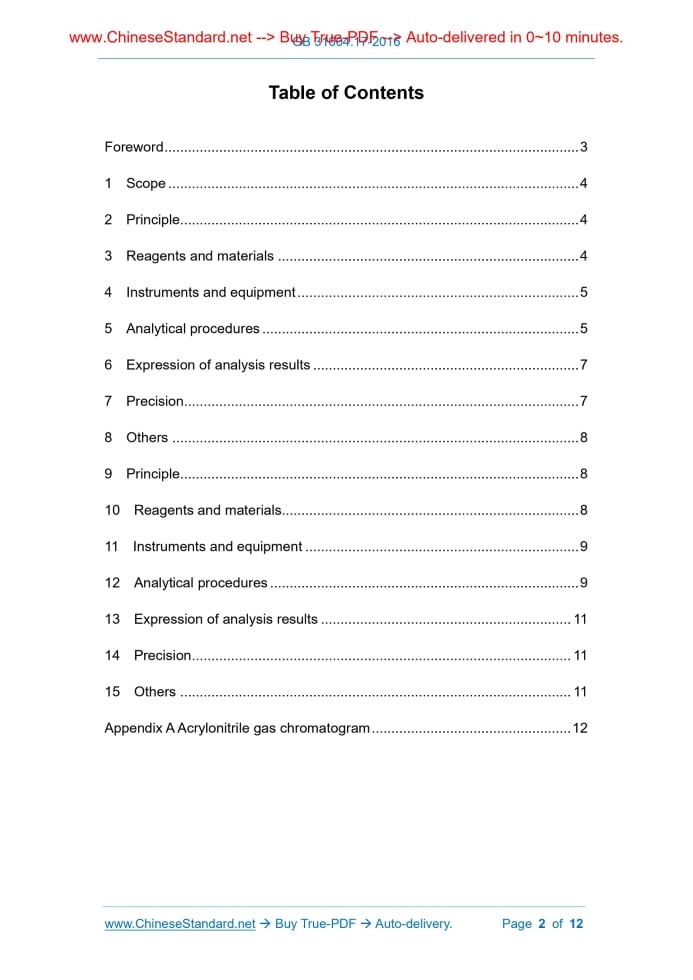
Table of Contents
Foreword... 3 1 Scope... 4 2 Principle... 4 3 Reagents and materials... 4 4 Instruments and equipment... 5 5 Analytical procedures... 5 6 Expression of analysis results... 7 7 Precision... 7 8 Others... 8 9 Principle... 8 10 Reagents and materials... 8 11 Instruments and equipment... 9 12 Analytical procedures... 9 13 Expression of analysis results... 11 14 Precision... 11 15 Others... 11 Appendix A Acrylonitrile gas chromatogram... 12Foreword
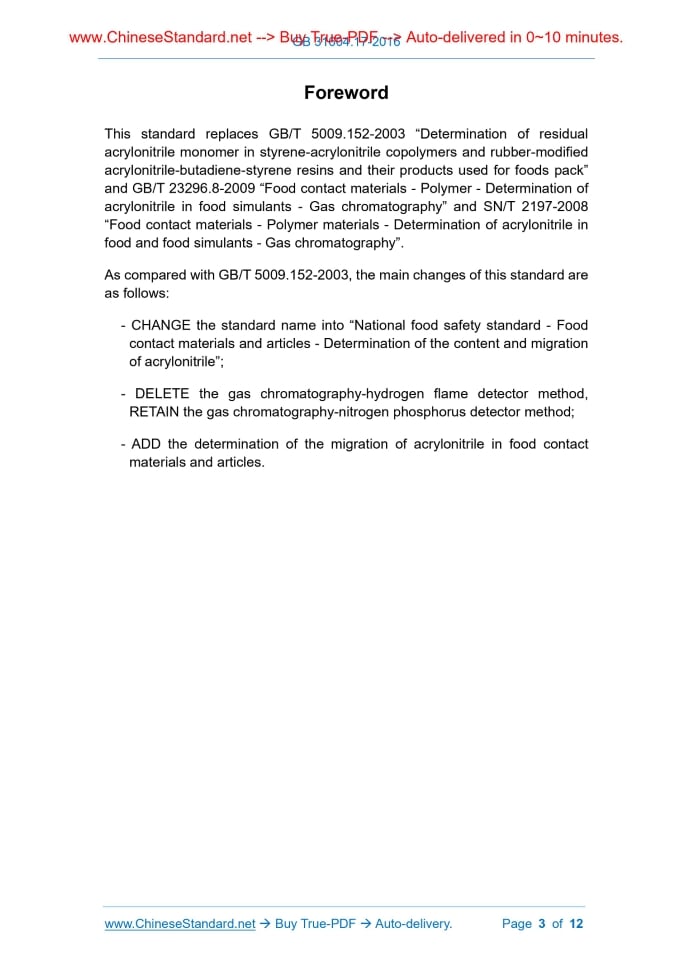
This standard replaces GB/T 5009.152-2003 “Determination of residual acrylonitrile monomer in styrene-acrylonitrile copolymers and rubber-modified acrylonitrile-butadiene-styrene resins and their products used for foods pack” and GB/T 23296.8-2009 “Food contact materials - Polymer - Determination of acrylonitrile in food simulants - Gas chromatography” and SN/T 2197-2008 “Food contact materials - Polymer materials - Determination of acrylonitrile in food and food simulants - Gas chromatography”. As compared with GB/T 5009.152-2003, the main changes of this standard are as follows. - CHANGE the standard name into “National food safety standard - Food contact materials and articles - Determination of the content and migration of acrylonitrile”; - DELETE the gas chromatography-hydrogen flame detector method, RETAIN the gas chromatography-nitrogen phosphorus detector method; - ADD the determination of the migration of acrylonitrile in food contact materials and articles. National food safety standard – Food contact materials and articles – Determination of the content and migration of acrylonitrile1 Scope
This standard specifies the method for determination of the content and migration of acrylonitrile in food contact materials and articles. This standard applies to the determination of the content and migration of acrylonitrile in food contact materials and articles. Determination of acrylonitrile2 Principle
The food contact materials and articles are dissolved or dispersed in a headspace flask via N,N-dimethylformamide, heated to allow the components to be tested to reach a gas-liquid equilibrium, then the top air is quantitatively sucked for gas chromatographic determination. The retention time is based for qualitative determination, the propionitrile is used as internal standard, the internal standard method is used for quantitative determination.3 Reagents and materials
The water used in this method is grade I water specified in GB/T 6682. Containers and transfer apparatus used in the test shall avoid the use of plastic materials. 3.1 Reagents N,N-dimethylformamide (DMF). analytically pure, no interference peaks at the retention times of acrylonitrile and propionitrile. 3.2 Standard substance 3.2.1 Acrylonitrile (C3H3N, CAS No.. 107-13-1). 1000 μg/mL, or a standard substance that is certified by the state and granted a standard substance certificate. 3.3 Standard solution preparation4 Instruments and equipment
4.1 Gas chromatograph (with nitrogen and phosphorus detectors). 4.2 Headspace autosampler. 4.6 250 μL micro-syringe.5 Analytical procedures
5.1 Specimen preparation TAKE 10 g of representative food packaging material, USE a crusher to crush it or USE scissors to cut it into pieces with a diameter of 0.2 cm or less, MIX it uniformly, PUT it into a clean container. 5.2 Preparation of test solution WEIGH 0.5 g (accurate to 0.01 g) of specimen into a headspace flask, ADD 5.0 mL of N,N-dimethylformamide, CAP to seal it immediately, USE a micro-syringe to add 200 μL of propionitrile standard solution into the headspace flask, 5.3 Instrument reference conditions 5.3.1 Headspace sample injector conditions Headspace sample injector conditions are listed below. 5.3.2 Gas chromatographic conditions Gas chromatographic conditions are listed below. 5.4 Calibration solution preparation and calibration curve making TAKE 5 headspace flasks, respectively ADD 200 μL of propionitrile standard solution, then ADD acrylonitrile series standard solutions in sequence. At this time, the acrylonitrile contents in the calibration solution correspond to 2.0 μg, 4.0 μg, 6.0 μg, 8.0 μg, and 10.0 μg, respectively. 5.5 Determination of specimen solution ADJUST the gas chromatograph to the best working condition. PLACE the headspace flask containing the liquid to be tested in a headspace sample injector, TAKE the gas above the liquid and INJECT it into gas chromatograph for determination, to get the chromatographic peaks corresponding to acrylonitrile and propionitrile.6 Expression of analysis results
The content of acrylonitrile in the specimen is calculated in accordance with the formula (1).7 Precision
The absolute difference between two independent determinations obtained under repeatability conditions must not exceed 10% of the arithmetic mean.8 Others
The method detection limit is 0.1 mg/kg, and the quantitation limit is 0.2 mg/kg. Determination of acrylonitrile migration9 Principle
Food contact materials and articles are immersed in food simulants, acrylonitrile migrates into the soaking liquor. A certain amount of simulated immersion solution is added to the headspace flask, heated to make the components to be tested reach gas-liquid equilibrium, then the top air is quantitatively taken for gas chromatography determination.10 Reagents and materials
The water used in this method is grade I water specified in GB/T 6682. Containers and transfer apparatus used in the test shall avoid the use of plastic materials. 10.1 Reagents 10.1.1 N,N-Dimethylformamide (DMF). Analytically pure, no interference peaks at the retention times of acrylonitrile and propionitrile. 10.2 Reagent preparation Water-based, acidic, alcoholic, oil-based food simulants. Operated in accordance with GB 5009.156. 10.3 Standard substance 10.3.1 Acrylonitrile (C3H3N, CAS No.. 107-13-1). 1000 μg/mL, or a standard substance that has been certified by the state and granted a standard substance certificate. 10.3.2 Propionitrile (C2H5CN, CAS No.. 107-12-0). 1000 μg/mL, or a standard substance that is certified by the state and granted a standard substance certificate. 10.4 Preparation of acrylonitrile standard solution Acrylonitrile series standard solution. Respectively PIPETTE 10 μL, 20 μL, 30 μL, 40 μL, and 50 μL of acrylonitrile standard solution into a 10 mL volumetric flask, respectively ADD N,N-dimethylformamide to dilute it to the mark, MIX it uniformly(each millimeter is equivalent to 1 μg, 2 μg, 3 μg, 4 μg, and 5 μg of acrylonitrile), PREPARE it at the day of use. ......Source: Above contents are excerpted from the full-copy PDF -- translated/reviewed by: www.ChineseStandard.net / Wayne Zheng et al.