GB 28480-2026 (GB 28480-2012) English PDF
Price & Delivery
US$70.00 · In stock · Download in 9 secondsGB 28480-2012: Adornment -- Provision for limit of baneful elements
Delivery: 9 seconds. True-PDF full-copy in English & invoice will be downloaded + auto-delivered via email. See step-by-step procedure
Status: Valid
GB 28480: Historical versions
| Standard ID | USD | BUY PDF | Delivery | Standard Title (Description) | Status |
| GB 28480-2026 | RFQ | ASK | 3 days | Jewellery - Technical requirements for safety | Valid |
| GB 28480-2012 | 70 | Add to Cart | Auto, 9 seconds. | Adornment -- Provision for limit of baneful elements | Valid |
Click to Preview this PDF
Similar standards
GB 28480-2012: Adornment -- Provision for limit of baneful elements
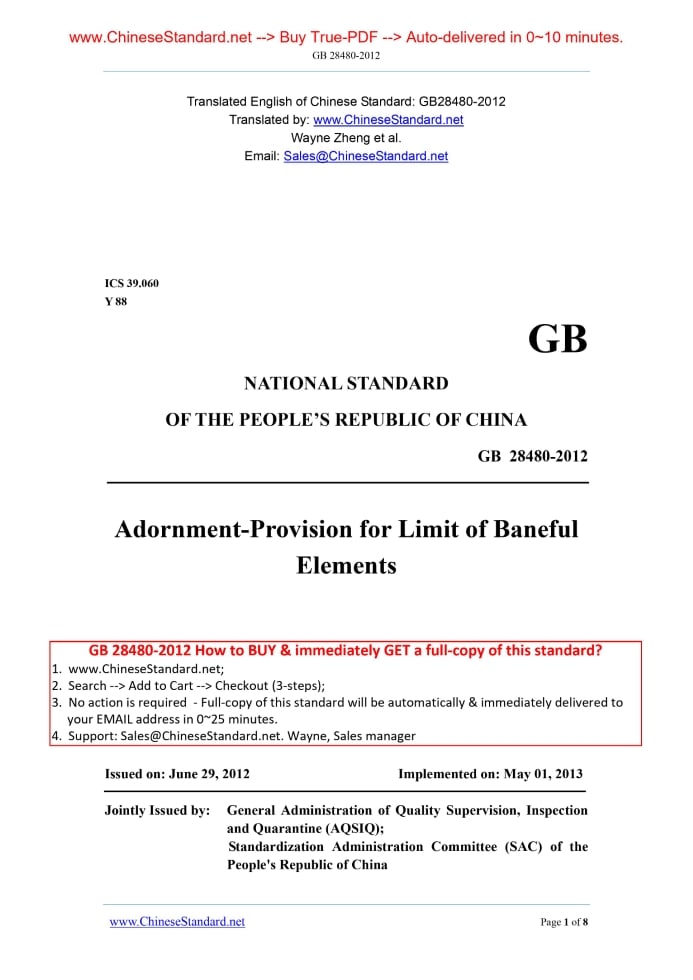
---This is an excerpt. Full copy of true-PDF in English version (including equations, symbols, images, flow-chart, tables, and figures etc.), auto-downloaded/delivered in 9 seconds, can be purchased online: https://www.ChineseStandard.net/PDF.aspx/GB28480-2012ICS 39.060 Y 88 GB NATIONAL STANDARD Adornment-Provision for Limit of Baneful Elements Issued on. JUNE 29, 2012 Implemented on. MAY 01, 2013 Jointly Issued by. General Administration of Quality Supervision, Inspection and Quarantine (AQSIQ); Standardization Administration Committee (SAC) of the People's Republic of China
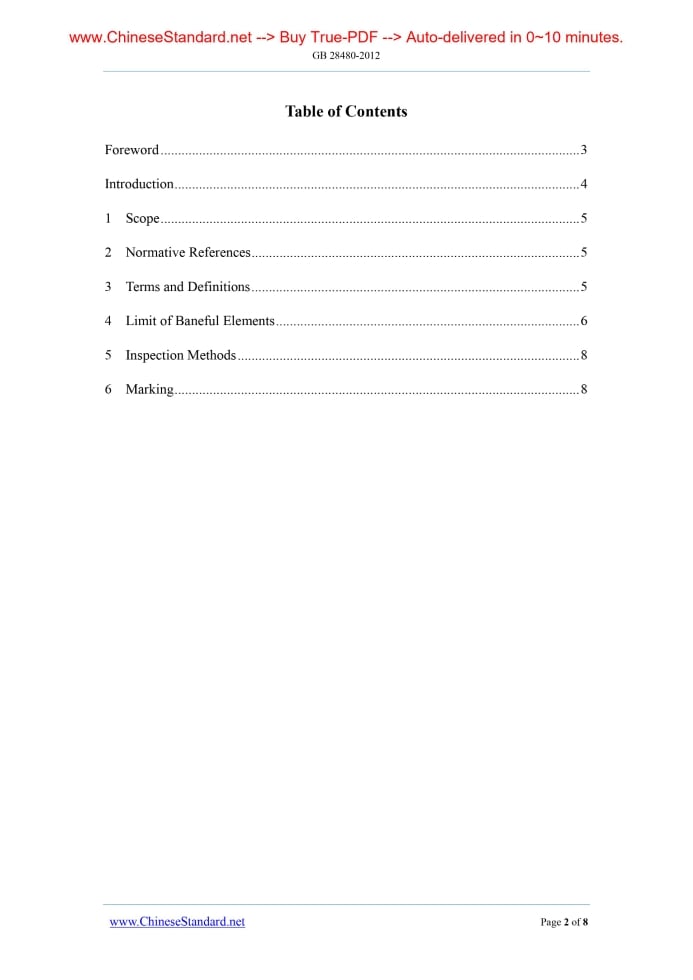
Table of Contents
Foreword... 3 Introduction... 4 1 Scope... 5 2 Normative References... 5 3 Terms and Definitions... 5 4 Limit of Baneful Elements... 6 5 Inspection Methods... 8 6 Marking... 8Foreword
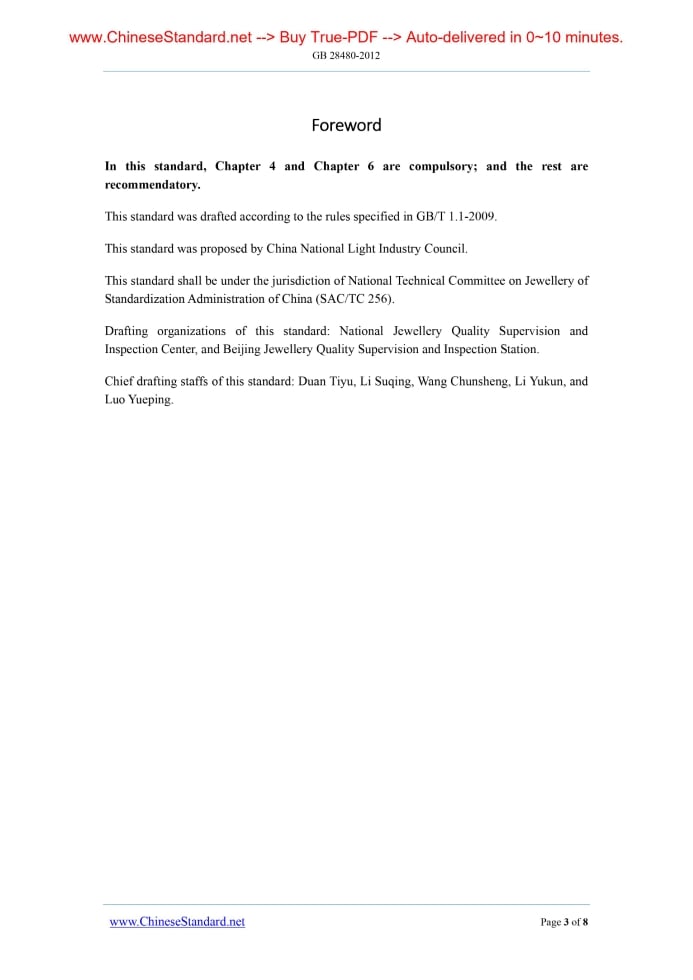
In this standard, Chapter 4 and Chapter 6 are compulsory; and the rest are recommendatory. This standard was drafted according to the rules specified in GB/T 1.1-2009. This standard was proposed by China National Light Industry Council. This standard shall be under the jurisdiction of National Technical Committee on Jewellery of Standardization Administration of China (SAC/TC 256). Drafting organizations of this standard. National Jewellery Quality Supervision and Inspection Center, and Beijing Jewellery Quality Supervision and Inspection Station. Chief drafting staffs of this standard. Duan Tiyu, Li Suqing, Wang Chunsheng, Li Yukun, and Luo Yueping.1 Scope
This standard specifies the types and limits of baneful elements in adornment. This standard is applicable to the adornment made of various materials (excluding gems).2 Normative References
The following documents are indispensable for the application of this document. For dated references, only the dated edition applies. For undated references, the latest edition (including all the amendments) of the normative document applies. GB/T 19719 Jewellery - Determination of the Release of Nickel - Method of Spectrometry GB/T 28019 Adornment - Determination of Chromium (VI) - 1,5-Diphenylcarbohydrazide Spectrophotometric Method GB/T 28020 Adornment - Determination of Baneful Elements - X-ray Fluorescence Spectrometric Method GB/T 28021 Adornment - Determination of Baneful Elements - Method of Spectrometry GB/T 28485 Coated Adornment - Detection of Nickel Release - Method for Simulation of Wear and Corrosion3 Terms and Definitions
For the purpose of this document, the following terms and definitions apply. 3.1 Adornment It is the general term of jewellery and ornaments. 3.2 Jewellery The adornments worn by people. 3.3 Ornaments The adornments used for decorating the indoor environment. 3.4 Gems The general term of natural gems (including natural gemstones, natural jades and natural organic gemstones) and artificial gemstones (including synthetic stones, artificial stones, composite stones and reconstructed stones); [Definition 3.1 in GB/T 16552-2010] 3.5 Baneful elements The general term of such chemical elements that may cause harms to the human health or environment during the process of application. It mainly refers to nickel, arsenic, cadmium, chromium, lead, mercury, stibium, barium, and selenium, etc. 3.6 Total content The ratio BETWEEN the mass of a certain element or substance AND the total mass of this material or component, expressed in mg/kg. 3.74 Limit of Baneful Elements
4.1 Nickel 4.1.1 For the products used during the occlusion of perforating wounds on ears or any other parts of human body, the nickel release shall be less than 0.2μg/(cm2·week). 4.1.2 Products having prolonged contact with skin of human body, for instance. 4.1.3 For the products designated in 4.1.2, if plating is applied on the surface, the plating shall guarantee that nickel release of the portion that has prolonged contact with skin is less than 0.5 μg/(cm2·week) in 2 years of normal use. 4.2 Other baneful elements 4.2.1 The adornment or adornment components made of metal materials shall meet the following requirements. 4.2.2 The adornment made of other materials shall meet the requirements of the corresponding national standards (if available). For instance, the limit of baneful elements in the adornment made of textile shall meet the safety requirements of textile.5 Inspection Methods
5.1 Determination of nickel release The nickel release shall be determined in accordance with GB/T 19719 and GB/T 28485. 5.2 Determination of other baneful elements It shall adopt the approved methods to determine the total content and the content of soluble elements of the baneful elements in adornment.6 Marking
Children jewellery shall be indicated in the label or in other markings. ......Source: Above contents are excerpted from the full-copy PDF -- translated/reviewed by: www.ChineseStandard.net / Wayne Zheng et al.