GB 19592-2019 English PDF
Price & Delivery
US$85.00 · In stock · Download in 9 secondsGB 19592-2019: Detergent Additive for Motor Gasoline
Delivery: 9 seconds. True-PDF full-copy in English & invoice will be downloaded + auto-delivered via email. See step-by-step procedure
Status: Valid
GB 19592: Historical versions
| Standard ID | USD | BUY PDF | Delivery | Standard Title (Description) | Status |
| GB 19592-2019 | 85 | Add to Cart | Auto, 9 seconds. | Detergent Additive for Motor Gasoline | Valid |
| GB 19592-2004 | 399 | Add to Cart | 3 days | [Replaced by GB 19592-2019] Detergent additive for vehicle gasoline | Obsolete |
Click to Preview this PDF
Similar standards
GB 19592-2019: Detergent Additive for Motor Gasoline
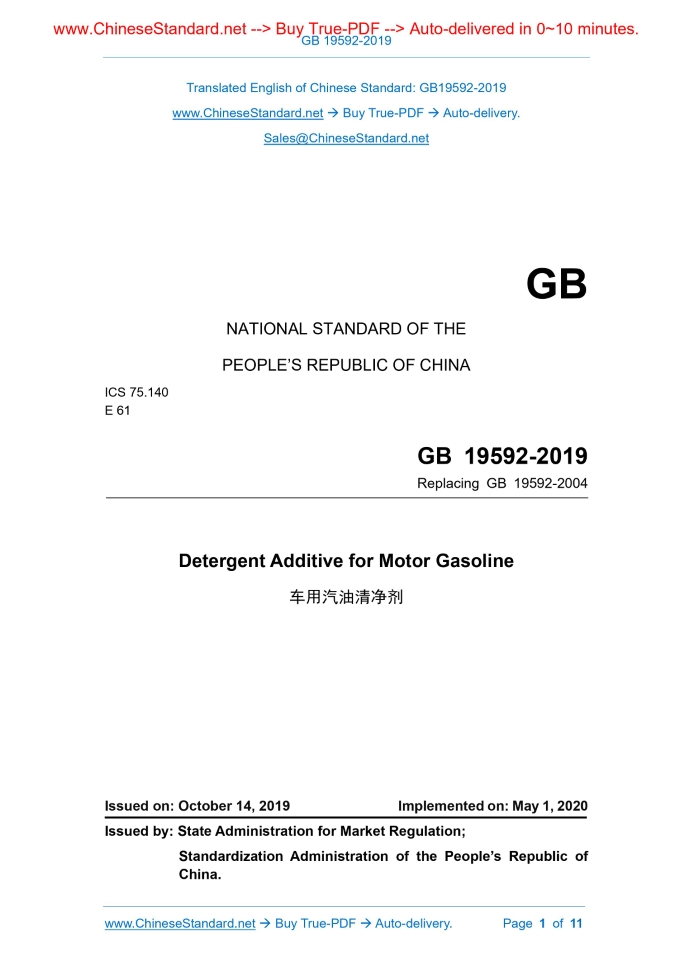
---This is an excerpt. Full copy of true-PDF in English version (including equations, symbols, images, flow-chart, tables, and figures etc.), auto-downloaded/delivered in 9 seconds, can be purchased online: https://www.ChineseStandard.net/PDF.aspx/GB19592-2019NATIONAL STANDARD OF THE PEOPLE’S REPUBLIC OF CHINA ICS 75.140 E 61 Replacing GB 19592-2004 Detergent Additive for Motor Gasoline Issued on. OCTOBER 14, 2019 Implemented on. MAY 1, 2020 Issued by. State Administration for Market Regulation; Standardization Administration of the People’s Republic of China.
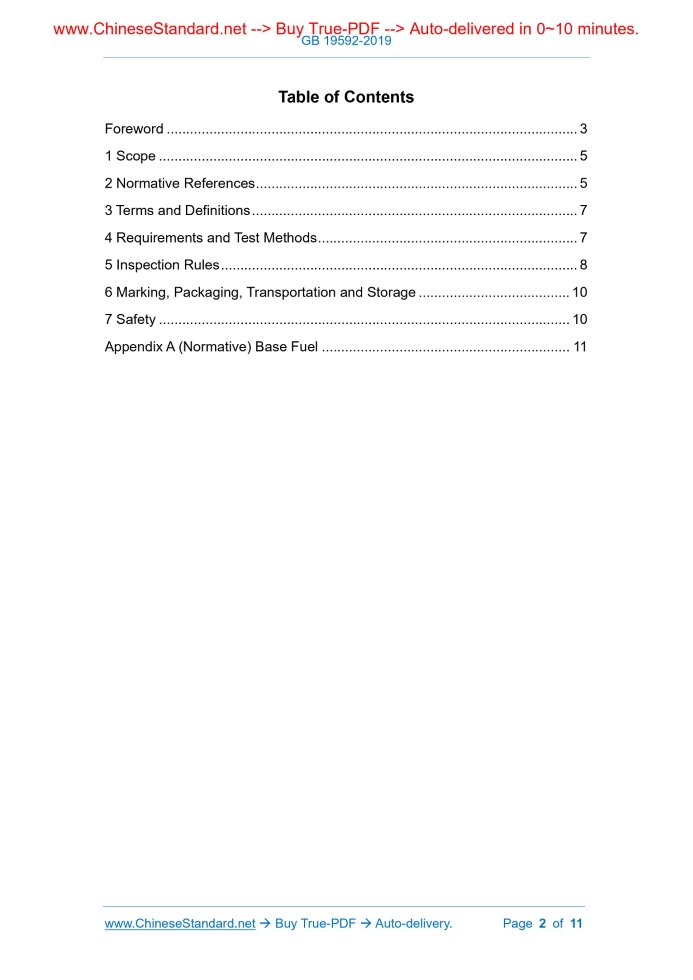
Table of Contents
Foreword... 3 1 Scope... 5 2 Normative References... 5 3 Terms and Definitions... 7 4 Requirements and Test Methods... 7 5 Inspection Rules... 8 6 Marking, Packaging, Transportation and Storage... 10 7 Safety... 10 Appendix A (Normative) Base Fuel... 11Foreword
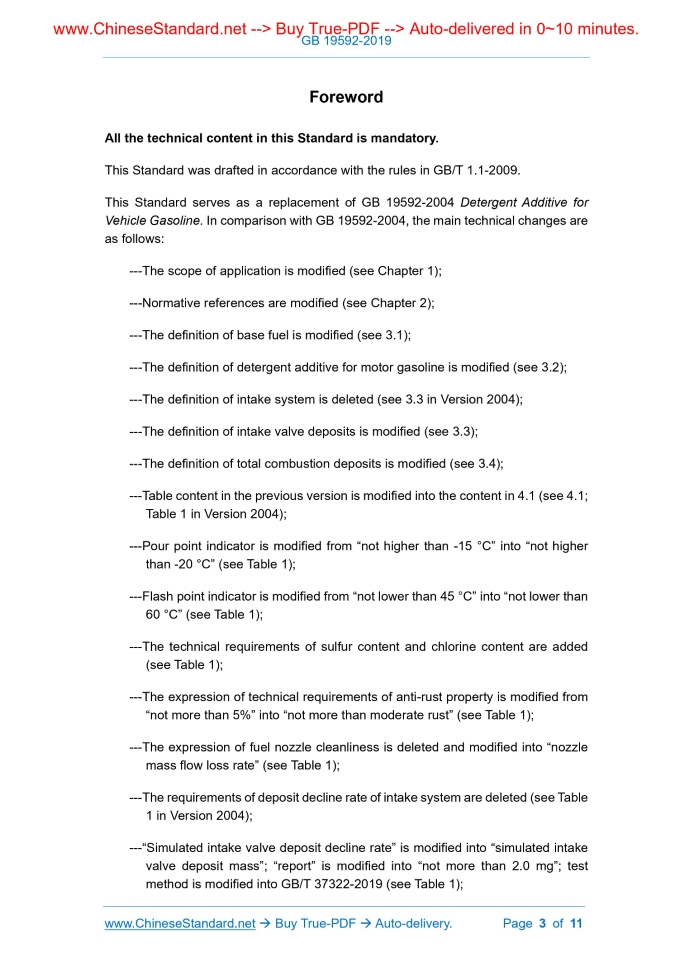
All the technical content in this Standard is mandatory. This Standard was drafted in accordance with the rules in GB/T 1.1-2009. This Standard serves as a replacement of GB 19592-2004 Detergent Additive for Vehicle Gasoline. In comparison with GB 19592-2004, the main technical changes are as follows. ---The scope of application is modified (see Chapter 1); ---Normative references are modified (see Chapter 2); ---The definition of base fuel is modified (see 3.1); ---The definition of detergent additive for motor gasoline is modified (see 3.2); ---The definition of intake system is deleted (see 3.3 in Version 2004); ---The definition of intake valve deposits is modified (see 3.3); ---The definition of total combustion deposits is modified (see 3.4); ---Table content in the previous version is modified into the content in 4.1 (see 4.1; Table 1 in Version 2004); ---Pour point indicator is modified from “not higher than -15 °C” into “not higher than -20 °C” (see Table 1); ---Flash point indicator is modified from “not lower than 45 °C” into “not lower than 60 °C” (see Table 1); ---The technical requirements of sulfur content and chlorine content are added (see Table 1); ---The expression of technical requirements of anti-rust property is modified from “not more than 5%” into “not more than moderate rust” (see Table 1); ---The expression of fuel nozzle cleanliness is deleted and modified into “nozzle mass flow loss rate” (see Table 1); ---The requirements of deposit decline rate of intake system are deleted (see Table 1 in Version 2004); ---“Simulated intake valve deposit decline rate” is modified into “simulated intake valve deposit mass”; “report” is modified into “not more than 2.0 mg”; test method is modified into GB/T 37322-2019 (see Table 1); ---Technical indicators of average intake valve deposit mass are modified, in other words, Method 1 is modified from “not more than 70 mg” into “not more than 30 mg”; Method 2 is modified from “not more than 130 mg” into “not more than 50 mg” (see Table 1); ---“Total combustion chamber deposit increase” is modified into “total combustion chamber deposit mass increase”; technical indicator is modified from “not more than 40%” into “not more than 30%” (see Table 1); ---A part of content in Note b in the previous version is modified into NOTE e (see Table 1); the other part of content is placed into Appendix A (see Table A.1; Table 1 in Version 2004); ---Note f is added to Table 1 (see Table 1); ---Inspection rules are modified (see Chapter 5); ---The content of designation is deleted (see Chapter 6 in 2004); ---The content of safety is added (see Chapter 7); ---Appendix A Base Fuel is modified (see Appendix A); ---Appendix B Gasoline Engine Intake Valve Deposit Simulation Test Method in the previous version is deleted (see Appendix B in Version 2004). This Standard was proposed by and shall be under the jurisdiction of National Energy Administration. The drafting organizations of this Standard. SINOPEC Research Institute of Petroleum Processing; Lanzhou Lubricant Research and Development Center of PetroChina Company Limited; Chinese Research Academy of Environmental Sciences; Shenzhen JPLUS Chemical Technology Co., Ltd.; Shandong EFIRM Biochemistry and Environmental Protection Co., Ltd. The main drafters of this Standard. Zhangxin, Liu Quanshan, Miao Qile, Yuexin, Li Ruibo, Xie Jianhai, Chen Yumeng, Liang Wangen, Sunmeng. The issuing of the previous versions of the standard replaced by this Standard is as follows. ---GB 19592-2004. Detergent Additive for Motor Gasoline Warning. if appropriate precautions are not abided by, there might be dangers in the production, storage, transportation and usage process of products that belong to this Standard. This Standard does not intend to propose suggestions to all the safety issues related with the products. Before putting this Standard into effect, users shall undertake the responsibility of establishing appropriate safety and preventive measures; confirming the applicability of relevant stipulations and restrictions.1 Scope
This Standard stipulates the terms and definitions, requirements, test methods, inspection rules, marking, packaging, transportation, storage and safety of detergent additive for motor gasoline. This Standard is applicable to detergent additives used in motor gasoline and motor ethanol gasoline.2 Normative References
The following documents are indispensable to the application of this document. In terms of references with a specified date, only versions with a specified date are applicable to this document. In terms of references without a specified date, the latest version (including all the modifications) is applicable to this document. GB 190 Packing Symbol of Dangerous Goods; GB/T 261 Determination of Flash Point - Pensky-Martens Closed Cup Method; GB/T 511 Petroleum, Petroleum Products and Additives - Method for Determination of Mechanical Admixtures; GB/T 3535 Petroleum Products - Determination of Pour Point; GB/T 4756 Method for Manual Sampling of Petroleum Liquids; GB/T 11140 Standard Test Method for Sulfur in Petroleum Products by Wavelength Dispersive X-ray Fluorescence Spectrometry; GB 17930 Gasoline for Motor Vehicles; GB/T 19230.1 Test Method for Evaluating Gasoline Detergent in Use - Part 1.Test Method for Rust-preventing Characteristics of Gasoline Detergent; GB/T 19230.2 Test Method for Evaluating Gasoline Detergent in Use - Part 2.Test Method for Demulsibility of Gasoline Detergent;3 Terms and Definitions
The following terms and definitions are applicable to this document. 3.1 Base Fuel Base fuel refers to fuel that is used to inspect a certain property of additives in tests. Base fuel has satisfying distinctiveness and does not include additives that may improve the property being inspected. 3.3 Intake Valve Deposits; IVDs Intake valve deposits refers to any matters that are generated by fuel, lubricating oil and additives, or, inhaled from the outside, and deposit on the surface of intake valve. 3.4 Total Combustion Deposits; TCDs Total combustion deposits refers to any matters that are generated by fuel, lubricating oil and additives, or, inhaled from the outside, and deposit on the part of combustion chamber (cylinder head and piston top).4 Requirements and Test Methods
4.1 Chemical substances that may generate ash content cannot be manually added to detergent additive for motor gasoline. Motor gasoline and motor ethanol gasoline, which adds detergent additive in accordance with the recommended dosage, shall comply with corresponding standards. 4.2 The technical requirements and test methods of detergent additive for motor gasoline are shown in Table 1.5 Inspection Rules
5.1 Inspection Classification and Inspection Items 5.1.1 Exit-factory inspection Exit-factory batch inspection items include. appearance, pour point, flash point (closed cup), nitrogen content, sulfur content, chlorine content, anti-rust property, demulsification, simulated intake valve deposit mass. 5.1.2 Type inspection Type inspection items include all the items stipulated in the technical requirements in Table 1. 5.3 Sampling Sampling shall comply with GB/T 4756.Sampling quantity shall be not less than 1 L; reserve for inspection and as reserved sample. 5.4 Determination Rules When the result of exit-factory inspection and the result of type inspection completely comply with the stipulations in Chapter 4, then, the batch of products shall be determined as qualified. When the result of simulated intake valve deposit mass and the result of average intake valve deposit mass in engine test are contradictory, the result of engine test shall be subject to. 5.5 Re-inspection Rules If the result of exit-factory inspection and the result of type inspection do not comply with the requirements of this Standard, re-take a double size of samples from the same batch of products; conduct re-inspection of the disqualified items.6 Marking, Packaging, Transportation and Storage
Detergent additive for motor gasoline belongs to flammable liquid. The marking, packaging, transportation, storage and delivery inspection of products shall comply with SH/T 0164, GB 30000.7-2013, GB 190 and NB/SH/T 0967.7 Safety
Detergent additive for motor gasoline belongs to flammable liquid. Please refer to Appendix D in GB 30000.7-2013 for a statement of its dangers and precautions. ......Source: Above contents are excerpted from the full-copy PDF -- translated/reviewed by: www.ChineseStandard.net / Wayne Zheng et al.