GB 13837-2012 PDF English
GB 13837: Historical versions
| Standard ID | USD | BUY PDF | Delivery | Standard Title (Description) | Status |
| GB 13837-2012 | 345 | Add to Cart | Auto, 9 seconds. | [GB/T 13837-2012] Sound and television broadcast receivers and associated equipment. Radio disturbance characteristics. Limits and methods of measurement | Obsolete |
| GB 13837-2003 | 839 | Add to Cart | 6 days | Sound and television broadcast receivers and associated equipment -- Radio disturbance characteristics -- Limits and methods of measurement | Obsolete |
| GB 13837-1997 | 759 | Add to Cart | 5 days | Limits and methods of measurement of radio interference characteristics of sound and television broadcast receivers and associated equipment | Obsolete |
| GB 13837-1992 | RFQ | ASK | 3 days | Limits and methods of measurement of interference characteristics on sound and television broadcast reveivers and associated equipment | Obsolete |
Similar standards
GB 13837-2012: [GB/T 13837-2012] Sound and television broadcast receivers and associated equipment. Radio disturbance characteristics. Limits and methods of measurement
---This is an excerpt. Full copy of true-PDF in English version (including equations, symbols, images, flow-chart, tables, and figures etc.), auto-downloaded/delivered in 9 seconds, can be purchased online: https://www.ChineseStandard.net/PDF.aspx/GB13837-2012
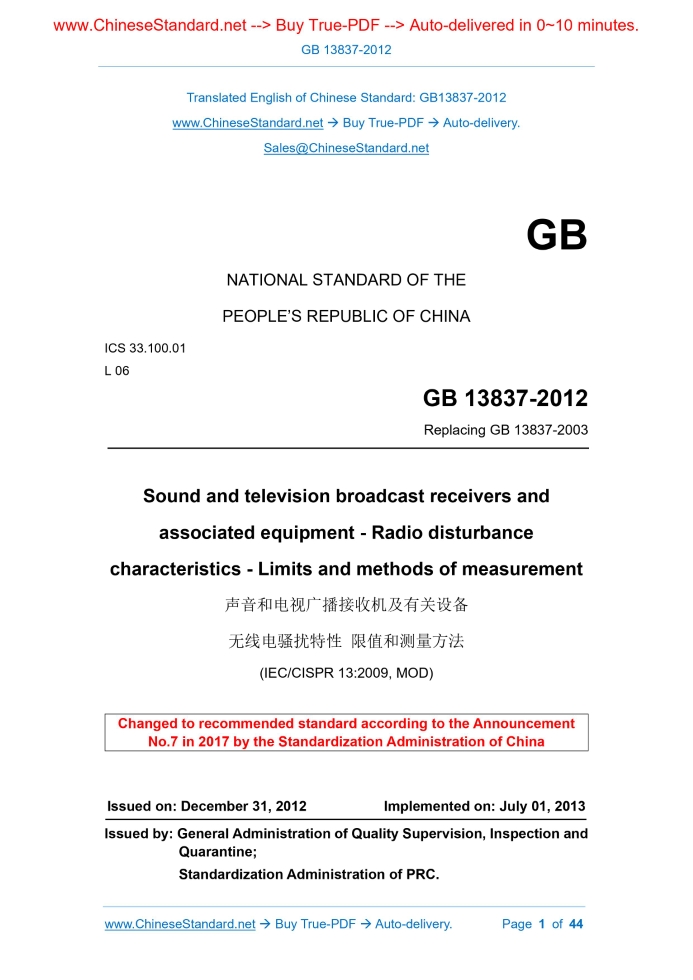
GB NATIONAL STANDARD OF THE PEOPLE’S REPUBLIC OF CHINA ICS 33.100.01 L 06 Replacing GB 13837-2003 Sound and television broadcast receivers and associated equipment - Radio disturbance characteristics - Limits and methods of measurement (IEC/CISPR 13.2009, MOD) Changed to recommended standard according to the Announcement No.7 in 2017 by the Standardization Administration of China Issued on. DECEMBER 31, 2012 Implemented on. JULY 01, 2013 Issued by. General Administration of Quality Supervision, Inspection and Quarantine; Standardization Administration of PRC.
Table of Contents
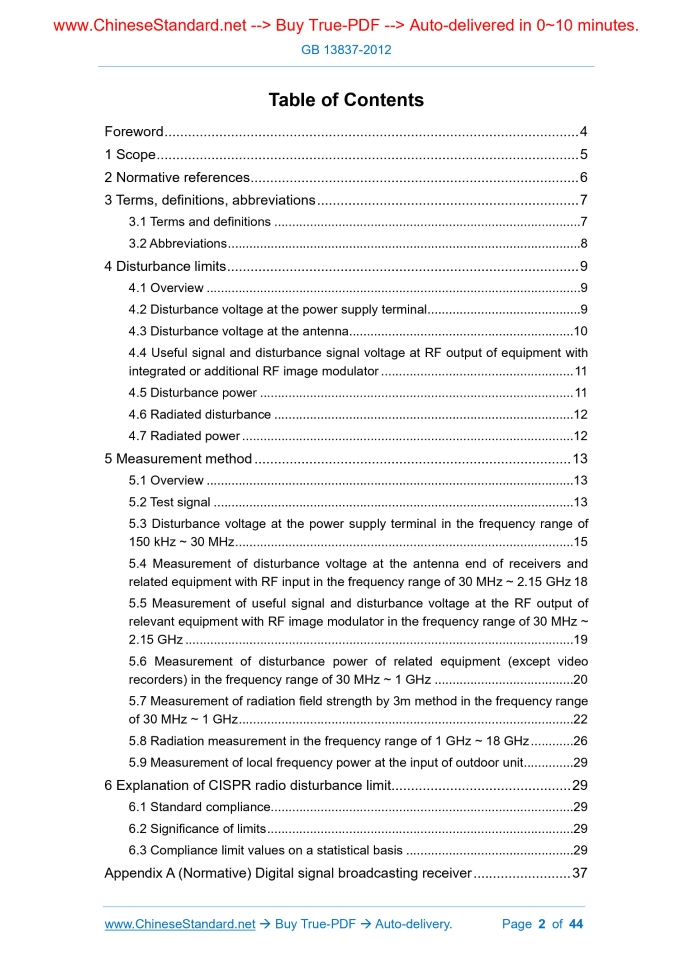
Foreword... 4 1 Scope... 5 2 Normative references... 6 3 Terms, definitions, abbreviations... 7 3.1 Terms and definitions... 7 3.2 Abbreviations... 8 4 Disturbance limits... 9 4.1 Overview... 9 4.2 Disturbance voltage at the power supply terminal... 9 4.3 Disturbance voltage at the antenna... 10 4.4 Useful signal and disturbance signal voltage at RF output of equipment with integrated or additional RF image modulator... 11 4.5 Disturbance power... 11 4.6 Radiated disturbance... 12 4.7 Radiated power... 12 5 Measurement method... 13 5.1 Overview... 13 5.2 Test signal... 13 5.3 Disturbance voltage at the power supply terminal in the frequency range of 150 kHz ~ 30 MHz... 15 5.4 Measurement of disturbance voltage at the antenna end of receivers and related equipment with RF input in the frequency range of 30 MHz ~ 2.15 GHz 18 5.5 Measurement of useful signal and disturbance voltage at the RF output of relevant equipment with RF image modulator in the frequency range of 30 MHz ~ 2.15 GHz... 19 5.6 Measurement of disturbance power of related equipment (except video recorders) in the frequency range of 30 MHz ~ 1 GHz... 20 5.7 Measurement of radiation field strength by 3m method in the frequency range of 30 MHz ~ 1 GHz... 22 5.8 Radiation measurement in the frequency range of 1 GHz ~ 18 GHz... 26 5.9 Measurement of local frequency power at the input of outdoor unit... 29 6 Explanation of CISPR radio disturbance limit... 29 6.1 Standard compliance... 29 6.2 Significance of limits... 29 6.3 Compliance limit values on a statistical basis... 29 Appendix A (Normative) Digital signal broadcasting receiver... 37 Appendix B (Informative) Basic information of digital television useful signals) ... 42 Appendix C (Informative) Settings of flat-panel TV receiver... 44Foreword
All technical content of this standard is mandatory. This standard was drafted in accordance with the rules given in GB/T 1.1-2009. This standard adopts IEC/CISPR 13.2009 "Sound and television broadcast receivers and associated equipment - Radio disturbance characteristics - Limits and methods of measurement" after modification. The most important change of IEC/CISPR 13.2009 is to add the RMS-average limit and clearly stipulate the requirements for digital broadcast receivers. The difference between this standard and IEC/CISPR 13.2009 is the addition of the last paragraph in 4.1 and the note in A.5.3.3.In addition, in view of the differences between Chinese digital TV standards and international standards, the contents of Appendix B of this standard and CISPR 13.2009 Appendix B are somewhat different. This standard provides relevant information based on China's digital television broadcasting system. In view of the fact that the display characteristics of flat-panel TV receivers are very different from those of CRT TV receivers, appendix C flat-panel TV receiver settings are added. This standard replaces GB 13837-2003 "Sound and television broadcast receivers and associated equipment - Radio disturbance characteristics - Limits and methods of measurement". Compared with GB 13837-2003, the main changes of this standard are as follows. - ADD the measurement and limits of the RMS-average detector; - ADD the limit requirements and measurement methods for digital television receivers and digital sound receivers. This standard was proposed by and shall be under the jurisdiction of the National Radio Interference Standardization Technical Committee (SAC/TC 79). Responsible drafting organization of this standard. The Third Research Institute of China Electronics Technology Group Corporation. The main drafters of this standard. Lin Jingping, Xu Wei, Zhang Xia, Guo Xiaoqi, Zhu Lin, Ma Xiaoyu. This standard replaces the standard previously issued as follows. - GB 6114-1985 and GB 7236-1986, GB 13837-1997, GB 13837-2003. Sound and television broadcast receivers and associated equipment - Radio disturbance characteristics - Limits and methods of measurement1 Scope
This standard specifies the measurement methods for sound and television receivers and related equipment, as well as the limits for the control of harassment from such equipment.2 Normative references
The following documents are essential to the application of this document. For the dated documents, only the versions with the dates indicated are applicable to this document; for the undated documents, only the latest version (including all the amendments) are applicable to this standard.3 Terms, definitions, abbreviations
The equipment used for receiving terrestrial, cable and satellite television broadcasting and similar services, the input signal of which can be analog or digital. Outdoor unit of direct to home satellite receiving systems for individual reception4 Disturbance limits
It shall be measured according to 5.4.The limits are as shown in Table 2. The limit corresponds to the nominal antenna impedance of 75 Ω. For receivers whose nominal antenna impedance is not 75 Ω, the limit shall be converted according to the formula (1).5 Measurement method
The measured voltage includes narrow-band disturbances from time-base circuits, video circuits, as well as the broadband disturbances generated from semiconductor rectifiers, etc. The tuned TV receiver receives the standard test signal specified in 5.2, for this, a small receiving antenna is connected to the receiver under test. If the receiver has an internal antenna, it can also use the internal antenna; at this time, it shall disconnect the external receiving antenna.6 Explanation of CISPR radio disturbance limit
For type appraisal products, the significance of the limit value shall be established on the basis of statistics. Based on the "non-central t distribution", no less than 5 samples of this type of product shall be sampled for testing at a time. In special circumstances, if 5 samples cannot be used, 3 samples shall be used for the test.Appendix A
(Normative) Digital signal broadcasting receiver This Appendix gives additional information concerning measurement methods for digital signal broadcasting receivers.Appendix B
(Informative) Basic information of digital television useful signals1) See Table B.1 for information on the digital TV broadcasting source used for measurement in accordance with this standard.Appendix C
(Informative) Settings of flat-panel TV receiver The purpose of adjusting the brightness of the TV receiver is to make it work at the rated power and to make the test results reproducible. ......Source: Above contents are excerpted from the full-copy PDF -- translated/reviewed by: www.ChineseStandard.net / Wayne Zheng et al.