YY/T 0119.4-2014 PDF English
Price & Delivery
US$150.00 · In stock · Download in 9 secondsYY/T 0119.4-2014: Spinal implants - Components used in the surgical fixation of the spinal skeletal system - Part 4: Metallic spinal rods
Delivery: 9 seconds. True-PDF full-copy in English & invoice will be downloaded + auto-delivered via email. See step-by-step procedure
Status: Valid
| Standard ID | USD | BUY PDF | Delivery | Standard Title (Description) | Status |
| YY/T 0119.4-2014 | 150 | Add to Cart | Auto, 9 seconds. | Spinal implants - Components used in the surgical fixation of the spinal skeletal system - Part 4: Metallic spinal rods | Valid |
Click to Preview this PDF
Similar standards
YY/T 0119.4-2014: Spinal implants - Components used in the surgical fixation of the spinal skeletal system - Part 4: Metallic spinal rods
---This is an excerpt. Full copy of true-PDF in English version (including equations, symbols, images, flow-chart, tables, and figures etc.), auto-downloaded/delivered in 9 seconds, can be purchased online: https://www.ChineseStandard.net/PDF.aspx/YYT0119.4-2014
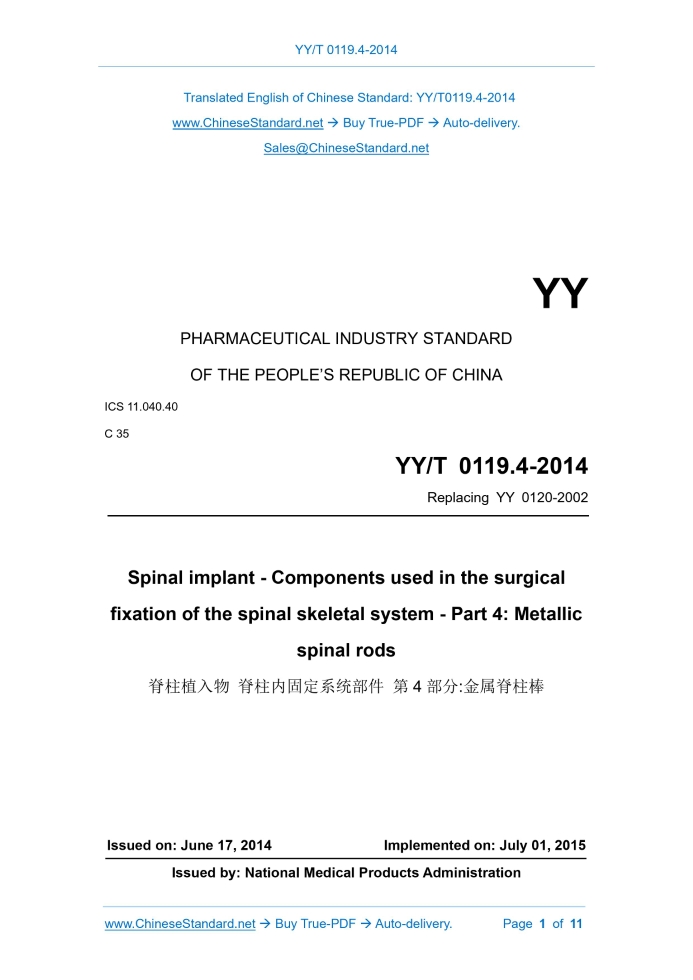
YY PHARMACEUTICAL INDUSTRY STANDARD OF THE PEOPLE’S REPUBLIC OF CHINA ICS 11.040.40 C 35 Replacing YY 0120-2002 Spinal implant - Components used in the surgical fixation of the spinal skeletal system - Part 4: Metallic spinal rods ISSUED ON: JUNE 17, 2014 IMPLEMENTED ON: JULY 01, 2015 Issued by: National Medical Products Administration
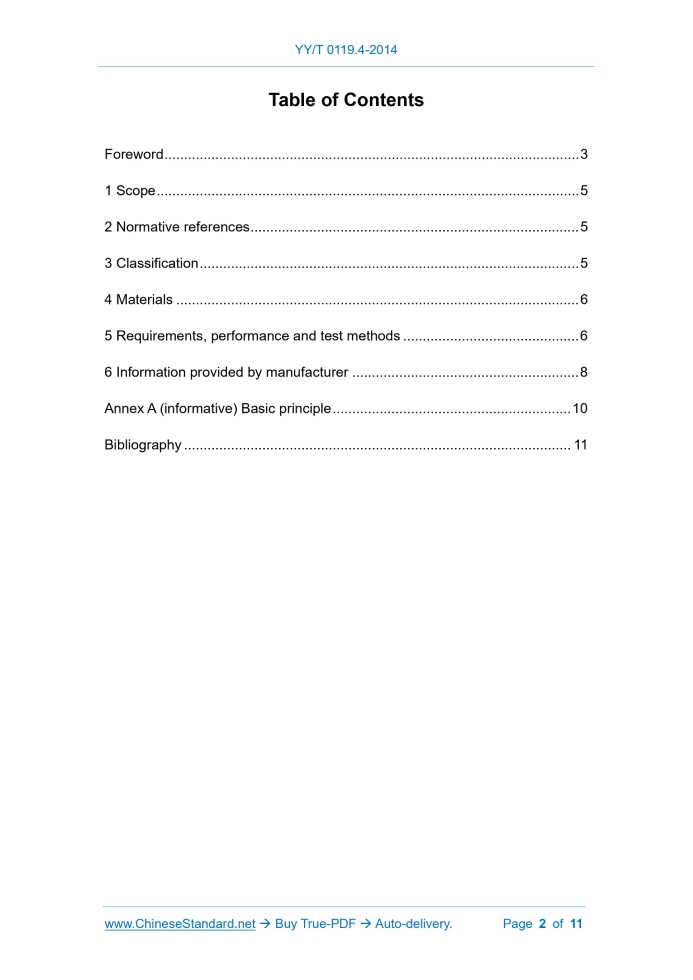
Table of Contents
Foreword ... 3 1 Scope ... 5 2 Normative references ... 5 3 Classification ... 5 4 Materials ... 6 5 Requirements, performance and test methods ... 6 6 Information provided by manufacturer ... 8 Annex A (informative) Basic principle ... 10 Bibliography ... 11 Spinal implant - Components used in the surgical fixation of the spinal skeletal system - Part 4: Metallic spinal rods1 Scope
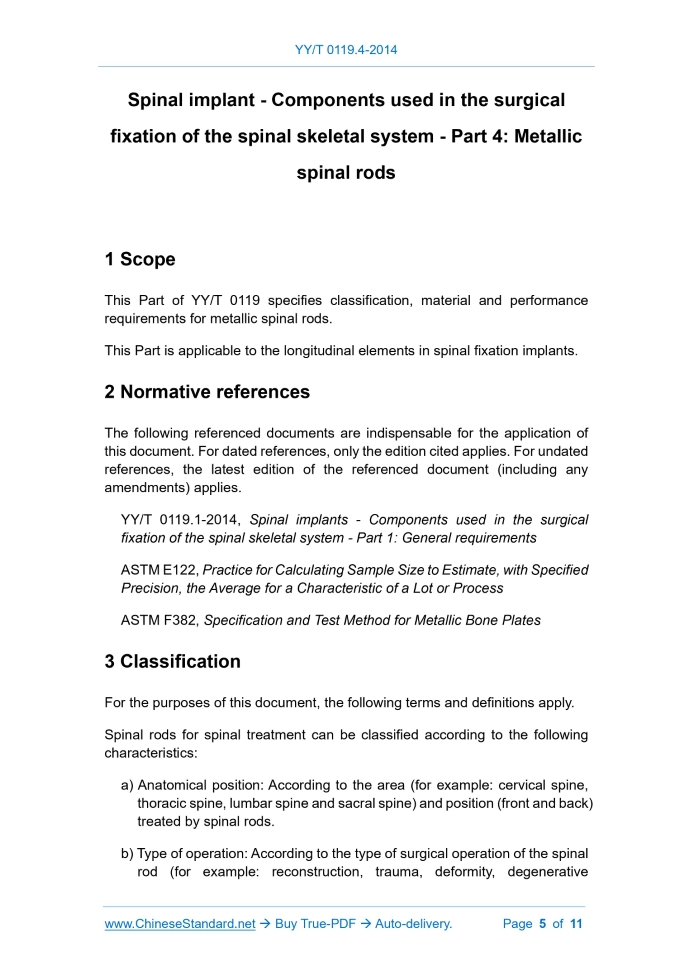
This Part of YY/T 0119 specifies classification, material and performance requirements for metallic spinal rods. This Part is applicable to the longitudinal elements in spinal fixation implants.2 Normative references
The following referenced documents are indispensable for the application of this document. For dated references, only the edition cited applies. For undated references, the latest edition of the referenced document (including any amendments) applies. YY/T 0119.1-2014, Spinal implants - Components used in the surgical fixation of the spinal skeletal system - Part 1: General requirements ASTM E122, Practice for Calculating Sample Size to Estimate, with Specified Precision, the Average for a Characteristic of a Lot or Process ASTM F382, Specification and Test Method for Metallic Bone Plates3 Classification
For the purposes of this document, the following terms and definitions apply. Spinal rods for spinal treatment can be classified according to the following characteristics: a) Anatomical position: According to the area (for example: cervical spine, thoracic spine, lumbar spine and sacral spine) and position (front and back) treated by spinal rods. b) Type of operation: According to the type of surgical operation of the spinal rod (for example: reconstruction, trauma, deformity, degenerative disease).4 Materials
According to the requirements and recommendations in Chapter 5 of YY/T 0119.1-2014, select the spinal rod material.5 Requirements, performance and test methods
5.1 Geometric characteristics The recommended size of the metal spinal rod can be found in YY/T 0119.1. 5.2 Static test and fatigue test 5.2.1 Test requirements Determine the bending structure stiffness, yield bending moment, ultimate bending moment, fatigue end bending moment and median fatigue bending moment of 2.5 million cycles of the spinal rod according to the test method in ASTM F382 (if applicable). The test method shall meet the requirements of 5.2.2. 5.2.2 Test method 5.2.2.1 Installation method and requirements 5.2.2.1.1 Install a 90°V-groove roller shaft on the test device. The shape of the roller allows a single set of rollers to test a range of sizes of spinal rods. These rollers also prevent the application of loads on the maximum stress points on the circumference of the spinal rod. 5.2.2.1.2 Install four-point bending test device to make the loading roller (the inner roller placed on both sides of "a") be placed according to the requirements of Table 1 (see Figure 1). 5.2.2.1.3 Place the support roller in the test device according to the recommended size in Table 1 (the outer roller shaft is placed at a distance "h" from the nearest roller shaft). Table 1 -- Cervical, thoracic, and lumbar loading roller spacing and supporting roller spacing Spine position h/mm a/mm Cervical spine 35.00 35.00 Thoracic and lumbar spine 76.00 76.00Annex A
(informative) Basic principle A.1 This Part aims to provide practical and uniform information related to spinal rods. A.2 Because the spinal rod is the main way to stabilize the active segment, the bending performance is an important performance characteristic of the spinal rod. In addition, the bending stiffness of the spinal rod may directly affect the healing rate and fusion ability. A.3 A four-point bending load is specified for the spinal rod. The loading structure of this test can simulate the principal stress state after the spinal rod is implanted. A.4 Since the cross-section of the spinal rod is uniform along the length of the spinal rod, and it is considered that there is no design feature of stress concentration points along the length, therefore, the user is allowed to freely choose the test fixture device (roller contact point) for the spinal rod test. Therefore, choosing any part of the spinal rod for test has the representativeness of its mechanical properties. ......Source: Above contents are excerpted from the full-copy PDF -- translated/reviewed by: www.ChineseStandard.net / Wayne Zheng et al.