SN/T 4148-2015 PDF English
Price & Delivery
US$145.00 · In stock · Download in 9 secondsSN/T 4148-2015: Determination of volatile organic compounds (VOCs) in packing materials - Static headspace gas chromatography
Delivery: 9 seconds. True-PDF full-copy in English & invoice will be downloaded + auto-delivered via email. See step-by-step procedure
Status: Valid
| Standard ID | USD | BUY PDF | Delivery | Standard Title (Description) | Status |
| SN/T 4148-2015 | 145 | Add to Cart | Auto, 9 seconds. | Determination of volatile organic compounds (VOCs) in packing materials - Static headspace gas chromatography | Valid |
Click to Preview this PDF
Similar standards
SN/T 4148-2015: Determination of volatile organic compounds (VOCs) in packing materials - Static headspace gas chromatography
---This is an excerpt. Full copy of true-PDF in English version (including equations, symbols, images, flow-chart, tables, and figures etc.), auto-downloaded/delivered in 9 seconds, can be purchased online: https://www.ChineseStandard.net/PDF.aspx/SNT4148-2015
SN ENTRY-EXIT INSPECTION AND QUARANTINE INDUSTRY STANDARD OF PRC Determination of volatile organic compounds (VOCs) in packing materials – Static headspace gas chromatography Issued on: FEBRUARY 09, 2015 Implemented on: SEPTEMBER 01, 2015 Issued by. General Administration of Quality Supervision, Inspection and Quarantine of PRC
Table of Contents
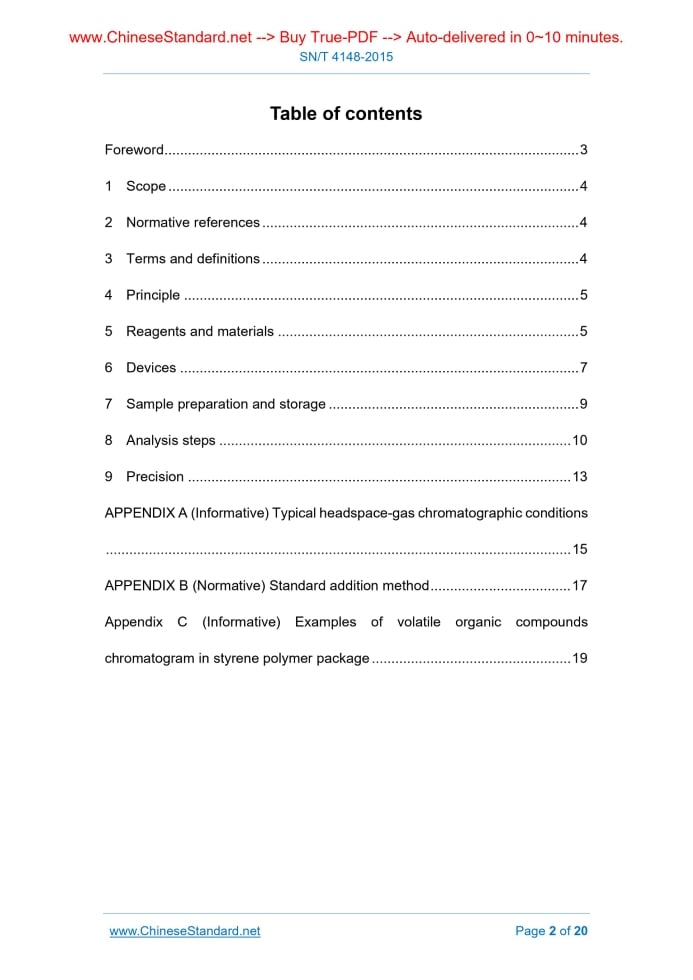
Foreword ... 3 1 Scope ... 4 2 Normative references ... 4 3 Terms and definitions ... 4 4 Principle ... 5 5 Reagents and materials ... 5 6 Devices ... 7 7 Sample preparation and storage ... 9 8 Analysis steps ... 10 9 Precision ... 13 APPENDIX A (Informative) Typical headspace-gas chromatographic conditions ... 15 APPENDIX B (Normative) Standard addition method ... 17 Appendix C (Informative) Examples of volatile organic compounds chromatogram in styrene polymer package ... 19Foreword
This standard was drafted in accordance with the rules given in GB/T 1.1-2009. This standard was proposed by AND shall be under the jurisdiction of the National Certification and Accreditation Administration. The drafting organizations of this standard. Shanghai Entry-exit Inspection and Quarantine Bureau of the People's Republic of China. The main drafters of this standard. Cheng Yuxiao, Li Hongtao, Ma Ming, Qiang Yin, Zhou Yuyan. Determination of volatile organic compounds (VOCs) in packing materials – Static headspace gas chromatography1 Scope
This standard specifies the method for the measurement of volatile organic compounds (VOCs) in packing materials through the static headspace gas chromatography. This standard is applicable to the measurement of volatile organic compounds of the known chemical compositions in in packing materials; however, the volatile organic compounds as generated due to the thermal degradation of packing materials are not covered by the measurement scope of this standard.2 Normative references
The following documents are essential to the application of this document. For the dated documents, only the versions with the dates indicated are applicable to this document; for the undated documents, only the latest version (including all the amendments) are applicable to this standard. GB/T 6682 Water for analytical laboratory use – Specification and tests methods3 Terms and definitions
The following terms and definitions apply to this document. 3.1 Packaging materials It is the general term of the materials that are used to manufacture the packaging containers AND constitute the packaging of the packed product. 3.2 Polymer packaging immediately with water, OR otherwise seek treatment immediately if serious. The volatile substances such as vinyl chloride and acrylonitrile shall not be released into the laboratory air. It shall prepare and treat the standard sample in a well-ventilated fume hood. The reagents and water used in this standard are, unless otherwise noted or required, analytical pure reagents and class III water as specified in GB/T 6682. 5.1 Methanol 5.2 Solvents. it is used to dissolve the polymer, AND it shall not contain any interference which has the same retention time as that of the volatile component to be measured. Typical polymer solvents include. a) Dimethylformamide (DMF); b) Dimethylacetamide (DMAC); c) Propylene carbonate; d) O-dichlorobenzene. Note. The volatile contaminants in the solvent can be removed through an inert gas purging for 24 h ~ 48 h. 5.3 Diluent. it is used to dilute and prepare the standard working solution of volatile organic compounds, its retention time in the gas chromatography shall be inconsistent with that of the substance to be measured, AND the commonly used diluent includes. a) Water; b) n-Hexadecane. 5.4 Volatile organic standard sample. the highest concentrations available for commercial analysis of volatile organic compounds by this method. Examples of volatile organic compounds that may be present in the styrene polymer package are as follows. a) Styrene; b) Acrylonitrile. c) Butadiene; d) Benzene; Note. Suitable detectors include the following detectors. a) Flame ionization detector (FID), which is used for the detection of conventional organic volatiles; b) Mass spectrometer (MSD), which is used for the detection of conventional organic volatiles; c) Electron capture detector (ECD), which is used for the detection of halides; d) Nitrogen and phosphorus detector (NPD), which is used for the detection of acrylonitrile. 6.2 Gas chromatographic column. Select a capillary gas chromatographic column which can separate the components to be measured. As for the volatile organic analysis of the styrene polymer package (1, 3-butadiene, acrylonitrile, styrene, benzene, toluene, ethylbenzene, cumene), it is preferable to select HP- INNOWA x 60 m x 0.32 mm (inner diameter) x 0.25 μm OR its equivalent. 6.3 Automatic headspace sampler. it is composed of the thermostatic sample tray and the related accessories as required to reach to the requirements for headspace vapour automatic sample injection. 6.4 Headspace bottle. 20 mL ~ 25 mL, with a rubber stopper gasket. 6.5 Syringe. it is calibrated; and the gas-tight syringes for headspace gas chromatographic sample injection can be heated during sampling and injection process. 6.6 Low-temperature freezing mill. with sieves of different apertures. 6.7 Constant temperature oven. it can maintain the temperature of 80 °C ~ 150 °C (± 2 °C). 6.8 Analytical balance. its sensitivity is 0.0001 g. Note 1. AVOID contacting with heated portion of the chromatograph, such as detectors, columns, sample trays, hot vials, etc. Note 2. Once heated, pressure is created in the sample vial containing the polymer volatile components. After analysis, it shall use the syringe to empty the pressure in the vial. 8.1.3 Headspace analysis conditions The headspace heating temperature and time conditions are selected in accordance with 8.1.2. Other headspace conditions are dependent on the instrument used. OPTIMIZE the relevant parameters to obtain stable analysis results and large detection signal values. The typical headspace analysis conditions are shown in Appendix A. 8.2 Calibration 8.2.1 Calibration with solvent dissolution Accurately PIPETTE the standard working solution A of certain volume [5.6.b)] into the headspace bottle; the pipetted solution volume shall be consistent with the volume of the solvent which is used to dissolve the sample in 7.4; quickly SEAL the headspace bottle; PREPARE for the headspace-gas chromatographic analysis. The calibration curve shall contain at least 5 different concentrations. 8.2.2 Calibration without solvent dissolution USE the calibrated syringe (6.5) to pipette a certain volume (2.0 µL ~ 10.0 µL) of standard working solution B [5.6.c)] to the bottom of the headspace bottle; quickly SEAL the headspace bottle; PREPARE for the headspace-gas chromatographic analysis. The calibration curve shall contain at least 5 different concentrations. 8.2.3 If the substrate of the sample to be measured has a great influence on the measurement results of some volatile organic compounds, USE the aforementioned two methods for measurement; if the recovery rate of the sample to be measured cannot reach to the analysis requirements, it is allowed to use the standard addition method in the Appendix B for detection. Note. The calibration method described above requires periodic and repeated calibration of the standard sample, AND the repeated calibration period is determined based on the stability status of the chromatograph. 8.3 Headspace sample injection 8.3.1 Automatic sample analysis PLACE the calibrated sample as mentioned in 8.2 AND the tested samples as prepared in 7.4 and 7.5 into the constant temperature sample tray of the automatic headspace sample injector (6.3); SET the headspace analysis conditions in accordance with 8.1.3; then RUN it.APPENDIX A
(Informative) Typical headspace-gas chromatographic conditions A.1 Examples of typical gas chromatographic conditions USE the measurement chromatographic conditions of the volatile organic compounds in styrene polymer packages as an example, since the measurement results are depending onto the instruments used, so it is not possible to provide the universal parameters for gas chromatography. The set parameters shall ensure that, during the chromatographic measurement, the measured components and other components can be effectively separated; the following parameters are proved to be feasible. a) Chromatography column. HP-INNOWAX capillary column 60 m x 0.32 mm (inner diameter) x 0.25 μm, or the... ......Source: Above contents are excerpted from the full-copy PDF -- translated/reviewed by: www.ChineseStandard.net / Wayne Zheng et al.