SN/T 2978-2011 PDF English
Price & Delivery
US$185.00 · In stock · Download in 9 secondsSN/T 2978-2011: PCR method for the detection of chicken components in animal derived products
Delivery: 9 seconds. True-PDF full-copy in English & invoice will be downloaded + auto-delivered via email. See step-by-step procedure
Status: Valid
| Standard ID | USD | BUY PDF | Delivery | Standard Title (Description) | Status |
| SN/T 2978-2011 | 185 | Add to Cart | Auto, 9 seconds. | PCR method for the detection of chicken components in animal derived products | Valid |
Click to Preview this PDF
Similar standards
SN/T 2978-2011: PCR method for the detection of chicken components in animal derived products
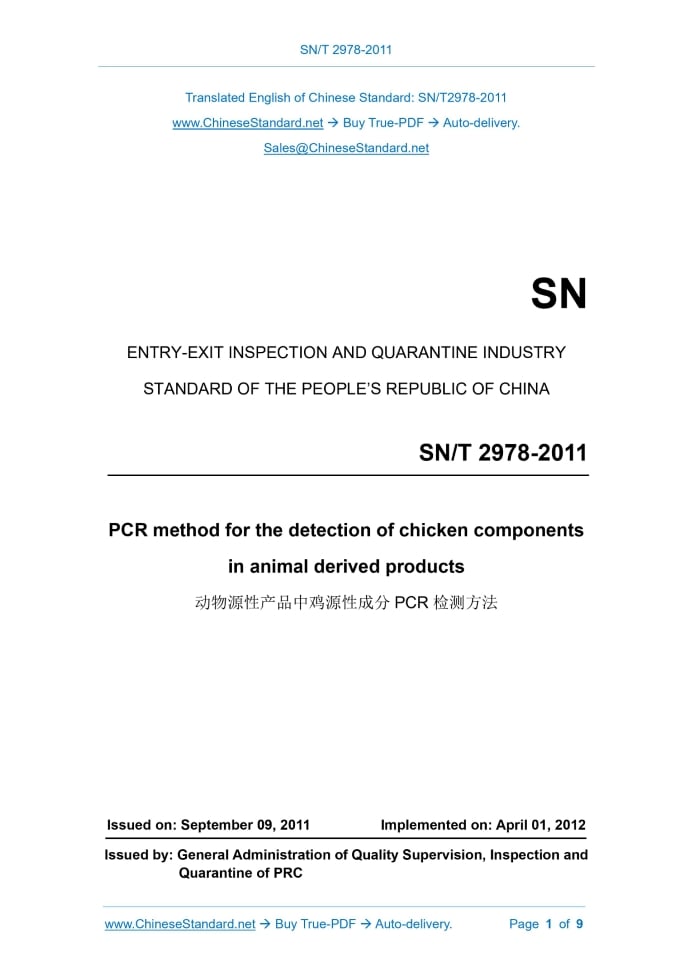
---This is an excerpt. Full copy of true-PDF in English version (including equations, symbols, images, flow-chart, tables, and figures etc.), auto-downloaded/delivered in 9 seconds, can be purchased online: https://www.ChineseStandard.net/PDF.aspx/SNT2978-2011SN ENTRY-EXIT INSPECTION AND QUARANTINE INDUSTRY STANDARD OF THE PEOPLE’S REPUBLIC OF CHINA PCR method for the detection of chicken components in animal derived products ISSUED ON: SEPTEMBER 09, 2011 IMPLEMENTED ON: APRIL 01, 2012 Issued by: General Administration of Quality Supervision, Inspection and Quarantine of PRC
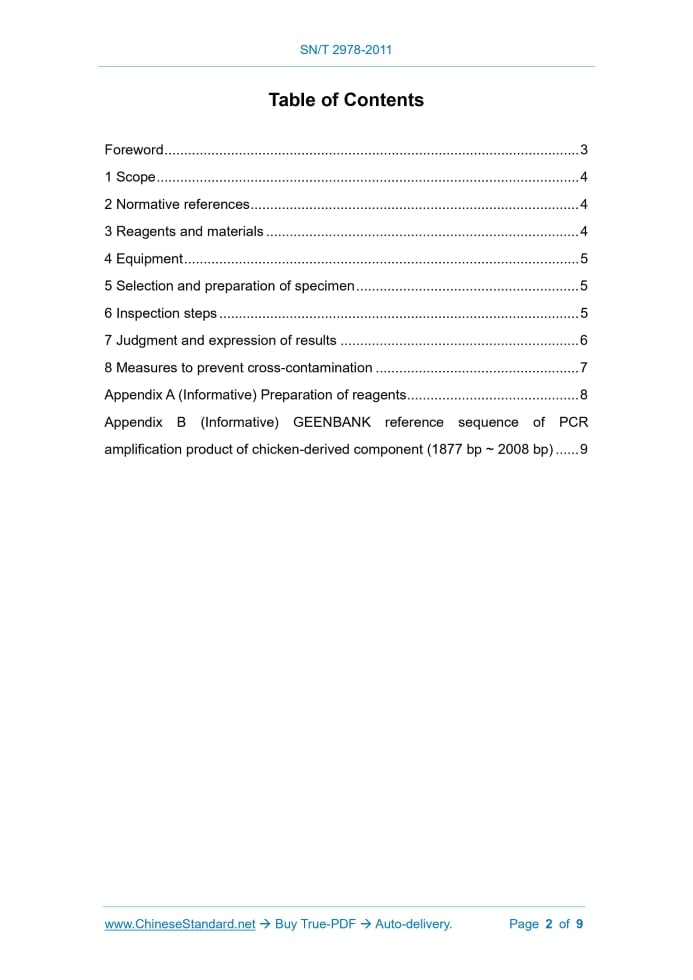
Table of Contents
Foreword ... 3 1 Scope ... 4 2 Normative references ... 4 3 Reagents and materials ... 4 4 Equipment ... 5 5 Selection and preparation of specimen ... 5 6 Inspection steps ... 5 7 Judgment and expression of results ... 6 8 Measures to prevent cross-contamination ... 7 Appendix A (Informative) Preparation of reagents ... 8 Appendix B (Informative) GEENBANK reference sequence of PCR amplification product of chicken-derived component (1877 bp ~ 2008 bp) ... 9 PCR method for the detection of chicken components in animal derived products1 Scope
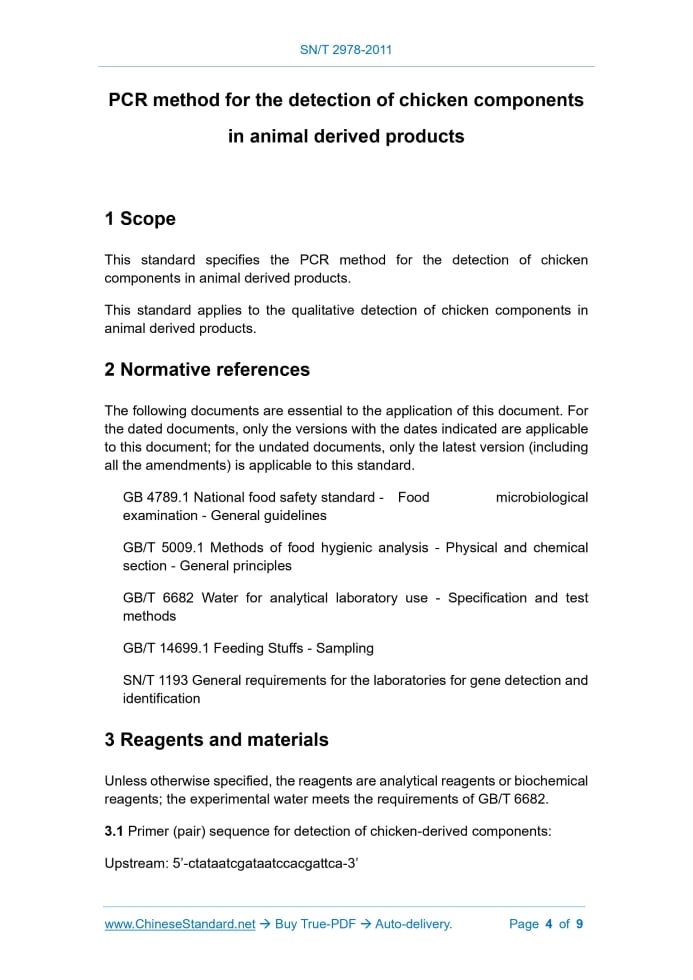
This standard specifies the PCR method for the detection of chicken components in animal derived products. This standard applies to the qualitative detection of chicken components in animal derived products.2 Normative references
The following documents are essential to the application of this document. For the dated documents, only the versions with the dates indicated are applicable to this document; for the undated documents, only the latest version (including all the amendments) is applicable to this standard. GB 4789.1 National food safety standard - Food microbiological examination - General guidelines GB/T 5009.1 Methods of food hygienic analysis - Physical and chemical section - General principles GB/T 6682 Water for analytical laboratory use - Specification and test methods GB/T 14699.1 Feeding Stuffs - Sampling SN/T 1193 General requirements for the laboratories for gene detection and identification3 Reagents and materials
Unless otherwise specified, the reagents are analytical reagents or biochemical reagents; the experimental water meets the requirements of GB/T 6682. 3.1 Primer (pair) sequence for detection of chicken-derived components: Upstream: 5’-ctataatcgataatccacgattca-3’ shake to mix it uniformly from time to time. Centrifuge it at 12000 r/min for 5 min. Transfer the supernatant into a clean centrifuge tube. Add 400 μL of chloroform/isoamyl alcohol (24:1). Mix well. Centrifuge it at 12000 r/min for 5 min. Take the supernatant. Add 0.8 times the volume of isopropanol. Precipitate it. Centrifuge it at 12000 r/min for 5 min. Discard the supernatant. Use the 75% ethanol to rinse it once. Dry it naturally. Add 50 μL of double-distilled water (ddH2O), to dissolve the precipitate, to make a DNA solution. Prepare for use. It may also use the equivalent DNA extraction kit, to extract sample DNA. 6.2 PCR amplification Reaction system: The volume is 25 μL, including 12.5 μL of 2 X PCR buffer, 5 μL of dNTPs (2 mmol/L), 0.5 μL of primer pair (10 nmol/L), 1 μL of DNA polymerase (1 U/μL), 5 μL of template DNA (100 ng ± 50 ng DNA), 0.5 μL of double-distilled water. Reaction conditions: PCR reaction conditions vary slightly with different PCR instruments. Perform pre-denaturation at 94 °C for 1 min ~ 3 min, denaturation at 94 °C for 30 s ~ 60 s, annealing at 63 °C for 30 s ~ 60 s, extension at 72 °C for 30 s ~ 60 s, in a total of 35 cycles; perform extension at 72 °C for 5 min; store it at 4 °C. In the detection process, set a positive control, a negative control, a blank control, respectively. 6.3 Electrophoresis detection of the amplified product of PCR Weigh 1.5 g of agarose in 100 mL of electrophoresis buffer. Heat it to fully melt. Add ethidium bromide to a final concentration of 0.5 μg/mL. Prepare a gel. Add the electrophoresis buffer to the electrophoresis tank, so that the liquid level has just covered the gel. Mix 8 μL of each amplified product of PCR with 3 μL of sample-added buffer. Apply the sample. Keep constant voltage at 9 V/cm. Carry out electrophoresis, until the bromophenol blue indicator migrates to the middle of the gel. Observe and record the electrophoresis results under the gel imager. 6.4 Sequencing When the electrophoresis result is suspiciously positive, the PCR amplification product is subjected to DNA sequencing.7 Judgment and expression of results
7.1 Electrophoresis and sequence analysis of PCR amplification product ......Source: Above contents are excerpted from the full-copy PDF -- translated/reviewed by: www.ChineseStandard.net / Wayne Zheng et al.