QC/T 893-2011 PDF English
Price & Delivery
US$85.00 · In stock · Download in 9 secondsQC/T 893-2011: Failure classification and assessment of electrical machine system for electric vehicle
Delivery: 9 seconds. True-PDF full-copy in English & invoice will be downloaded + auto-delivered via email. See step-by-step procedure
Status: Valid
| Standard ID | USD | BUY PDF | Delivery | Standard Title (Description) | Status |
| QC/T 893-2011 | 85 | Add to Cart | Auto, 9 seconds. | Failure classification and assessment of electrical machine system for electric vehicle | Valid |
Click to Preview this PDF
QC/T 893-2011: Failure classification and assessment of electrical machine system for electric vehicle
---This is an excerpt. Full copy of true-PDF in English version (including equations, symbols, images, flow-chart, tables, and figures etc.), auto-downloaded/delivered in 9 seconds, can be purchased online: https://www.ChineseStandard.net/PDF.aspx/QCT893-2011
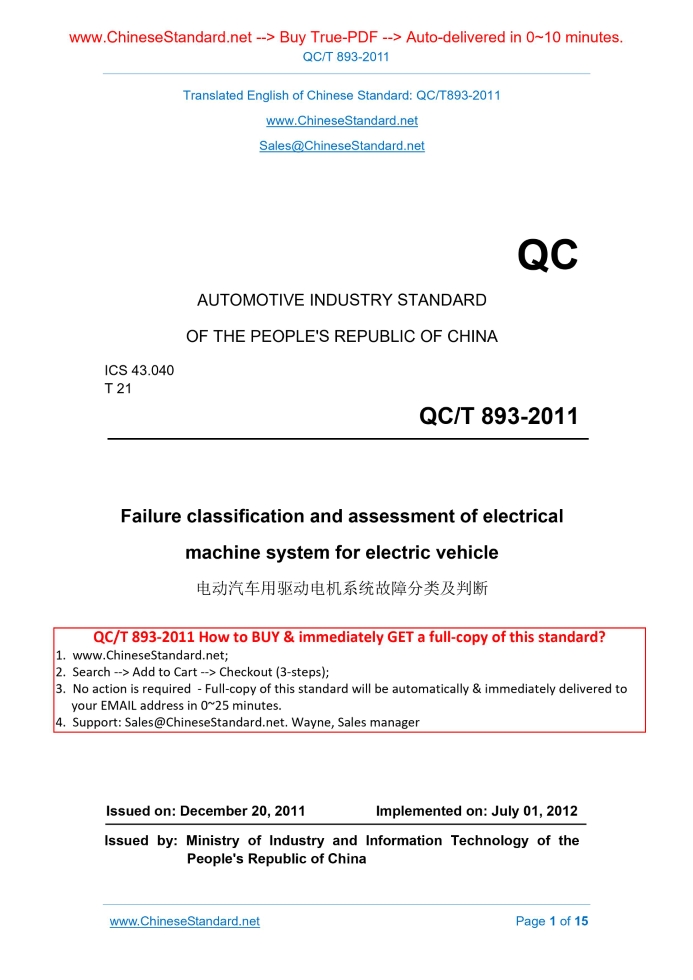
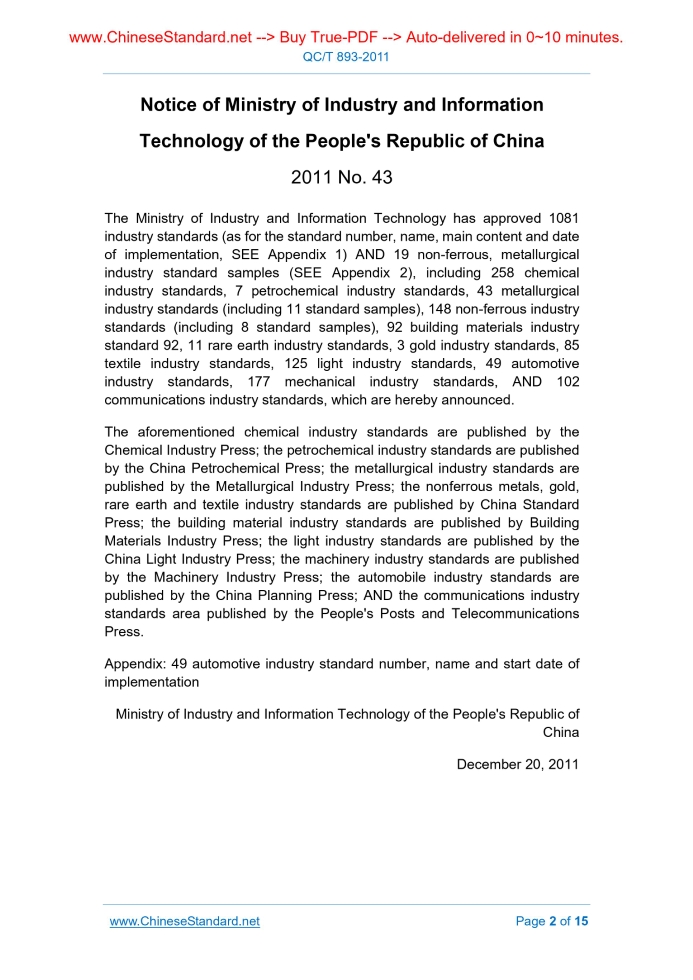
QC AUTOMOTIVE INDUSTRY STANDARD OF THE PEOPLE'S REPUBLIC OF CHINA ICS 43.040 T 21 Failure classification and assessment of electrical machine system for electric vehicle Issued on. DECEMBER 20, 2011 Implemented on. JULY 01, 2012 Issued by. Ministry of Industry and Information Technology of the People's Republic of China Notice of Ministry of Industry and Information Technology of the People's Republic of China 2011 No. 43
Table of Contents
Foreword... 6 1 Scope... 7 2 Normative references... 7 3 Terms and definitions... 7 4 Judgment principles of failure modes... 7 5 Failure classification... 8 Appendix A (Normative) Drive motor system failure mode... 9 APPENDIX B (Informative) Examples of failure mode and classification of drive motor system... 12Foreword
This standard was drafted in accordance with the rules specified in GB/T 1.1-2009. This standard was proposed by AND shall be under the jurisdiction of the National Automotive Standardization Technical Committee (SAC/TC 114). The drafting organizations of this standard. Hunan CSR Times Electric Vehicle Co., Ltd., Beijing Institute of Technology, Shanghai Electric Drive Co., Ltd., China Automotive Technology Research Center, Tianjin Qingyuan Electric Vehicle Co., Ltd., Chery Automobile Co., Ltd., Shanghai Motor Vehicle Testing Center, Institute of Electrical Engineering of Chinese Academy of Sciences, Harbin Institute of Technology, Beijing Automotive New Energy Vehicle Co., Ltd., Shanghai Automotive Technology Co., Ltd. China Automotive Engineering Research Institute Co., Ltd. The main drafters of this standard. Guo Shijun, Guo Shuying, Wu Lixun, Song Qiang, Zhang Qin, Guo Wei, Du Zhiming, Lin Weiyi, Fu Zhenxing, Cui Shumei, Wen Xuhui, Meng Xiangfeng, Li Yujun, Miu Wenquan, Luo Yongping. Failure classification and assessment of electrical machine system for electric vehicle1 Scope
This standard specifies the failure judgment principles, failure modes, and failure classification of the electrical machine system for electric vehicle. This standard applies to all types of electrical machine system for electric vehicle.2 Normative references
The following documents are essential to the application of this document. For the dated documents, only the versions with the dates indicated are applicable to this document; for the undated documents, only the latest version (including all the amendments) are applicable to this Standard. GB/T 18488 (all parts) - The electrical machines and controllers for electric vehicles - Technical specification GB/T 19596 Terminology of electric vehicles3 Terms and definitions
The terms and definitions established in GB/T 19596, GB/T 18488 (all parts) and the terms in Appendix A apply to this standard.4 Judgment principles of failure modes
4.1 In principle, it shall use the failure mode of the drive motor (hereinafter referred to as the motor), the components of the motor controller, and the wiring between them to describe the failure. 4.4 As for the association failure occurred due to other failure, it shall use the failure of the highest level caused to classify the failure. 4.5 When the failure is classified, if the failure extends, it shall, in accordance with Chapter 5, conduct qualitative identification based on levels.5 Failure classification
Based on the hazardous degree, the failure can be divided into four levels. fatal failure, serious failure, ordinary failure, and minor failure.Appendix A
(Normative) Drive motor system failure mode A.1 Damage failure mode Damage failure modes mainly include. A.2 Degradation failure mode Degradation failure modes mainly include. A.4 Offset failure mode Offset failure mode mainly includes. - Gap deviation. The phenomenon that the function is affected by the contact gap or fit clearance exceeding the specified value, such as the gap deviation of contactor, bearing, and so on. - Interference. The phenomenon of collision or abnormal friction between moving parts, such as the interference between fan blades and wind hood, speed sensor and tooth plate, motor stator and rotor, and so on. - Performance offset. The instability of critical output, such as the oscillation or instability of output torque and speed. A.5 Blockage and leakage failure modes Blockage and leakage failure modes mainly include. - Blockage. The phenomenon that the fluid in the pipeline cannot flow OR flow smoothly, such as the pipeline of the liquid-cooled motor and controller.APPENDIX B
(Informative) Examples of failure mode and classification of drive motor system Drive motor system failure modes include, but are not limited to, those in Table B.1 ~ Table B.4. QC/T 893-2011 QC AUTOMOTIVE INDUSTRY STANDARD OF THE PEOPLE'S REPUBLIC OF CHINA ICS 43.040 T 21 Failure classification and assessment of electrical machine system for electric vehicle Issued on. DECEMBER 20, 2011 Implemented on. JULY 01, 2012 Issued by. Ministry of Industry and Information Technology of the People's Republic of China Notice of Ministry of Industry and Information Technology of the People's Republic of China 2011 No. 43Table of Contents
Foreword... 6 1 Scope... 7 2 Normative references... 7 3 Terms and definitions... 7 4 Judgment principles of failure modes... 7 5 Failure classification... 8 Appendix A (Normative) Drive motor system failure mode... 9 APPENDIX B (Informative) Examples of failure mode and classification of drive motor system... 12Foreword
This standard was drafted in accordance with the rules specified in GB/T 1.1-2009. This standard was proposed by AND shall be under the jurisdiction of the National Automotive Standardization Technical Committee (SAC/TC 114). The drafting organizations of this standard. Hunan CSR Times Electric Vehicle Co., Ltd., Beijing Institute of Technology, Shanghai Electric Drive Co., Ltd., China Automotive Technology Research Center, Tianjin Qingyuan Electric Vehicle Co., Ltd., Chery Automobile Co., Ltd., Shanghai Motor Vehicle Testing Center, Institute of Electrical Engineering of Chinese Academy of Sciences, Harbin Institute of Technology, Beijing Automotive New Energy Vehicle Co., Ltd., Shanghai Automotive Technology Co., Ltd. China Automotive Engineering Research Institute Co., Ltd. The main drafters of this standard. Guo Shijun, Guo Shuying, Wu Lixun, Song Qiang, Zhang Qin, Guo Wei, Du Zhiming, Lin Weiyi, Fu Zhenxing, Cui Shumei, Wen Xuhui, Meng Xiangfeng, Li Yujun, Miu Wenquan, Luo Yongping. Failure classification and assessment of electrical machine system for electric vehicle1 Scope
This standard specifies the failure judgment principles, failure modes, and failure classification of the electrical machine system for electric vehicle. This standard applies to all types of electrical machine system for electric vehicle.2 Normative references
The following documents are essential to the application of this document. For the dated documents, only the versions with the dates indicated are applicable to this document; for the undated documents, only the latest version (including all the amendments) are applicable to this Standard. GB/T 18488 (all parts) - The electrical machines and controllers for electric vehicles - Technical specification GB/T 19596 Terminology of electric vehicles3 Terms and definitions
The terms and definitions established in GB/T 19596, GB/T 18488 (all parts) and the terms in Appendix A apply to this standard.4 Judgment principles of failure modes
4.1 In principle, it shall use the failure mode of the drive motor (hereinafter referred to as the motor), the components of the motor controller, and the wiring between them to describe the failure. 4.4 As for the association failure occurred due to other failure, it shall use the failure of the highest level caused to classify the failure. 4.5 When the failure is classified, if the failure extends, it shall, in accordance with Chapter 5, conduct qualitative identification based on levels.5 Failure classification
Based on the hazardous degree, the failure can be divided into four levels. fatal failure, serious failure, ordinary failure, and minor failure.Appendix A
(Normative) Drive motor system failure mode A.1 Damage failure mode Damage failure modes mainly include. A.2 Degradation failure mode Degradation failure modes mainly include. A.4 Offset failure mode Offset failure mode mainly includes. - Gap deviation. The phenomenon that the function is affected by the contact gap or fit clearance exceeding the specified value, such as the gap deviation of contactor, bearing, and so on. - Interference. The phenomenon of collision or abnormal friction between moving parts, such as the interference between fan blades and wind hood, speed sensor and tooth plate, motor stator and rotor, and so on. - Performance offset. The instability of critical output, such as the oscillation or instability of output torque and speed. A.5 Blockage and leakage failure modes Blockage and leakage failure modes mainly include. - Blockage. The phenomenon that the fluid in the pipeline cannot flow OR flow smoothly, such as the pipeline of the liquid-cooled motor and controller.APPENDIX B
(Informative) Examples of failure mode and classification of drive motor system Drive motor system failure modes include, but are not limited to, those in Table B.1 ~ Table B.4. ......Source: Above contents are excerpted from the full-copy PDF -- translated/reviewed by: www.ChineseStandard.net / Wayne Zheng et al.