QB/T 1375-2015 PDF English
Price & Delivery
US$90.00 · In stock · Download in 9 secondsQB/T 1375-2015: Canned fish
Delivery: 9 seconds. True-PDF full-copy in English & invoice will be downloaded + auto-delivered via email. See step-by-step procedure
Status: Valid
QB/T 1375: Historical versions
| Standard ID | USD | BUY PDF | Delivery | Standard Title (Description) | Status |
| QB/T 1375-2015 | 90 | Add to Cart | Auto, 9 seconds. | Canned fish | Valid |
| QB/T 1375-1991 | 199 | Add to Cart | 2 days | Canned tried fish | Obsolete |
Click to Preview this PDF
Similar standards
QB/T 1375-2015: Canned fish
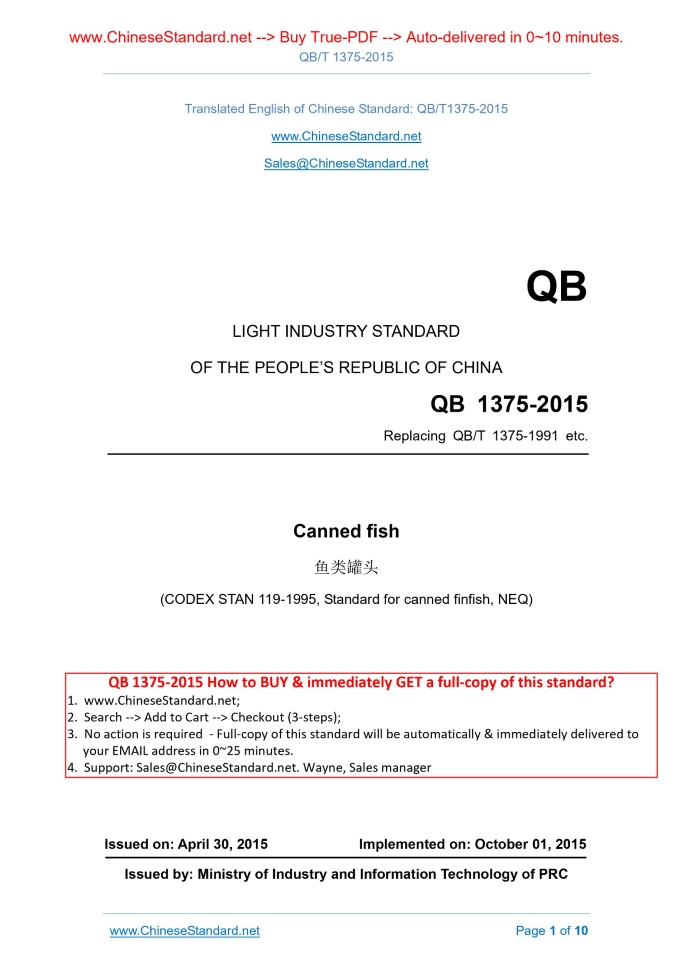
---This is an excerpt. Full copy of true-PDF in English version (including equations, symbols, images, flow-chart, tables, and figures etc.), auto-downloaded/delivered in 9 seconds, can be purchased online: https://www.ChineseStandard.net/PDF.aspx/QBT1375-2015QB LIGHT INDUSTRY STANDARD QB 1375-2015 Replacing QB/T 1375-1991 etc. Canned fish (CODEX STAN 119-1995, Standard for canned finfish, NEQ) Issued on. APRIL 30, 2015 Implemented on. OCTOBER 01, 2015 Issued by. Ministry of Industry and Information Technology of PRC
Table of Contents
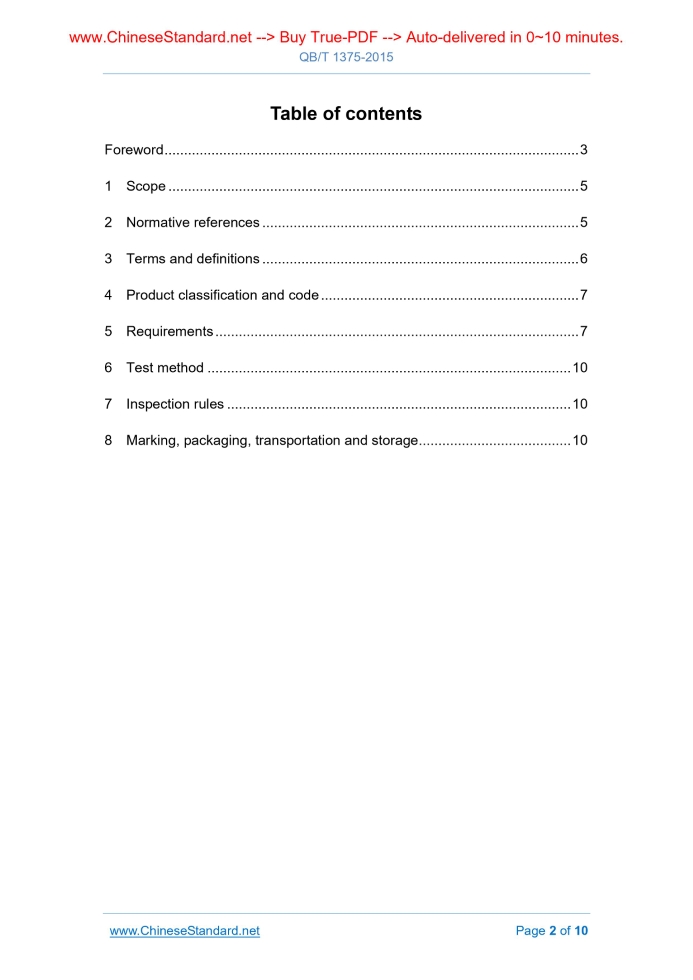
Foreword... 3 1 Scope... 5 2 Normative references... 5 3 Terms and definitions... 6 4 Product classification and code... 7 5 Requirements... 7 6 Test method... 10 7 Inspection rules... 10 8 Marking, packaging, transportation and storage... 10Foreword
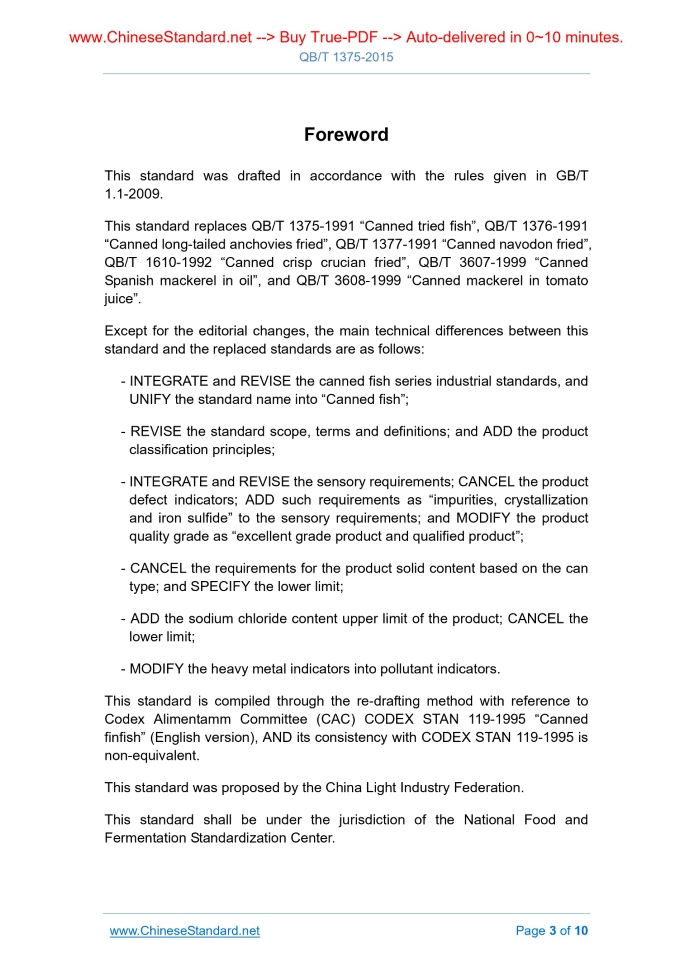
This standard was drafted in accordance with the rules given in GB/T 1.1-2009. This standard replaces QB/T 1375-1991 “Canned tried fish”, QB/T 1376-1991 “Canned long-tailed anchovies fried”, QB/T 1377-1991 “Canned navodon fried”, QB/T 1610-1992 “Canned crisp crucian fried”, QB/T 3607-1999 “Canned Spanish mackerel in oil”, and QB/T 3608-1999 “Canned mackerel in tomato juice”. Except for the editorial changes, the main technical differences between this standard and the replaced standards are as follows. - INTEGRATE and REVISE the canned fish series industrial standards, and UNIFY the standard name into “Canned fish”; - REVISE the standard scope, terms and definitions; and ADD the product classification principles; - INTEGRATE and REVISE the sensory requirements; CANCEL the product defect indicators; ADD such requirements as “impurities, crystallization and iron sulfide” to the sensory requirements; and MODIFY the product quality grade as “excellent grade product and qualified product”; - CANCEL the requirements for the product solid content based on the can type; and SPECIFY the lower limit; - ADD the sodium chloride content upper limit of the product; CANCEL the lower limit; - MODIFY the heavy metal indicators into pollutant indicators. This standard is compiled through the re-drafting method with reference to Codex Alimentamm Committee (CAC) CODEX STAN 119-1995 “Canned finfish” (English version), AND its consistency with CODEX STAN 119-1995 is non-equivalent. This standard was proposed by the China Light Industry Federation. This standard shall be under the jurisdiction of the National Food and Fermentation Standardization Center. The drafting organizations of this standard. China Food and Fermentation Industry Research Institute, China Canned Industry Association, Xiamen Gulong Food Co., Ltd., Shanghai Meilin Zhengguang Co., Ltd., Taixiang Group Technology Development Co., Ltd., Liaoning Dalian Ocean Fishery Group, Xiamen Baolintai Seafood Co., Ltd., Guangdong Ganzhu Canned Food Co., Ltd., Penglai Jinglu Fisheries Co., Ltd., Dalian Zhenxin Canned Food Co., Ltd., Fujian Zishan Group Co., Ltd. The main drafters of this standard. Qiu Kai, Zhang Wei, Zhang Xingsong, Li Zhijun, Chen Jun, Li Yujin, Lv Daqiang, Lin Baochun, Liu Yuanping, Xie Dehai, Lin Dong, Yu Bo. This Standard replaces the standard previously issued as follows. - QB/T 1375-1991, QB/T 1376-1991, QB/T 1377-1991, QB/T 1610-1992, QB/T 3607-1999, QB/T 3608-1999 Canned fish1 Scope
This standard specifies the terms and definitions, product classification and code, requirements, test methods, inspection rules and marking, packaging, transportation, and storage of canned fish. This standard applies to the canned food using the fish as raw materials which had been subjected to processing treatment, being smoked or not smoked, seasoning or not seasoning, being canned (bagged), addition of oil or seasoning (materials) or not, sealing, sterilization, and cooling.2 Normative references
The following documents are essential to the application of this document. For the dated documents, only the versions with the dates indicated are applicable to this document; for the undated documents, only the latest version (including all the amendments) are applicable to this Standard. GB 317 White granulated sugar GB 2712 Hygienic standard for fermented bean product GB 2716 Hygienic standard for edible vegetable oils GB 2717 Hygienic standard for soy sauce GB 2733 Hygienic standard for fresh and frozen marine products of animal origin GB 2760 National food safety standard - Hygienic standards for uses of food additives GB 2762 National food safety standard - Maximum levels of contaminants in foods3 Terms and definitions
The following terms and definitions apply to this document. 3.1 Flake or grated fish It refers to the fragmented fish as naturally formed in the fish processing. 3.2 Flabby The fish is broken or scattered, without a sense of tenacity.4 Product classification and code
4.1 Product classification It is divided based on the production, processing and seasoning methods into. canned fish in oil, canned fish steamed, and canned fish seasoned (spiced, braised, spicy, fermented soya beans, tomato juice, and smoked).5 Requirements
5.1 Raw and auxiliary materials 5.1.1 Fish It shall use the fresh or frozen fish, the quality of which shall comply with the requirements of GB 2733. 5.1.6 Monosodium L-glutamate It shall comply with the requirements of GB/T 8967. 5.1.7 White granulated sugar It shall comply with the requirements of GB 317. 5.1.8 Chinese rice wine It shall comply with the requirements of GB/T 13662. 5.1.9 Tomato juice It shall comply with the requirements of GB/T 14215 5.1.10 Flavor It shall comply with the requirements of GB/T 15691. 5.1.11 Production water It shall comply with the requirements of GB 5749. 5.1.12 Other ingredients and auxiliary materials It shall comply with the requirements of the relevant standards and regulations. 5.1.13 Relevant requirements on canned frying mud carps with fermented soybean 5.3 Physiochemical indicators The physiochemical indicators of the product shall comply with the requirements of Table 2 (except for the canned frying mud carps and canned tuna). 5.4 Contaminant indicator It shall comply with the requirements of GB 2762. 5.5 Microorganism indicator It shall comply with the sterilization requirements in canned food industry. 5.6 Food additives It shall comply with the requirements of GB 2760.6 Test method
6.1 Sensory requirements, net content, solid content CONDUCT test in accordance with the methods as specified in GB/T 10786. 6.2 Chloride content CONDUCT test in accordance with the methods as specified in GB/T 12457. 6.4 Microbiological indicator CONDUCT test in accordance with the methods as specified in GB 4789.26.7 Inspection rules
It shall comply with the provisions of QB/T 1006, wherein the sensory requirements, net content, solid content, sodium chloride content, and the microbiological indicators belong to exit-factory test items.8 Marking, packaging, transportation and storage
It shall comply with the relevant provisions of QB/T 4631. QB/T 1375-2015 QB LIGHT INDUSTRY STANDARD QB 1375-2015 Replacing QB/T 1375-1991 etc. Canned fish (CODEX STAN 119-1995, Standard for canned finfish, NEQ) Issued on. APRIL 30, 2015 Implemented on. OCTOBER 01, 2015 Issued by. Ministry of Industry and Information Technology of PRCTable of Contents
Foreword... 3 1 Scope... 5 2 Normative references... 5 3 Terms and definitions... 6 4 Product classification and code... 7 5 Requirements... 7 6 Test method... 10 7 Inspection rules... 10 8 Marking, packaging, transportation and storage... 10Foreword
This standard was drafted in accordance with the rules given in GB/T 1.1-2009. This standard replaces QB/T 1375-1991 “Canned tried fish”, QB/T 1376-1991 “Canned long-tailed anchovies fried”, QB/T 1377-1991 “Canned navodon fried”, QB/T 1610-1992 “Canned crisp crucian fried”, QB/T 3607-1999 “Canned Spanish mackerel in oil”, and QB/T 3608-1999 “Canned mackerel in tomato juice”. Except for the editorial changes, the main technical differences between this standard and the replaced standards are as follows. - INTEGRATE and REVISE the canned fish series industrial standards, and UNIFY the standard name into “Canned fish”; - REVISE the standard scope, terms and definitions; and ADD the product classification principles; - INTEGRATE and REVISE the sensory requirements; CANCEL the product defect indicators; ADD such requirements as “impurities, crystallization and iron sulfide” to the sensory requirements; and MODIFY the product quality grade as “excellent grade product and qualified product”; - CANCEL the requirements for the product solid content based on the can type; and SPECIFY the lower limit; - ADD the sodium chloride content upper limit of the product; CANCEL the lower limit; - MODIFY the heavy metal indicators into pollutant indicators. This standard is compiled through the re-drafting method with reference to Codex Alimentamm Committee (CAC) CODEX STAN 119-1995 “Canned finfish” (English version), AND its consistency with CODEX STAN 119-1995 is non-equivalent. This standard was proposed by the China Light Industry Federation. This standard shall be under the jurisdiction of the National Food and Fermentation Standardization Center. The drafting organizations of this standard. China Food and Fermentation Industry Research Institute, China Canned Industry Association, Xiamen Gulong Food Co., Ltd., Shanghai Meilin Zhengguang Co., Ltd., Taixiang Group Technology Development Co., Ltd., Liaoning Dalian Ocean Fishery Group, Xiamen Baolintai Seafood Co., Ltd., Guangdong Ganzhu Canned Food Co., Ltd., Penglai Jinglu Fisheries Co., Ltd., Dalian Zhenxin Canned Food Co., Ltd., Fujian Zishan Group Co., Ltd. The main drafters of this standard. Qiu Kai, Zhang Wei, Zhang Xingsong, Li Zhijun, Chen Jun, Li Yujin, Lv Daqiang, Lin Baochun, Liu Yuanping, Xie Dehai, Lin Dong, Yu Bo. This Standard replaces the standard previously issued as follows. - QB/T 1375-1991, QB/T 1376-1991, QB/T 1377-1991, QB/T 1610-1992, QB/T 3607-1999, QB/T 3608-1999 Canned fish1 Scope
This standard specifies the terms and definitions, product classification and code, requirements, test methods, inspection rules and marking, packaging, transportation, and storage of canned fish. This standard applies to the canned food using the fish as raw materials which had been subjected to processing treatment, being smoked or not smoked, seasoning or not seasoning, being canned (bagged), addition of oil or seasoning (materials) or not, sealing, sterilization, and cooling.2 Normative references
The following documents are essential to the application of this document. For the dated documents, only the versions with the dates indicated are applicable to this document; for the undated documents, only the latest version (including all the amendments) are applicable to this Standard. GB 317 White granulated sugar GB 2712 Hygienic standard for fermented bean product GB 2716 Hygienic standard for edible vegetable oils GB 2717 Hygienic standard for soy sauce GB 2733 Hygienic standard for fresh and frozen marine products of animal origin GB 2760 National food safety standard - Hygienic standards for uses of food additives GB 2762 National food safety standard - Maximum levels of contaminants in foods3 Terms and definitions
The following terms and definitions apply to this document. 3.1 Flake or grated fish It refers to the fragmented fish as naturally formed in the fish processing. 3.2 Flabby The fish is broken or scattered, without a sense of tenacity.4 Product classification and code
4.1 Product classification It is divided based on the production, processing and seasoning methods into. canned fish in oil, canned fish steamed, and canned fish seasoned (spiced, braised, spicy, fermented soya beans, tomato juice, and smoked).5 Requirements
5.1 Raw and auxiliary materials 5.1.1 Fish It shall use the fresh or frozen fish, the quality of which shall comply with the requirements of GB 2733. 5.1.6 Monosodium L-glutamate It shall comply with the requirements of GB/T 8967. 5.1.7 White granulated sugar It shall comply with the requirements of GB 317. 5.1.8 Chinese rice wine It shall comply with the requirements of GB/T 13662. 5.1.9 Tomato juice It shall comply with the requirements of GB/T 14215 5.1.10 Flavor It shall comply with the requirements of GB/T 15691. 5.1.11 Production water It shall comply with the requirements of GB 5749. 5.1.12 Other ingredients and auxiliary materials It shall comply with the requirements of the relevant standards and regulations. 5.1.13 Relevant requirements on canned frying mud carps with fermented soybean 5.3 Physiochemical indicators The physiochemical indicators of the product shall comply with the requirements of Table 2 (except for the canned frying mud carps and canned tuna). 5.4 Contaminant indicator It shall comply with the requirements of GB 2762. 5.5 Microorganism indicator It shall comply with the sterilization requirements in canned food industry. 5.6 Food additives It shall comply with the requirements of GB 2760.6 Test method
6.1 Sensory requirements, net content, solid content CONDUCT test in accordance with the methods as specified in GB/T 10786. 6.2 Chloride content CONDUCT test in accordance with the methods as specified in GB/T 12457. 6.4 Microbiological indicator CONDUCT test in accordance with the methods as specified in GB 4789.26.7 Inspection rules
It shall comply with the provisions of QB/T 1006, wherein the sensory requirements, net content, solid content, sodium chloride content, and the microbiological indicators belong to exit-factory test items.8 Marking, packaging, transportation and storage
It shall comply with the relevant provisions of QB/T 4631. ......Source: Above contents are excerpted from the full-copy PDF -- translated/reviewed by: www.ChineseStandard.net / Wayne Zheng et al.