NB/T 10902-2021 PDF English
Price & Delivery
US$200.00 · In stock · Download in 9 secondsNB/T 10902-2021: 20 kW and below off-board DC charger technical conditions and installation requirements
Delivery: 9 seconds. True-PDF full-copy in English & invoice will be downloaded + auto-delivered via email. See step-by-step procedure
Status: Valid
| Standard ID | USD | BUY PDF | Delivery | Standard Title (Description) | Status |
| NB/T 10902-2021 | 200 | Add to Cart | Auto, 9 seconds. | 20 kW and below off-board DC charger technical conditions and installation requirements | Valid |
Click to Preview this PDF
Similar standards
NB/T 10902-2021: 20 kW and below off-board DC charger technical conditions and installation requirements
---This is an excerpt. Full copy of true-PDF in English version (including equations, symbols, images, flow-chart, tables, and figures etc.), auto-downloaded/delivered in 9 seconds, can be purchased online: https://www.ChineseStandard.net/PDF.aspx/NBT10902-2021
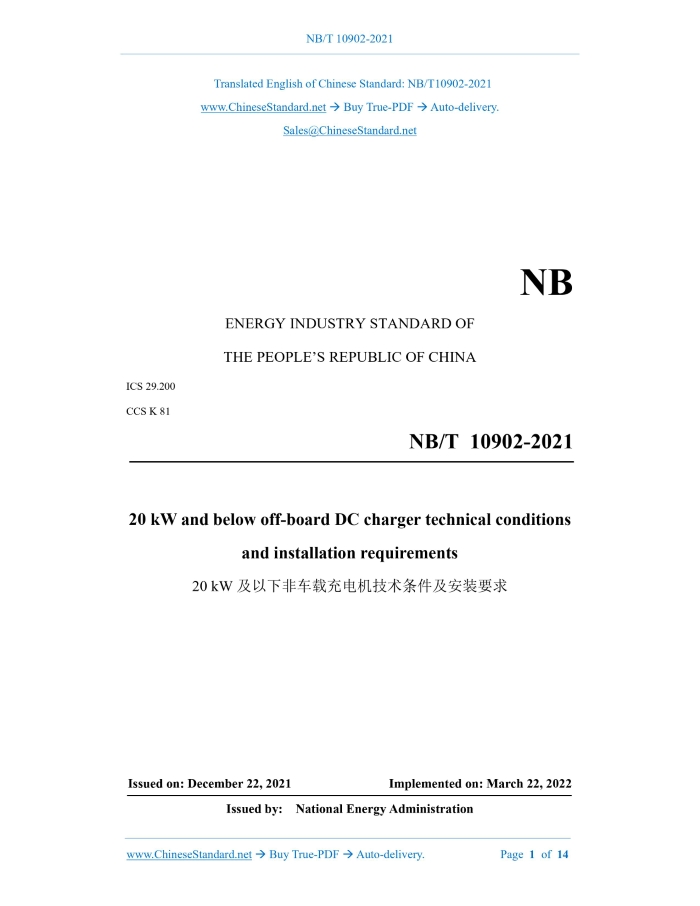
NB ENERGY INDUSTRY STANDARD OF THE PEOPLE’S REPUBLIC OF CHINA ICS 29.200 CCS K 81 20 kW and below off-board DC charger technical conditions and installation requirements ISSUED ON: DECEMBER 22, 2021 IMPLEMENTED ON: MARCH 22, 2022 Issued by: National Energy Administration
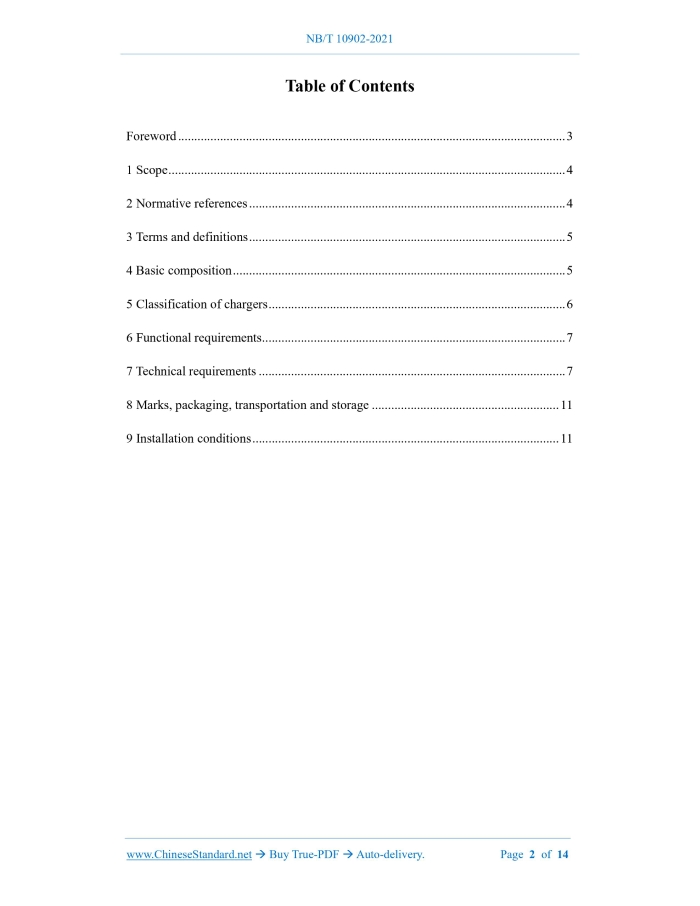
Table of Contents
Foreword ... 3 1 Scope ... 4 2 Normative references ... 4 3 Terms and definitions ... 5 4 Basic composition ... 5 5 Classification of chargers ... 6 6 Functional requirements ... 7 7 Technical requirements ... 7 8 Marks, packaging, transportation and storage ... 11 9 Installation conditions ... 11 20 kW and below off-board DC charger technical conditions and installation requirements1 Scope
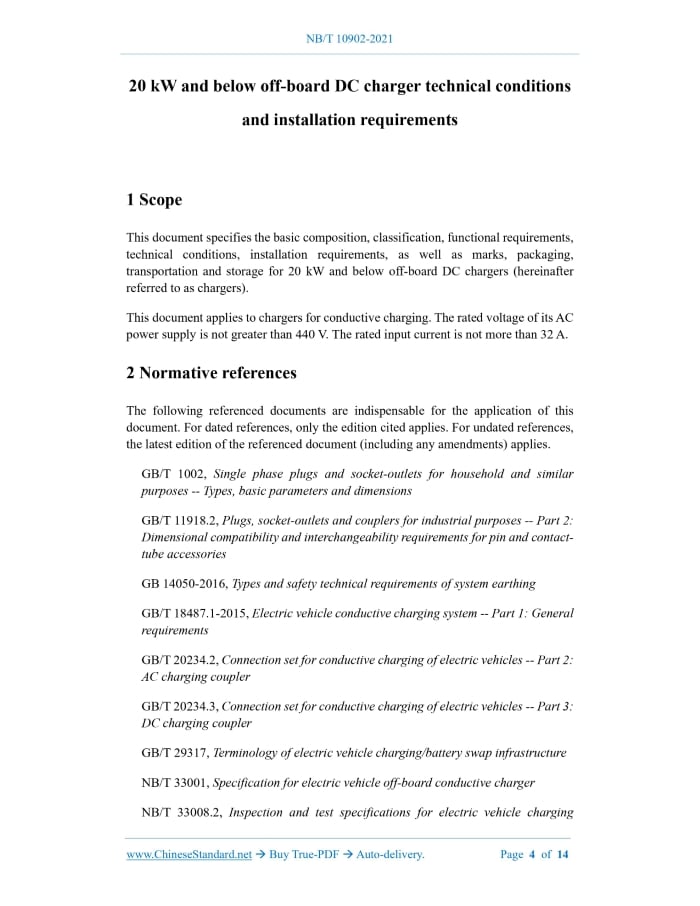
This document specifies the basic composition, classification, functional requirements, technical conditions, installation requirements, as well as marks, packaging, transportation and storage for 20 kW and below off-board DC chargers (hereinafter referred to as chargers). This document applies to chargers for conductive charging. The rated voltage of its AC power supply is not greater than 440 V. The rated input current is not more than 32 A.2 Normative references
The following referenced documents are indispensable for the application of this document. For dated references, only the edition cited applies. For undated references, the latest edition of the referenced document (including any amendments) applies. GB/T 1002, Single phase plugs and socket-outlets for household and similar purposes -- Types, basic parameters and dimensions GB/T 11918.2, Plugs, socket-outlets and couplers for industrial purposes -- Part 2: Dimensional compatibility and interchangeability requirements for pin and contact- tube accessories GB 14050-2016, Types and safety technical requirements of system earthing GB/T 18487.1-2015, Electric vehicle conductive charging system -- Part 1: General requirements GB/T 20234.2, Connection set for conductive charging of electric vehicles -- Part 2: AC charging coupler GB/T 20234.3, Connection set for conductive charging of electric vehicles -- Part 3: DC charging coupler GB/T 29317, Terminology of electric vehicle charging/battery swap infrastructure NB/T 33001, Specification for electric vehicle off-board conductive charger NB/T 33008.2, Inspection and test specifications for electric vehicle charging equipment -- Part 2: A. C. charging spot NB/T 42077, In-Cable Control and Protective Device for mode 2 charging of electric road vehicles (IC-CPD)3 Terms and definitions
For the purposes of this document, the terms and definitions defined in GB/T 29317, NB/T 33001 as well as the followings apply. 3.1 power access mode Ⅰ When the charger is connected to the AC grid, use a plug and socket that complies with GB/T 1002. The power supply side uses phase wires, neutral wires and grounding protective conductors. The cable assembly with the plug is a part of the charger. 3.2 power access mode II When the charger is connected to the AC power grid, use a plug that meets the requirements of GB/T 11918.2 or a vehicle socket specified in GB/T 20234.2. The power side uses the phase line, neutral line and grounding protective conductor. The cable assembly or vehicle socket with a plug is part of the charger. 3.3 power access mode III When the charger is connected to the AC grid, a cable is used to permanently connect the charging device to the AC grid. Use the phase, neutral and earth protective conductors on the mains side. 3.4 main body of the charger The part of the charger except the cable assembly.4 Basic composition
The basic composition of the charger shall include power supply input, power conversion unit, output switch unit, charging cable and vehicle plug, as well as control power supply, charging control unit, human-computer interaction unit. It may include functional units such as metering. Public operation scenarios shall include units of measurement. Power access mode I and power access mode II shall include cable assemblies with plugs or vehicle sockets. Refer to Figure 1 for the basic composition of the charger. b) The protection level of the portable charger body shall not be lower than IP57. c) When the vehicle plug is coupled with the vehicle socket, the protection level shall comply with the provisions in 7.2 of GB/T 18487.1-2015. 7.3 Electric shock protection Electric shock protection requirements shall meet: a) The electric shock protection of mobile and fixed motors shall comply with the provisions in Chapter 7 of GB/T 18487.1-2015. b) When the portable charger is connected to the vehicle socket, the charger body, cables and plugs that the human body may come into contact with shall meet the double insulation requirements. 7.4 Output voltage and current The output voltage and current requirements shall meet: a) The DC output voltage level can be divided into 200 V ~ 500 V, 350 V ~ 700 V, 500 V ~ 950 V, 200 V ~ 750 V, 200 V ~ 950 V. b) The preferred value of output current is 2 A, 5 A, 8 A, 10 A, 16 A, 20 A, 60 A, 80 A. 7.5 Low voltage auxiliary power The rated current of the auxiliary power supply shall not be less than 1 A. 7.6 Mechanical strength The mechanical strength of fixed chargers and mobile chargers whose body height is greater than 250 mm shall comply with the provisions of NB/T 33008.2. 7.7 Special technical requirements for portable and mobile chargers 7.7.1 Heat resistance Heat resistance requirements shall meet: a) The temperature test in the heating box can be carried out with reference to NB/T 42077. During the test, there shall not be any changes affecting the normal use of the charger. The sealing compound shall not be lost to such an extent that live parts are exposed. b) Cool the charger to room temperature after the test. Live parts that are not accessible in normal use shall not be touched. c) After the test, the mark of the charger shall be clear. It shall work normally after power on. Normal operation means that the charging, communication, display and various protection functions of the charger shall be normal. Loss of function is not allowed, the same below. 7.7.2 Resistance to abnormal heat and fire a) The outer parts of the insulating material of the charger shall not ignite or spread fire when they reach a high temperature state under fault or overload. b) The burning wire test can be performed with reference to NB/T 42077. 7.7.3 Vibration and shock The vibration and impact resistance performance of the charger shall meet the requirements of NB/T 42077. 7.7.4 Free fall For chargers whose main body mass is not greater than 5 kg, the drop test shall be carried out according to the following regulations: a) Number of samples: 3. b) Number of drops of the sample: twice in each of the x, y, and z axes. c) Drop height: 500 mm. d) Impact surface: concrete floor or steel plate. e) Direction: Each sample is tested in different axis directions for the first time. A second test is made on the same axis but on the opposite side of the enclosure. f) Operating mode: no operation. g) After the above tests are completed, the shell of the charger body shall have no visible weakening of the contact protection damage. It shall work normally after power on. 7.7.5 Vehicle rolling The rolling resistance performance of portable chargers or mobile chargers whose body height is less than 250 mm shall meet the requirements of NB/T 42077. 7.8 Output DC side cable The nominal cross-sectional area of the output DC side cables of the charger (DC power ......Source: Above contents are excerpted from the full-copy PDF -- translated/reviewed by: www.ChineseStandard.net / Wayne Zheng et al.