HG/T 2502-1993 PDF English
Price & Delivery
US$100.00 · In stock · Download in 9 secondsHG/T 2502-1993: 5201 Grease
Delivery: 9 seconds. True-PDF full-copy in English & invoice will be downloaded + auto-delivered via email. See step-by-step procedure
| Standard ID | USD | BUY PDF | Delivery | Standard Title (Description) | Status |
| HG/T 2502-1993 | 100 | Add to Cart | Auto, 9 seconds. | 5201 Grease |
Click to Preview this PDF
HG/T 2502-1993: 5201 Grease
---This is an excerpt. Full copy of true-PDF in English version (including equations, symbols, images, flow-chart, tables, and figures etc.), auto-downloaded/delivered in 9 seconds, can be purchased online: https://www.ChineseStandard.net/PDF.aspx/HGT2502-1993HG CHEMICAL INDUSTRY STANDARD OF THE PEOPLE’S REPUBLIC OF CHINA 5201 Silicone Grease 5201 硅脂 Issued on: SEPTEMBER 8, 1993 Implemented on: JULY 1, 1994 Issued by. Ministry of Chemical Industry of PRC
Table of Contents
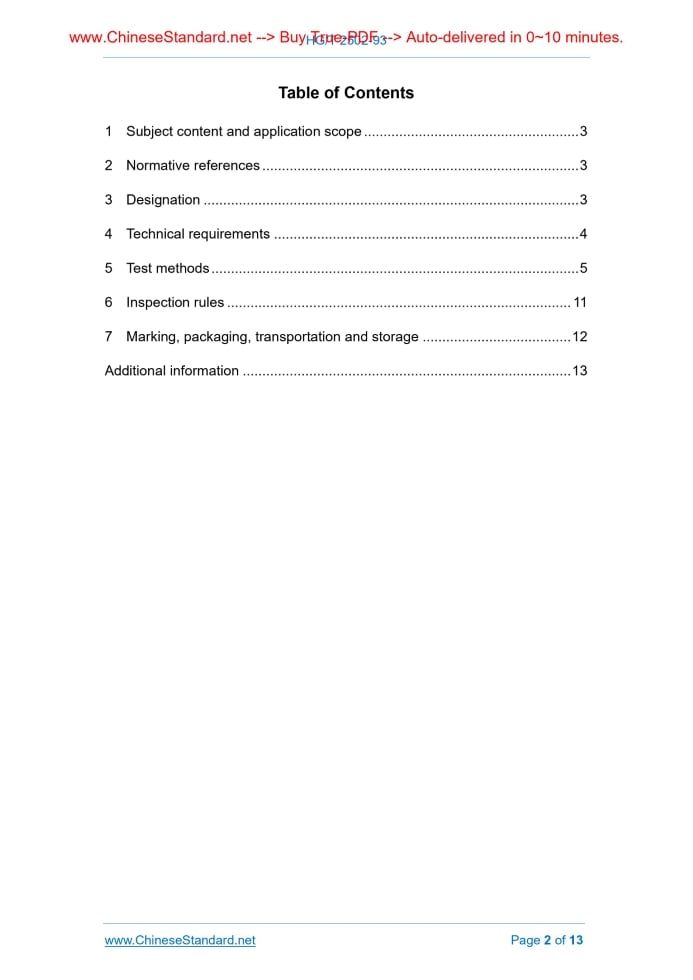
1 Subject content and application scope ... 3 2 Normative references ... 3 3 Designation ... 3 4 Technical requirements ... 4 5 Test methods ... 5 6 Inspection rules ... 11 7 Marking, packaging, transportation and storage ... 12 Additional information ... 13 5201 Silicone Grease1 Subject content and application scope
This Standard specifies the technical requirements, test methods, inspection rules and the requirements for marking, packaging, transportation and storage for 5201 silicone grease. This Standard applies to silicone grease made from dimethyl silicon oil by densifying fumed silica.2 Normative references
GB 269, Lubricating grease – Determination of cone penetration GB 1408, Test methods at power frequencies for electric strength of solid insulating materials GB 1409, Methods for the determination of the permittivity and dielectric dissipation factor of solid electrical insulating materials at power, audio and radio frequencies including metre wavelengths GB 1410, Methods of test for volume resistivity and surface resistivity of solid electrical insulating materials GB/T 6678, General principles for sampling chemical products GB/T 6679, General rules for sampling solid chemical products GB 10580, Standard conditions for use prior to and during the testing of solid electrical insulating materials SY 2710, Corrosion test of lubricating grease3 Designation
3.1 The designation of this product consists of secondary processing type code, silicone oil code, group code and sequence number, as shown in Figure 1.5 Test methods
5.1 Determination of appearance Open the package and conduct visual inspection under natural lighting. 5.2 Determination of cone penetration 5.2.1 Determination of non-working cone penetration Conduct the determination in accordance with the method specified in paragraphs 2 to 4 in method A of the 1st section, GB 269, including. a. the gas is exhausted for 1 h under the residual pressure not greater than 400 Pa; and b. the test temperature is 25 ± 5˚C. The results shall be rounded off to 3 significant figures. 5.2.2 Determination of working cone penetration Conduct the determination in accordance with the method specified in paragraphs 2 to 3 and paragraph 5 in method A of the 1st section of GB 269, including the exhaust conditions and test conditions for the specimens the same as 5.2.1. The results shall be rounded off to 3 significant figures. 5.3 Determination of oil separation and volatile content 5.3.1 Apparatus 5.3.1.1 Electric constant-temperature drying oven. the maximum working temperature 300˚C; the temperature control accuracy ± 2˚C. 5.3.1.2 Analytical balance. the maximum load 200 g; the sensitivity 0.1 mg. 5.3.1.3 Desiccator. containing allochroic silicagel or anhydrous calcium chloride desiccant. 5.3.1.4 Steel mesh oil separation measuring equipment. as shown in Figure 2. 5.7.1.3 Screen. stainless steel screen, mesh size 1.0 to 1.3 mm. 5.7.1.4 Tripod. made of iron. 5.7.2 Test procedure Weigh approximately 10 g of the specimen to place on the stainless-steel screen, whose coverage is a circle with a diameter of 2.5 cm. Place the screen on the tripod; heat underneath it cautiously with a combustion lamp not to let the flame run to the above of the screen. When the specimen starts to decompose or becomes volatile, use a second combustion lamp to ignite the gas discharged. When the combustion lamps are both withdrawn, observe whether the flame extinguishes immediately. If it does not extinguish immediately, the specimen is not self-extinguishing, and stop the test. If it extinguishes, continue to heat until the specimen is red hot, and ignite once again. if it still extinguishes, the specimen is self-extinguishing, or else, it is not self- extinguishing, and then stop the test. 5.7.3 Judgment of test results Conduct 3 tests in parallel and take two results identical as the final test result. 5.8 Determination of corrosivity Conduct the determination in accordance with the method specified in SY 2710, including. the material of the sheet metal is steel no. 45 of the dimensions 50 mm × 50 mm × (3.5 to 5) mm. 5.9 Determination of waterproofing 5.9.1 Reagent and solution Cobalt chloride water solution. containing 25 g of cobalt chloride per 100 mL of the solution. 5.9.2 Apparatus and materials 5.9.2.1 Electric constant-temperature drying oven. the maximum working temperature 150˚C and the temperature control accuracy ± 1˚C. 5.9.2.2 Oxidation vessel. glass made, the diameter 30 ± 2 mm and the height 12 ± 1 mm. 5.9.2.3 Water bath. 5.9.2.4 Scraper. 5.9.2.5 Filter paper. Ø 25 ± 1 mm. with this Standard; and if a re-inspection is necessary, it shall be conducted within 6 weeks after receiving the products. 6.7 When there is any dispute between the supplier and the purchaser on the product quality, it shall be settled by both sides through consultation or a statutory quality inspection department through arbitration.7 Marking, packaging, transportation and storage
7.1 Marking Each package of the products shall be marked legibly and indelibly, indicating product name, type, grade, batch number, net weight, manufacturing date and manufacturer name. 7.2 Packaging The products shall be packaged in a closed container lined with a plastic bag; each package shall be provided with a conformity certificate, indicating batch number and a reference of this Standard. 7.3 Transportation The products shall be transported as a non-toxic non-dangerous article. During transportation, they shall be protected from rain and exposure to sunlight. 7.4 Storage The products shall be stored in a dry and ventilated place, which shall be isolated from combustion sources and keep away from heat sources. The storage life of the products at -5 to 40˚C is 2 years from the date of manufacture. When the products are past the storage life, they can be re-inspected in accordance with this Standard; if the re- inspection results still conform to this Standard, they can still be usable. ......Source: Above contents are excerpted from the full-copy PDF -- translated/reviewed by: www.ChineseStandard.net / Wayne Zheng et al.