GB/T 9286-2021 PDF English
Price & Delivery
US$260.00 · In stock · Download in 9 secondsGB/T 9286-2021: Paints and varnishes - Cross-cut test
Delivery: 9 seconds. True-PDF full-copy in English & invoice will be downloaded + auto-delivered via email. See step-by-step procedure
Status: Valid
GB/T 9286: Historical versions
| Standard ID | USD | BUY PDF | Delivery | Standard Title (Description) | Status |
| GB/T 9286-2021 | 260 | Add to Cart | Auto, 9 seconds. | Paints and varnishes - Cross-cut test | Valid |
| GB/T 9286-1998 | 85 | Add to Cart | Auto, 9 seconds. | Paints and varnishes--Cross cut test for films | Obsolete |
| GB/T 9286-1988 | RFQ | ASK | 3 days | Paints and varnishes--Cross test for films | Obsolete |
Click to Preview this PDF
Similar standards
GB/T 9286-2021: Paints and varnishes - Cross-cut test
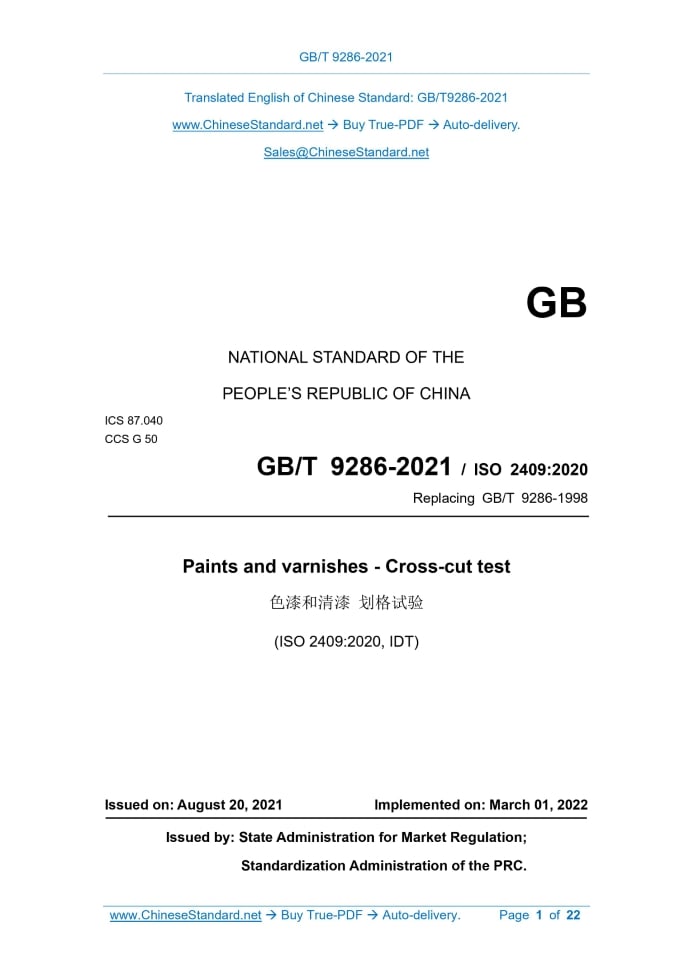
---This is an excerpt. Full copy of true-PDF in English version (including equations, symbols, images, flow-chart, tables, and figures etc.), auto-downloaded/delivered in 9 seconds, can be purchased online: https://www.ChineseStandard.net/PDF.aspx/GBT9286-2021GB NATIONAL STANDARD OF THE PEOPLE’S REPUBLIC OF CHINA ICS 87.040 CCS G 50 GB/T 9286-2021 / ISO 2409.2020 Replacing GB/T 9286-1998 Paints and varnishes - Cross-cut test (ISO 2409.2020, IDT) Issued on. AUGUST 20, 2021 Implemented on. MARCH 01, 2022 Issued by. State Administration for Market Regulation; Standardization Administration of the PRC.
Table of Contents
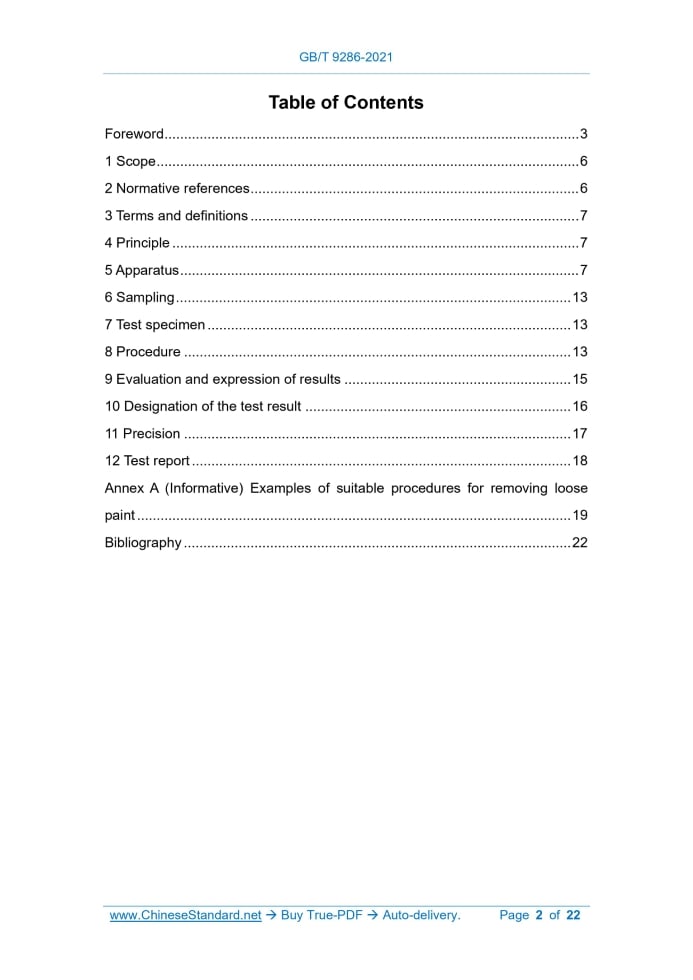
Foreword... 3 1 Scope... 6 2 Normative references... 6 3 Terms and definitions... 7 4 Principle... 7 5 Apparatus... 7 6 Sampling... 13 7 Test specimen... 13 8 Procedure... 13 9 Evaluation and expression of results... 15 10 Designation of the test result... 16 11 Precision... 17 12 Test report... 18 Annex A (Informative) Examples of suitable procedures for removing loose paint... 19 Bibliography... 22Foreword
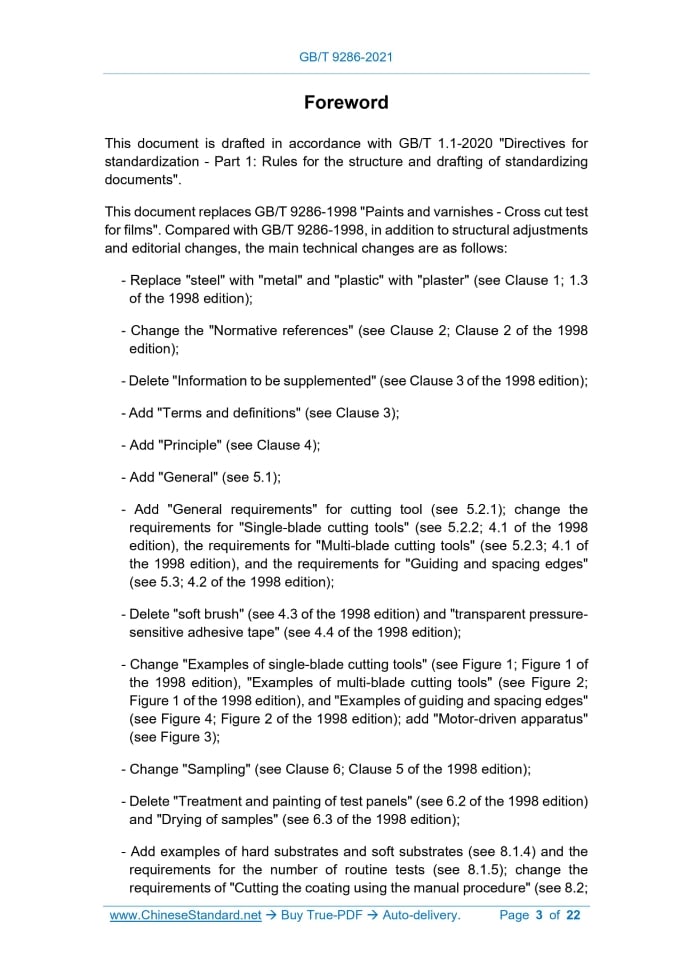
This document is drafted in accordance with GB/T 1.1-2020 "Directives for standardization - Part 1.Rules for the structure and drafting of standardizing documents". This document replaces GB/T 9286-1998 "Paints and varnishes - Cross cut test for films". Compared with GB/T 9286-1998, in addition to structural adjustments and editorial changes, the main technical changes are as follows. - Replace "steel" with "metal" and "plastic" with "plaster" (see Clause 1; 1.3 of the 1998 edition); - Change the "Normative references" (see Clause 2; Clause 2 of the 1998 edition); - Delete "Information to be supplemented" (see Clause 3 of the 1998 edition); - Add "Terms and definitions" (see Clause 3); - Add "Principle" (see Clause 4); - Add "General" (see 5.1); - Add "General requirements" for cutting tool (see 5.2.1); change the requirements for "Single-blade cutting tools" (see 5.2.2; 4.1 of the 1998 edition), the requirements for "Multi-blade cutting tools" (see 5.2.3; 4.1 of the 1998 edition), and the requirements for "Guiding and spacing edges" (see 5.3; 4.2 of the 1998 edition); - Delete "soft brush" (see 4.3 of the 1998 edition) and "transparent pressure- sensitive adhesive tape" (see 4.4 of the 1998 edition); - Change "Examples of single-blade cutting tools" (see Figure 1; Figure 1 of the 1998 edition), "Examples of multi-blade cutting tools" (see Figure 2; Figure 1 of the 1998 edition), and "Examples of guiding and spacing edges" (see Figure 4; Figure 2 of the 1998 edition); add "Motor-driven apparatus" (see Figure 3); - Change "Sampling" (see Clause 6; Clause 5 of the 1998 edition); - Delete "Treatment and painting of test panels" (see 6.2 of the 1998 edition) and "Drying of samples" (see 6.3 of the 1998 edition); - Add examples of hard substrates and soft substrates (see 8.1.4) and the requirements for the number of routine tests (see 8.1.5); change the requirements of "Cutting the coating using the manual procedure" (see 8.2; 7.2 of the 1998 edition); change the requirements of "Cutting the coating using a motor-driven tool" (see 8.3; 7.3 of the 1998 edition); - Change the graphical description for classification of test results (see Table 1; Table 1 of the 1998 edition); - Add "Designation of the test result" (see Clause 10); - Add "Precision" (see Clause 11); - Change the content of "Test report" (see Clause 12; Clause 9 of the 1998 edition); - Change the informative annex (see Annex A; Annex A of the 1998 edition). This document, using translation method, is identical to ISO 2409.2020 "Paints and varnishes - Cross-cut test". China’s documents which have a consistent correspondence with the international documents normatively referenced in this document are as follows. GB/T 3186-2006 Paints, varnishes and raw materials for paints and varnishes - Sampling (ISO 15528.2000, IDT); GB/T 5206-2015 Paints and varnishes - Terms and definitions (ISO 4618.2014, IDT); GB/T 13452.2-2008 Paints and varnishes - Determination of film thickness (ISO 2808.2007, IDT); GB/T 20777-2006 Paints and varnishes - Examination and preparation of samples for testing (ISO 1513.1992, IDT); GB/T 37356-2019 Paints and varnishes - Lighting and procedure for visual assessments of coatings (ISO 13076.2012, IDT). Attention is drawn to the possibility that some of the elements of this document may be the subject of patent rights. The issuing authority of this document shall not be held responsible for identifying any or all such patent rights. This document was proposed by China Petroleum and Chemical Industry Federation. This document shall be under the jurisdiction of National Technical Committee 5 on Paints & Pigments of Standardization Administration of China (SAC/TC 5). Drafting organizations of this document. CNOOC Changzhou Paint and Coatings Industry Research Institute Co., Ltd.; Biuged Laboratory Instruments (Guangzhou) Co., Ltd.; Zhejiang Yu Tong New Materials Co., Ltd.; T&H Chemicals Corporation Ltd.; Ningbo Xin'an Dope Co., Ltd.; Shenzhen Grandland Hightech New Material Co., Ltd.; The China Paint MFG. Co., (Shenzhen) Ltd.; Forever Testing Int’l Co., Ltd.; Guohengxin (Changzhou) Testing and Certification Technology Co., Ltd.; Fujian Wanan Group Co., Ltd.; Zhejiang Transfar Co., Ltd.; Xuzhou Daguang Paint Factory; Zhejiang Feijing New Material Technology Co., Ltd.; BEVS Industrial Co., Ltd.; Banfert New- materials Technology Co., Ltd.; Dongguan Taiho Paint Products Co., Ltd.; Qingdao Xingguo Painting Co., Ltd.; Zhuzhou Jiuhua New Material Coating Industry Co., Ltd.; AVIC BIAM New Materials Technology & Engineering Co., Ltd.; Tian He Resin Co., Ltd.; Shunde Polytechnic; MACO Group Co., Ltd.; Shanghai Baolijia New Material Co., Ltd.; Zhejiang Research Institute of Product Quality and Safety; Hubei O • BAST Science and Technology Co., Ltd.; Fujian Nianmeng Technology Co., Ltd.; Xiamen University; Longhai Dahua Paint Co., Ltd.; Fujian Tenglong Industrial Company; Fujian Rongcheng Detection Technology Co., Ltd.; Hui’erming (Fujian) Chemical Industry Co., Ltd.; Zhangzhou Taixing Chemical Coating Co., Ltd.; Zhangzhou Xianghao Paint Industry and Trade Co., Ltd.; Meijiale (Qingyuan) EP & New Materials Co., Ltd. Main drafters of this document. Chen Gang, He Wenhua, Xu Yunli, Peng Jufang, Li Yuewu, Yang Yaliang, Xu Jinbao, Gu Erning, Wang Zhi, Chen Lihong, Huang Wen, Gao Dongmei, Liang Xizhen, Tang Hao, Zeng Yuling, Li Shizhen, Xiong Guogang, Liu Caixia, Gong Wenjing, Liu Wei, Ma Yong, Chen Yanwu, Niu Zhiqiang, Wang Wei, Wu Ruilang, Dai Yanzhong, Xu Yiting, Tang Xiaoyan, Huang Wanglie, Lin Shishi, Fang Bin, Zheng Qingyun, Cai Dehe, Guan Zhongxiang. The previous releases of this document and the documents it replaces are as follows. - It was first issued as GB/T 9286-1988 in 1988.It was revised for the first time in 1998; - This is the second revision. Paints and varnishes - Cross-cut test1 Scope
This document specifies a test method for assessing the resistance of paint coatings and varnishes (including wood stains) to separation from substrates when a right-angle lattice pattern is cut into the coating, penetrating through to the substrate. The property determined by this empirical test procedure depends, among other factors, on the adhesion of the coating to either the preceding coat or the substrate. This procedure is not, however, a means of measuring adhesion.2 Normative references
The contents of the following documents, through normative references in this text, constitute indispensable provisions of this document. Among them, for dated references, only the edition corresponding to that date applies to this document. For undated references, the latest edition (including all amendments) applies to this document. ISO 1513 Paints and varnishes - Examination and preparation of test samples ISO 2808 Paints and varnishes - Determination of film thickness3 Terms and definitions
For the purposes of this document, the terms and definitions given in ISO 4618 apply.4 Principle
Six parallel cuts are introduced in the coating and another six cuts are introduced perpendicular to the first cuts. Any loose paint particles are removed. The cut area is examined visually and compared to a six-step classification.5 Apparatus
The tools described in 5.2.2 and 5.2.3 are suitable for manual use, which is the more usual method of use, but the tools may also be mounted on a motor- driven apparatus, which gives more uniform cutting. The application of the latter procedure shall be subject to agreement between the interested parties.6 Sampling
Take a representative sample of the product to be tested, as described in ISO 15528.7 Test specimen
Where panels consist of a relatively soft material such as wood, the minimum thickness shall be 10 mm. Where panels consist of a hard material, the minimum thickness shall be 0.25 mm. Determine the thickness, in micrometres, of the dried coating by one of the procedures specified in ISO 2808.Make the measurement at, or as near as possible to, the positions at which the cross-cut is to be made. The number of thickness determinations is dependent on the method used.8 Procedure
The number of cuts in each direction of the lattice pattern shall be six. If a higher precision is required, carry out the test in at least three different places (see 7.1) on the panel. If the results do not match, the differences being more than one classification unit, repeat the test at three other places, if necessary using different panels, and record all the results. original cuts at 90° to them so that a lattice pattern is formed.9 Evaluation and expression of results
Carefully examine visually the cut area of the test coating in good lighting as specified in ISO 13076, using normal or corrected vision or, if agreed between the interested parties, using a viewing lens (5.4). ......Source: Above contents are excerpted from the full-copy PDF -- translated/reviewed by: www.ChineseStandard.net / Wayne Zheng et al.