GB/T 7964-2020 PDF English
Price & Delivery
US$145.00 · In stock · Download in 9 secondsGB/T 7964-2020: Sintered Metal Materials (Excluding Hardmetal) - Tension Testing at Room Temperature
Delivery: 9 seconds. True-PDF full-copy in English & invoice will be downloaded + auto-delivered via email. See step-by-step procedure
Status: Valid
GB/T 7964: Historical versions
| Standard ID | USD | BUY PDF | Delivery | Standard Title (Description) | Status |
| GB/T 7964-2020 | 145 | Add to Cart | Auto, 9 seconds. | Sintered Metal Materials (Excluding Hardmetal) - Tension Testing at Room Temperature | Valid |
| GB/T 7964-1987 | 239 | Add to Cart | 2 days | Sintered metal materials(excluding hardmetal). Tension testing at room temperature | Obsolete |
Click to Preview this PDF
Similar standards
GB/T 7964-2020: Sintered Metal Materials (Excluding Hardmetal) - Tension Testing at Room Temperature
---This is an excerpt. Full copy of true-PDF in English version (including equations, symbols, images, flow-chart, tables, and figures etc.), auto-downloaded/delivered in 9 seconds, can be purchased online: https://www.ChineseStandard.net/PDF.aspx/GBT7964-2020
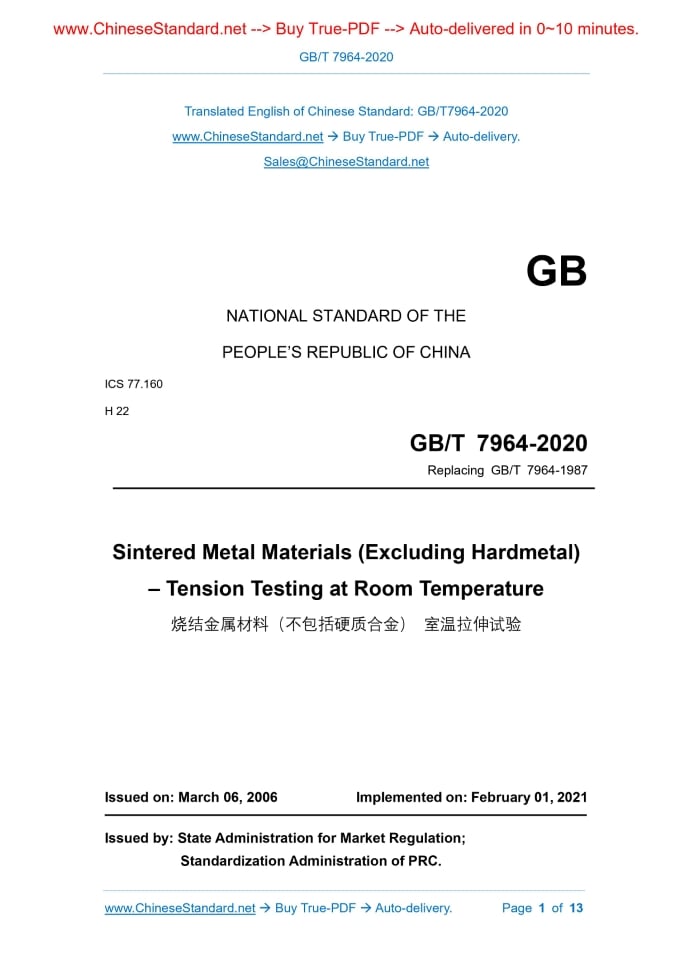
NATIONAL STANDARD OF THE PEOPLE’S REPUBLIC OF CHINA ICS 77.160 H 22 Replacing GB/T 7964-1987 Sintered Metal Materials (Excluding Hardmetal) – Tension Testing at Room Temperature ISSUED ON: MARCH 06, 2006 IMPLEMENTED ON: FEBRUARY 01, 2021 Issued by: State Administration for Market Regulation; Standardization Administration of PRC.
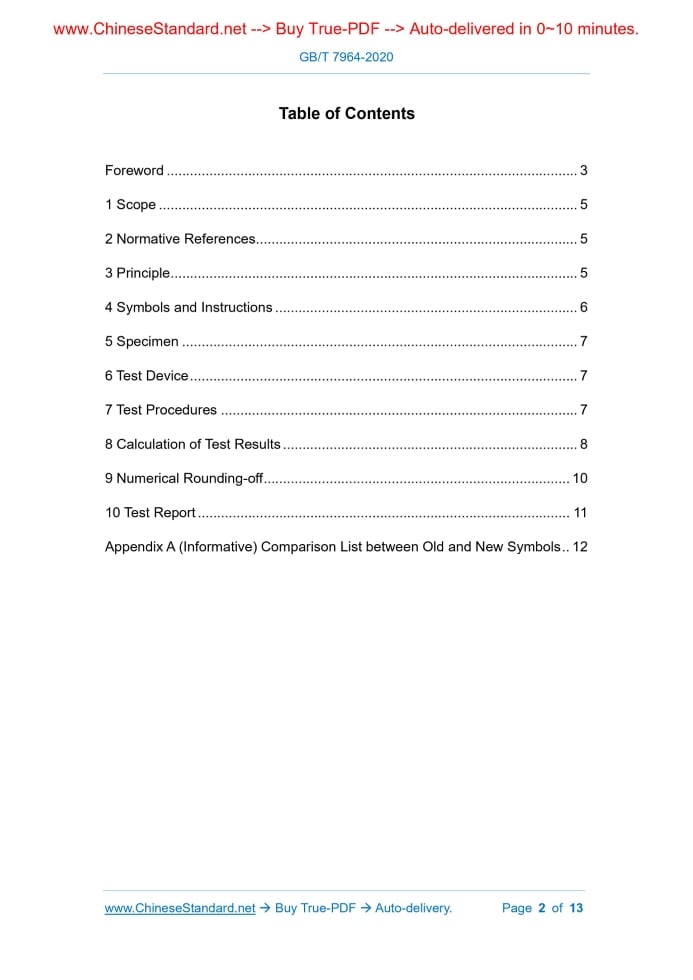
Table of Contents
Foreword ... 3 1 Scope ... 5 2 Normative References ... 5 3 Principle ... 5 4 Symbols and Instructions ... 6 5 Specimen ... 7 6 Test Device ... 7 7 Test Procedures ... 7 8 Calculation of Test Results ... 8 9 Numerical Rounding-off ... 10 10 Test Report ... 11 Appendix A (Informative) Comparison List between Old and New Symbols .. 12Foreword
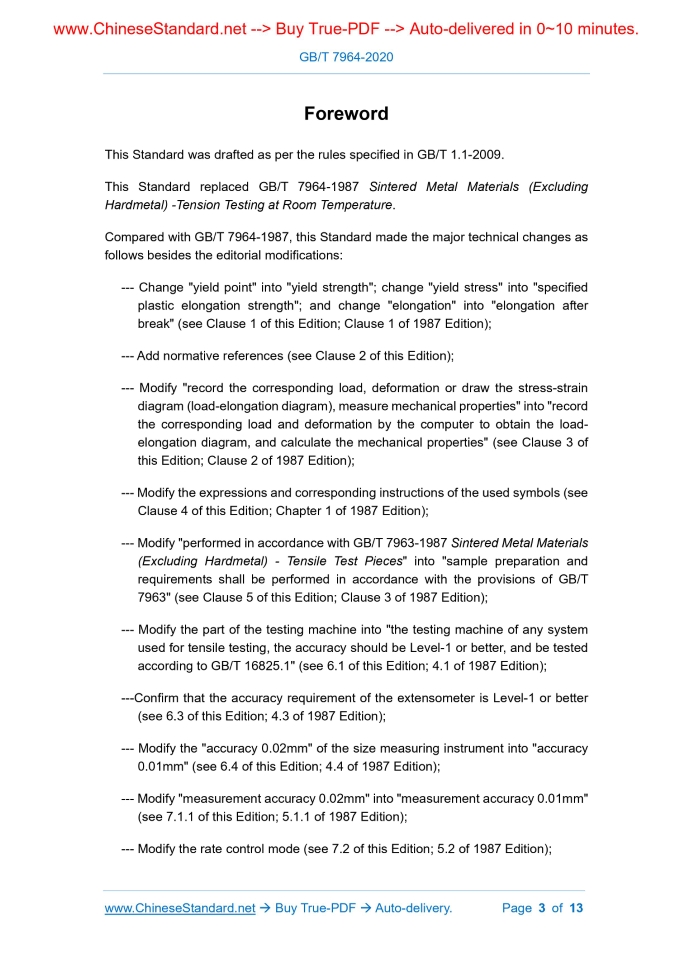
This Standard was drafted as per the rules specified in GB/T 1.1-2009. This Standard replaced GB/T 7964-1987 Sintered Metal Materials (Excluding Hardmetal) -Tension Testing at Room Temperature. Compared with GB/T 7964-1987, this Standard made the major technical changes as follows besides the editorial modifications: --- Change "yield point" into "yield strength"; change "yield stress" into "specified plastic elongation strength"; and change "elongation" into "elongation after break" (see Clause 1 of this Edition; Clause 1 of 1987 Edition); --- Add normative references (see Clause 2 of this Edition); --- Modify "record the corresponding load, deformation or draw the stress-strain diagram (load-elongation diagram), measure mechanical properties" into "record the corresponding load and deformation by the computer to obtain the load- elongation diagram, and calculate the mechanical properties" (see Clause 3 of this Edition; Clause 2 of 1987 Edition); --- Modify the expressions and corresponding instructions of the used symbols (see Clause 4 of this Edition; Chapter 1 of 1987 Edition); --- Modify "performed in accordance with GB/T 7963-1987 Sintered Metal Materials (Excluding Hardmetal) - Tensile Test Pieces" into "sample preparation and requirements shall be performed in accordance with the provisions of GB/T 7963" (see Clause 5 of this Edition; Clause 3 of 1987 Edition); --- Modify the part of the testing machine into "the testing machine of any system used for tensile testing, the accuracy should be Level-1 or better, and be tested according to GB/T 16825.1" (see 6.1 of this Edition; 4.1 of 1987 Edition); ---Confirm that the accuracy requirement of the extensometer is Level-1 or better (see 6.3 of this Edition; 4.3 of 1987 Edition); --- Modify the "accuracy 0.02mm" of the size measuring instrument into "accuracy 0.01mm" (see 6.4 of this Edition; 4.4 of 1987 Edition); --- Modify "measurement accuracy 0.02mm" into "measurement accuracy 0.01mm" (see 7.1.1 of this Edition; 5.1.1 of 1987 Edition); --- Modify the rate control mode (see 7.2 of this Edition; 5.2 of 1987 Edition); Sintered Metal Materials (Excluding Hardmetal) – Tension Testing at Room Temperature1 Scope
This Standard specifies the room temperature tensile test method for sintered metal materials, including principles, symbols and instructions, specimens, test device, test procedures, calculation of test results, numerical rounding-off and test reports. This Standard is applicable to the determination of the yield strength, specified plastic elongation strength, tensile strength, elongation after break, and reduction of area for machined or non-machined sintered metal materials (excluding hardmetal).2 Normative References
The following documents are essential to the application of this document. For the dated documents, only the versions with the dates indicated are applicable to this document; for the undated documents, only the latest version (including all the amendments) are applicable to this document. GB/T 7963 Sintered Metal Materials, Excluding Hardmetals - Tensile Test Pieces GB/T 16825.1 Verification of Static Uniaxial Testing Machines - Part 1 : Tension/Compression Testing Machines - Verification and Calibration of the Force- Measuring System3 Principle
Put the specimen in the appropriate position of the fixture; start the testing machine; make the specimen continuously and uniformly bear the tensile stress till break under the specified tensile speed; and record the corresponding load and deformation by the computer to obtain the load-elongation diagram; and calculate the mechanical properties.5 Specimen
The preparation and requirements of the specimens shall be carried out in accordance with the provisions of GB/T 7963.6 Test Device
6.1 Testing machine The testing machine of any system used for tensile testing shall have an accuracy of Level-1 or better; and shall be tested in accordance with GB/T 16825.1. The testing machine shall have sufficient rigidity and shall not cause instability within its tensile load range. 6.2 Fixture Choose a suitable specimen clamping device. The wedge chuck and collar chuck are usually used to transfer the load applied by the testing machine to the specimen. The axis of the specimen shall coincide with the center of the chuck of the testing machine. 6.3 Extensometer The accuracy of the extensometer shall be Level-1 or better. 6.4 Size measuring instrument Use a suitable instrument for measuring the specimen size, with an accuracy of 0.01 mm.7 Test Procedures
7.1 Measuring specimen size 7.1.1 Cross-sectional area of the specimen Respectively measure once in two directions perpendicular to the two ends and middle of the specimen gauge length, the measuring accuracy is 0.01mm. Choose the smallest of the three cross-sectional areas. The cross-sectional area is calculated according to Formulas (1) and (2). a) Flat specimen: b) Cylindrical specimen: 7.1.2 Specimen gauge length The original specimen has a gauge length of 25.0mm and a marking accuracy of ±0.1mm. 7.2 Test speed According to the characteristics of the testing machine, the specimen material and the purpose of the test, unless otherwise specified in the relevant material standards or agreements, the tensile test speed shall meet the following requirements: --- When measuring the tensile yield strength, the strain rate shall not exceed 0.0008s-1; --- When measuring the tensile strength, the strain rate shall not exceed 0.0024s-1. NOTE: For the beam displacement control testing machine, it is allowed to set a speed equivalent to the above required strain rate. When using beam displacement control, the test rate is calculated as per the following formula:8 Calculation of Test Results
8.1 Yield strength Graphic method: on the tensile curve (Figure 1), find the constant load at the platform [Figure 1a)], or the lowest load at yield [Figure 1b)], or the load that begins to deviate from the straight line [Figure 1c)]. The yield strength is calculated according to Formula (3): 8.2 Specified plastic elongation strength Graphic method: When the specified plastic elongation strength is measured on the tensile curve (Figure 2), in the load-elongation diagram, OM (L0×εp) is equal to the specified plastic deformation value; MN is parallel to OA and intersects the curve at p; the corresponding Fp is the specified plastic elongation force. The specified plastic ......Source: Above contents are excerpted from the full-copy PDF -- translated/reviewed by: www.ChineseStandard.net / Wayne Zheng et al.