GB/T 6670-2008 PDF English
Price & Delivery
US$155.00 · In stock · Download in 9 secondsGB/T 6670-2008: Flexible cellular polymeric materials -- Determination of resilience by ball rebound
Delivery: 9 seconds. True-PDF full-copy in English & invoice will be downloaded + auto-delivered via email. See step-by-step procedure
Status: Valid
GB/T 6670: Historical versions
| Standard ID | USD | BUY PDF | Delivery | Standard Title (Description) | Status |
| GB/T 6670-2008 | 155 | Add to Cart | Auto, 9 seconds. | Flexible cellular polymeric materials -- Determination of resilience by ball rebound | Valid |
| GB/T 6670-1997 | 199 | Add to Cart | 2 days | Cellular plastics--Flexible polyurethane foam--Determination of resilience | Obsolete |
| GB/T 6670-1986 | RFQ | ASK | 3 days | Flexible cellular plastics--Determination of resilience | Obsolete |
Click to Preview this PDF
GB/T 6670-2008: Flexible cellular polymeric materials -- Determination of resilience by ball rebound
---This is an excerpt. Full copy of true-PDF in English version (including equations, symbols, images, flow-chart, tables, and figures etc.), auto-downloaded/delivered in 9 seconds, can be purchased online: https://www.ChineseStandard.net/PDF.aspx/GBT6670-2008
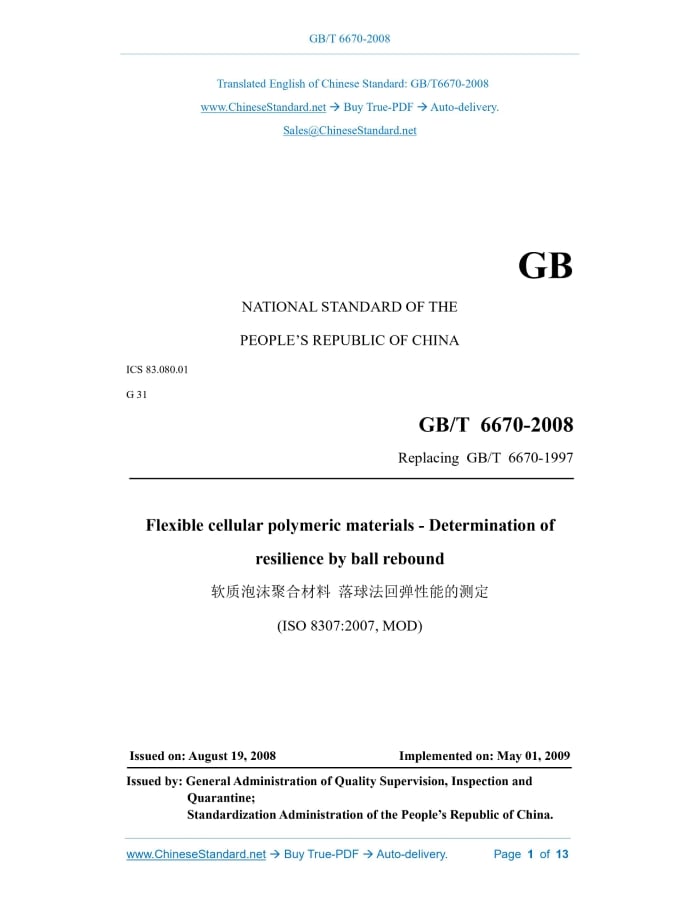
GB NATIONAL STANDARD OF THE PEOPLE’S REPUBLIC OF CHINA ICS 83.080.01 G 31 Replacing GB/T 6670-1997 Flexible cellular polymeric materials - Determination of resilience by ball rebound (ISO 8307:2007, MOD) ISSUED ON: AUGUST 19, 2008 IMPLEMENTED ON: MAY 01, 2009 Issued by: General Administration of Quality Supervision, Inspection and Quarantine; Standardization Administration of the People’s Republic of China.
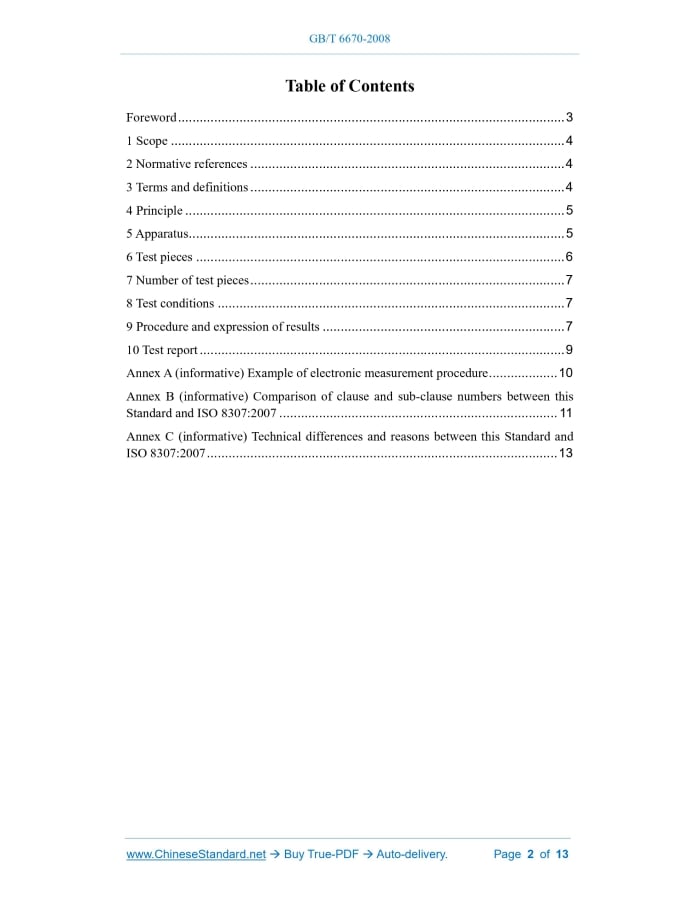
Table of Contents
Foreword ... 3 1 Scope ... 4 2 Normative references ... 4 3 Terms and definitions ... 4 4 Principle ... 5 5 Apparatus ... 5 6 Test pieces ... 6 7 Number of test pieces ... 7 8 Test conditions ... 7 9 Procedure and expression of results ... 7 10 Test report ... 9 Annex A (informative) Example of electronic measurement procedure ... 10 Annex B (informative) Comparison of clause and sub-clause numbers between this Standard and ISO 8307:2007 ... 11 Annex C (informative) Technical differences and reasons between this Standard and ISO 8307:2007 ... 13Foreword
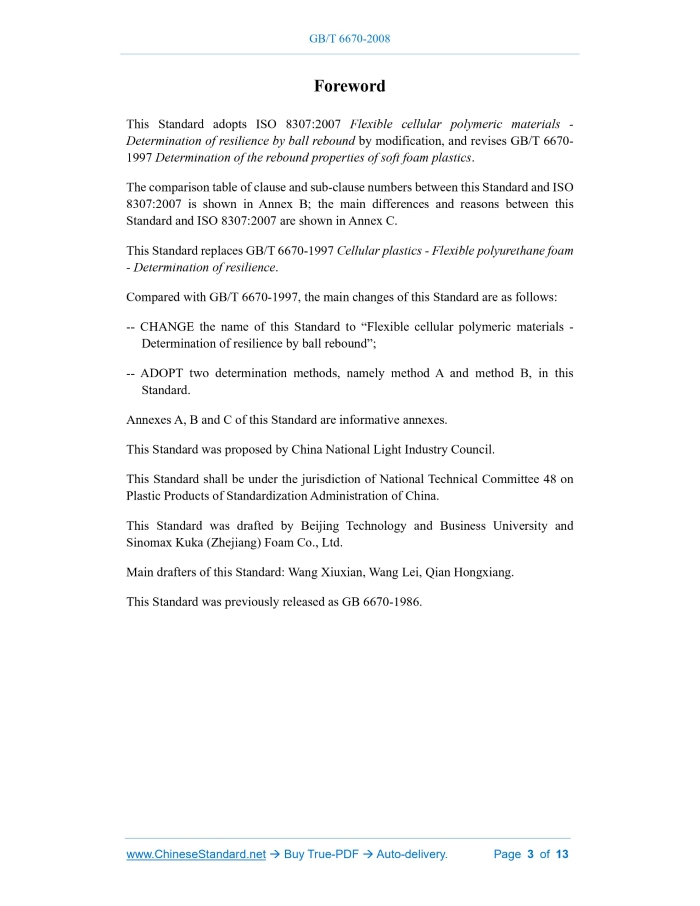
This Standard adopts ISO 8307:2007 Flexible cellular polymeric materials - Determination of resilience by ball rebound by modification, and revises GB/T 6670- 1997 Determination of the rebound properties of soft foam plastics. The comparison table of clause and sub-clause numbers between this Standard and ISO 8307:2007 is shown in Annex B; the main differences and reasons between this Standard and ISO 8307:2007 are shown in Annex C. This Standard replaces GB/T 6670-1997 Cellular plastics - Flexible polyurethane foam - Determination of resilience. Compared with GB/T 6670-1997, the main changes of this Standard are as follows: -- CHANGE the name of this Standard to “Flexible cellular polymeric materials - Determination of resilience by ball rebound”; -- ADOPT two determination methods, namely method A and method B, in this Standard. Annexes A, B and C of this Standard are informative annexes. This Standard was proposed by China National Light Industry Council. This Standard shall be under the jurisdiction of National Technical Committee 48 on Plastic Products of Standardization Administration of China. This Standard was drafted by Beijing Technology and Business University and Sinomax Kuka (Zhejiang) Foam Co., Ltd. Main drafters of this Standard: Wang Xiuxian, Wang Lei, Qian Hongxiang. This Standard was previously released as GB 6670-1986. Flexible cellular polymeric materials - Determination of resilience by ball rebound1 Scope
This Standard specifies two methods for determining the resilience of flexible cellular polymeric materials. This Standard applies to the determination of resilience by ball rebound of flexible cellular polymeric materials.2 Normative references
The terms in the following documents become the terms of this Standard by reference to this Standard. For dated references, all subsequent amendments (not including errata content) or revisions do not apply to this standard. However, parties to agreements that are based on this Standard are encouraged to study whether the latest versions of these documents can be used. For undated references, the latest edition applies to this Standard. GB/T 2918-1998, Plastics - Standard atmospheres for conditioning and testing (idt ISO 291:1997)3 Terms and definitions
The following terms and definitions are applicable to this Standard. 3.1 open-cell flexible cellular material flexible cellular material with less than 25% of its cell volume closed 3.2 closed-cell flexible cellular material flexible cellular material with more than 25% of its cell volume closed Note: This preflex conditioning is not applicable to closed-cell material as defined in 3.2. 9.2 Test method A 9.2.1 Carry out the test immediately after conditioning, preferably in the same atmosphere as was used to condition the test pieces. 9.2.2 Centre the test piece at the base of the tube and adjust the height of the tube so that zero rebound is 16 mm ± 0.5 mm above the surface of the test piece. Clamp the tube to make light contact with the test pieces without causing visible compression. 9.2.3 Mount the steel ball on the release mechanism, then drop it and note the maximum rebound height to the nearest percentage point. If the ball strikes the tube on the drop or rebound, the value obtained is invalid. This condition is usually due to the tube not being vertical or to irregularities on the test piece surface. In order to minimize parallax error, the eye-level of the observer shall be such that the markings on the tube in the region where the percentage rebound value is read appear as straight lines. Trial drops are necessary in order to establish the correct eye-level. 9.2.4 At least three rebound values in succession within 1 min shall be obtained on each of the three test pieces. 9.2.5 For each test piece, determine the median of the three rebound height values. If any value deviates by more than 20% (one-fifth) of the median value from the median, make two additional drops and determine the median for all five rebound height values. Using the median values obtained for the three test pieces, determine the overall median value as the rebound resilience value of the material. If automated measurement is employed, the results shall also be expressed to the nearest integer. 9.3 Test method B 9.3.1 Carry out the test immediately after conditioning in Clause 8, preferably in the same atmosphere as was used to condition the test pieces. 9.3.2 Place the test piece horizontally on the rebound test apparatus and adjust the drop height of the bottom of the steel ball from the fixed position to the sample surface to 460 mm. 9.3.3 Carry out tests according to 9.2.3 ~ 9.2.4. 9.3.4 Expression of results: 3 results are measured for each test piece, and the maximum value is taken from the 3 results. Then the average value of the 3 maximum values is calculated as the rebound resilience of the test piece. Chinese Standards This is an excerpt of the PDF (Some pages are marked off intentionally) Full-copy PDF can be purchased from 1 of 2 websites: 1. https://www.ChineseStandard.us SEARCH the standard ID, such as GB 4943.1-2022. Select your country (currency), for example: USA (USD); Germany (Euro). Full-copy of PDF (text-editable, true-PDF) can be downloaded in 9 seconds. Tax invoice can be downloaded in 9 seconds. Receiving emails in 9 seconds (with download links). SEARCH the standard ID, such as GB 4943.1-2022. Full-copy of PDF (text-editable, true-PDF) can be downloaded in 9 seconds. Receiving emails in 9 seconds (with PDFs attached, invoice and download links). Translated by: Field Test Asia Pte. Ltd. (Incorporated & taxed in Singapore. Tax ID: 201302277C) Linkin: https://www.linkedin.com/in/waynezhengwenrui/ ------ The End ------ ......Source: Above contents are excerpted from the full-copy PDF -- translated/reviewed by: www.ChineseStandard.net / Wayne Zheng et al.