GB/T 528-2009 PDF English
Price & Delivery
US$85.00 · In stock · Download in 9 secondsGB/T 528-2009: Rubber, vulcanized or thermoplastic -- Determination of tensile stress-strain properties
Delivery: 9 seconds. True-PDF full-copy in English & invoice will be downloaded + auto-delivered via email. See step-by-step procedure
Status: Valid
GB/T 528: Historical versions
| Standard ID | USD | BUY PDF | Delivery | Standard Title (Description) | Status |
| GB/T 528-2009 | 85 | Add to Cart | Auto, 9 seconds. | Rubber, vulcanized or thermoplastic -- Determination of tensile stress-strain properties | Valid |
| GB/T 528-1998 | 639 | Add to Cart | 5 days | Rubber, vulcanized or thermoplastic--Determination of tensile stress-strain properties [including MODIFICATION 1] | Obsolete |
| GB/T 528-1992 | RFQ | ASK | 3 days | Rubber, vulcanized and thermoplastic - Determinnation of tensile properties | Obsolete |
Click to Preview this PDF
Similar standards
GB/T 528-2009: Rubber, vulcanized or thermoplastic -- Determination of tensile stress-strain properties
---This is an excerpt. Full copy of true-PDF in English version (including equations, symbols, images, flow-chart, tables, and figures etc.), auto-downloaded/delivered in 9 seconds, can be purchased online: https://www.ChineseStandard.net/PDF.aspx/GBT528-2009
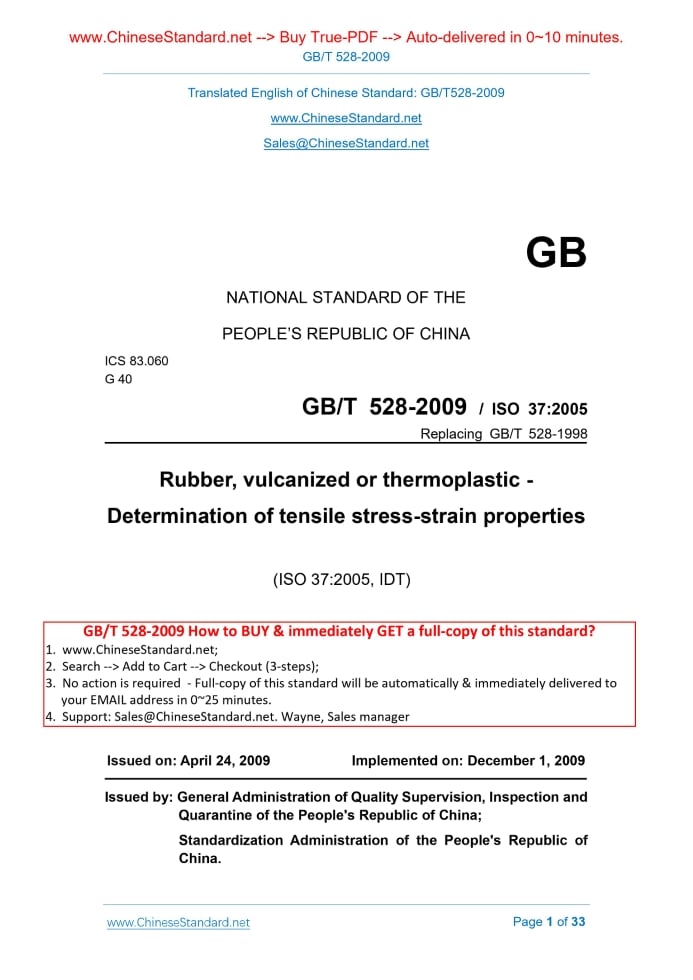
GB NATIONAL STANDARD OF THE PEOPLE’S REPUBLIC OF CHINA ICS 83.060 G 40 GB/T 528-2009 / ISO 37.2005 Replacing GB/T 528-1998 Rubber, vulcanized or thermoplastic - Determination of tensile stress-strain properties (ISO 37.2005, IDT) Issued on. APRIL 24, 2009 Implemented on. DECEMBER 1, 2009 Issued by. General Administration of Quality Supervision, Inspection and Quarantine of the People's Republic of China; Standardization Administration of the People's Republic of China.
Table of Contents
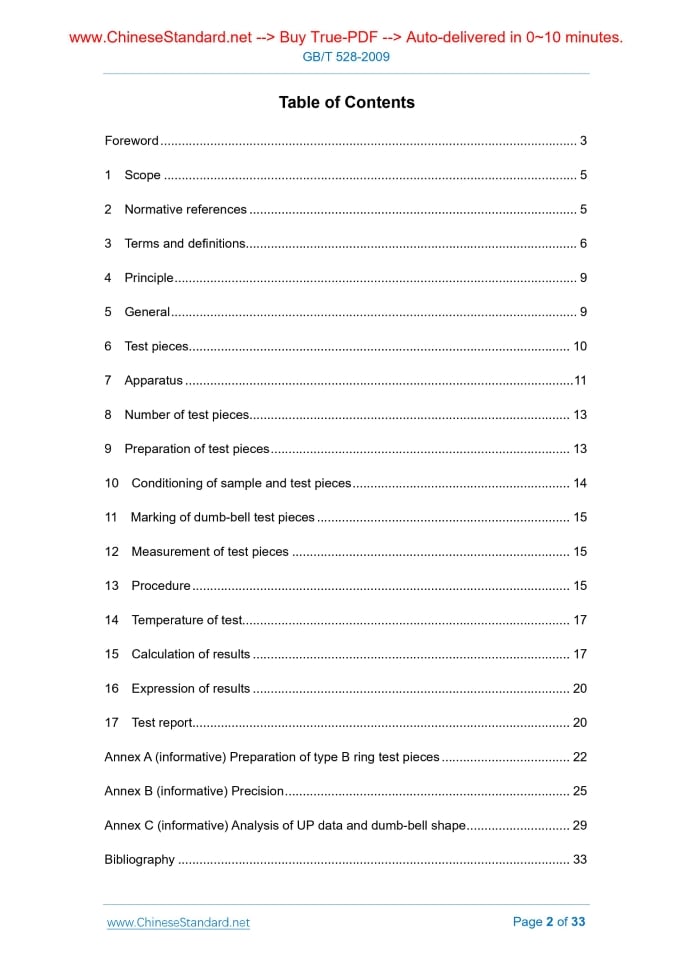
Foreword... 3 1 Scope... 5 2 Normative references... 5 3 Terms and definitions... 6 4 Principle... 9 5 General... 9 6 Test pieces... 10 7 Apparatus... 11 8 Number of test pieces... 13 9 Preparation of test pieces... 13 10 Conditioning of sample and test pieces... 14 11 Marking of dumb-bell test pieces... 15 12 Measurement of test pieces... 15 13 Procedure... 15 14 Temperature of test... 17 15 Calculation of results... 17 16 Expression of results... 20 17 Test report... 20 Annex A (informative) Preparation of type B ring test pieces... 22 Annex B (informative) Precision... 25 Annex C (informative) Analysis of UP data and dumb-bell shape... 29 Bibliography... 33Foreword
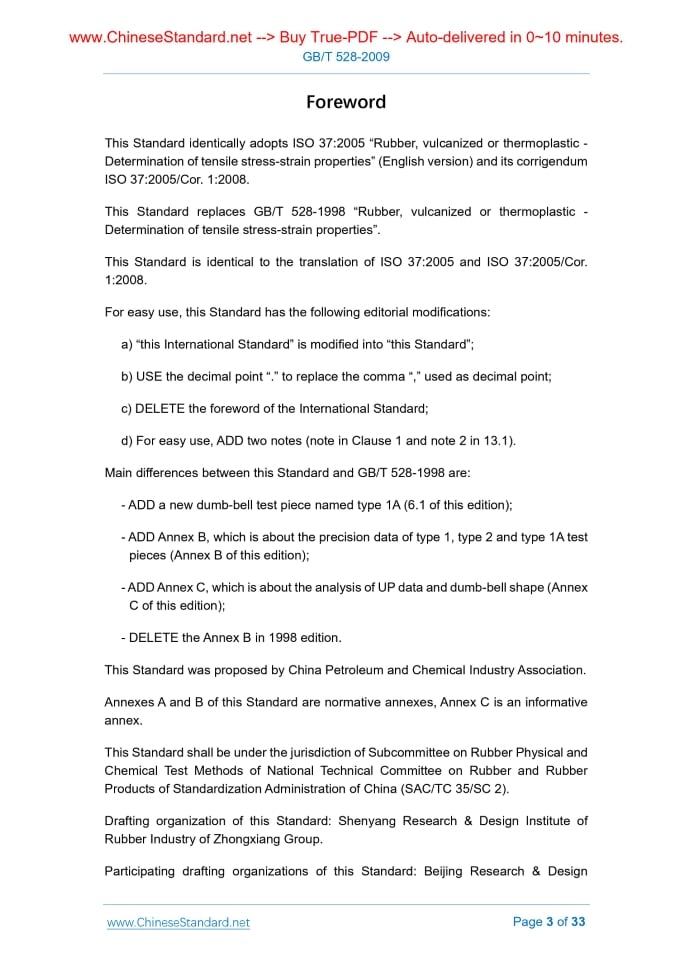
This Standard identically adopts ISO 37.2005 “Rubber, vulcanized or thermoplastic - Determination of tensile stress-strain properties” (English version) and its corrigendum ISO 37.2005/Cor. 1.2008. This Standard replaces GB/T 528-1998 “Rubber, vulcanized or thermoplastic - Determination of tensile stress-strain properties”. This Standard is identical to the translation of ISO 37.2005 and ISO 37.2005/Cor. 1.2008. For easy use, this Standard has the following editorial modifications. a) “this International Standard” is modified into “this Standard”; b) USE the decimal point “.” to replace the comma “,” used as decimal point; c) DELETE the foreword of the International Standard; d) For easy use, ADD two notes (note in Clause 1 and note 2 in 13.1). Main differences between this Standard and GB/T 528-1998 are. - ADD a new dumb-bell test piece named type 1A (6.1 of this edition); - ADD Annex B, which is about the precision data of type 1, type 2 and type 1A test pieces (Annex B of this edition); - ADD Annex C, which is about the analysis of UP data and dumb-bell shape (Annex C of this edition); - DELETE the Annex B in 1998 edition. This Standard was proposed by China Petroleum and Chemical Industry Association. Annexes A and B of this Standard are normative annexes, Annex C is an informative annex. This Standard shall be under the jurisdiction of Subcommittee on Rubber Physical and Chemical Test Methods of National Technical Committee on Rubber and Rubber Products of Standardization Administration of China (SAC/TC 35/SC 2). Drafting organization of this Standard. Shenyang Research & Design Institute of Rubber Industry of Zhongxiang Group. Participating drafting organizations of this Standard. Beijing Research & Design Institute of Rubber Industry, Chengde Precision Testing Machine Co., Ltd. Main drafters of this Standard. Fei Kanghong and Ji Lianzhong. Participating drafters of this Standard. Xie Junfang, Ding Xiaoying, Zhao Lingyun and Wang Xinhua. The previous edition of the standards replaced by this Standard are as follows. - GB/T 528-1992, GB/T 528-1998. Rubber, vulcanized or thermoplastic - Determination of tensile stress-strain properties Warning. Personnel using this Standard shall have practical experience in formal laboratory work. This Standard does not purport to address safety issues that may arise from the use of this Standard. It is the responsibility of the user to take appropriate safety and health measures and to ensure compliance with the relevant national regulations.1 Scope
This Standard describes a method for the determination of the tensile stress-strain properties of vulcanized and thermoplastic rubbers.2 Normative references
The provisions in following documents become the provisions of this Standard through reference in this Standard. For dated references, the subsequent amendments (excluding corrigendum) or revisions do not apply to this Standard, however, parties who reach an agreement based on this Standard are encouraged to study if the latest versions of these documents are applicable. For undated references, the latest edition of the referenced document applies.3 Terms and definitions
For the purposes of this Standard, the following terms and definitions apply. Tensile strain, expressed as a percentage of the test length, produced in the test piece by a tensile stress.4 Principle
Standard test pieces, either dumb-bells or rings, are stretched in a tensile-testing machine at a constant rate of traverse of the driven grip or pulley. Readings of force and elongation are taken as required during the uninterrupted stretching of the test piece and when it breaks.5 General
Dumb-bell and ring test pieces do not necessarily give the same values for their respective stress-strain properties. This is mainly because in stretched rings the stress is not uniform over the cross-section.6 Test pieces
The standard type B ring test piece shall have an internal diameter of 8.0 mm ± 0.1 mm. The median axial thickness and median radial width shall be 1.0 mm ± 0.1 mm. The radial width within any ring shall nowhere deviate from the median by more than 0.1 mm.7 Apparatus
The instrument for measuring the thickness of dumb-bell test pieces and the axial thickness of ring test pieces shall be in accordance with that used in method A of GB/T 2941. A calibrated cone gauge or other suitable equipment shall be used to measure the internal diameter of ring test pieces.8 Number of test pieces
A minimum of three test pieces shall be tested.9 Preparation of test pieces
Ring test pieces shall be prepared by cutting or punching, using the appropriate methods described in GB/T 2941, or by moulding.10 Conditioning of sample and test pieces
For non-product tests the maximum time between vulcanization and testing shall be 4 weeks and, for evaluations intended to be comparable, the tests, as far as possible, shall be carried out after the same time interval.11 Marking of dumb-bell test pieces
If using a non-contact extensometer, mark the dumb-bell test pieces with two reference marks to define the test length as specified in Table 1, using a suitable marker. The test piece shall be unstrained when it is marked.12 Measurement of test pieces
Measure the radial width and axial thickness at six approximately equally spaced positions around the ring. ......Source: Above contents are excerpted from the full-copy PDF -- translated/reviewed by: www.ChineseStandard.net / Wayne Zheng et al.