GB/T 40521.1-2021 PDF English
Price & Delivery
US$170.00 · In stock · Download in 9 secondsGB/T 40521.1-2021: Passenger cars test track for a severe lane-change manoeuvre - Part 1: Double lane-change
Delivery: 9 seconds. True-PDF full-copy in English & invoice will be downloaded + auto-delivered via email. See step-by-step procedure
Status: Valid
| Standard ID | USD | BUY PDF | Delivery | Standard Title (Description) | Status |
| GB/T 40521.1-2021 | 170 | Add to Cart | Auto, 9 seconds. | Passenger cars test track for a severe lane-change manoeuvre - Part 1: Double lane-change | Valid |
Click to Preview this PDF
Similar standards
GB/T 40521.1-2021: Passenger cars test track for a severe lane-change manoeuvre - Part 1: Double lane-change
---This is an excerpt. Full copy of true-PDF in English version (including equations, symbols, images, flow-chart, tables, and figures etc.), auto-downloaded/delivered in 9 seconds, can be purchased online: https://www.ChineseStandard.net/PDF.aspx/GBT40521.1-2021
GB NATIONAL STANDARD OF THE PEOPLE’S REPUBLIC OF CHINA ICS 43.020 CCS T 41 Passenger cars test track for a severe lane-change manoeuvre - Part 1: Double lane-change (ISO 3888-1:2018, Passenger cars - Test track for a severe lane-change manoeuvre - Part 1: Double lane-change, MOD) ISSUED ON: AUGUST 20, 2021 IMPLEMENTED ON: MARCH 01, 2022 Issued by: State Administration for Market Regulation; Standardization Administration of the People’s Republic of China.
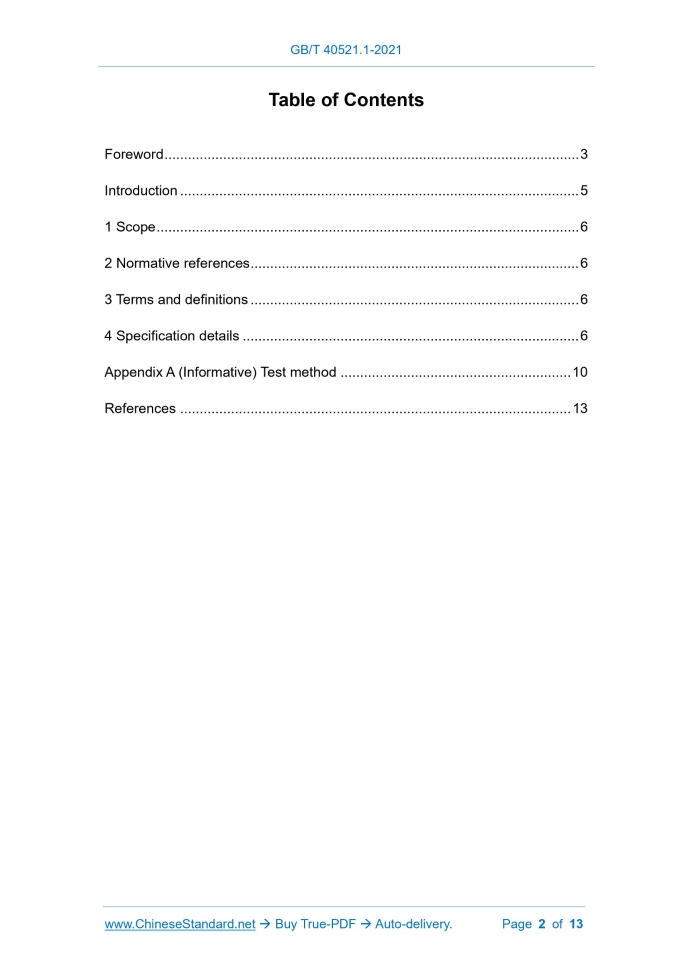
Table of Contents
Foreword ... 3 Introduction ... 5 1 Scope ... 6 2 Normative references ... 6 3 Terms and definitions ... 6 4 Specification details ... 6 Appendix A (Informative) Test method ... 10 References ... 13 Passenger cars test track for a severe lane-change manoeuvre - Part 1: Double lane-change1 Scope
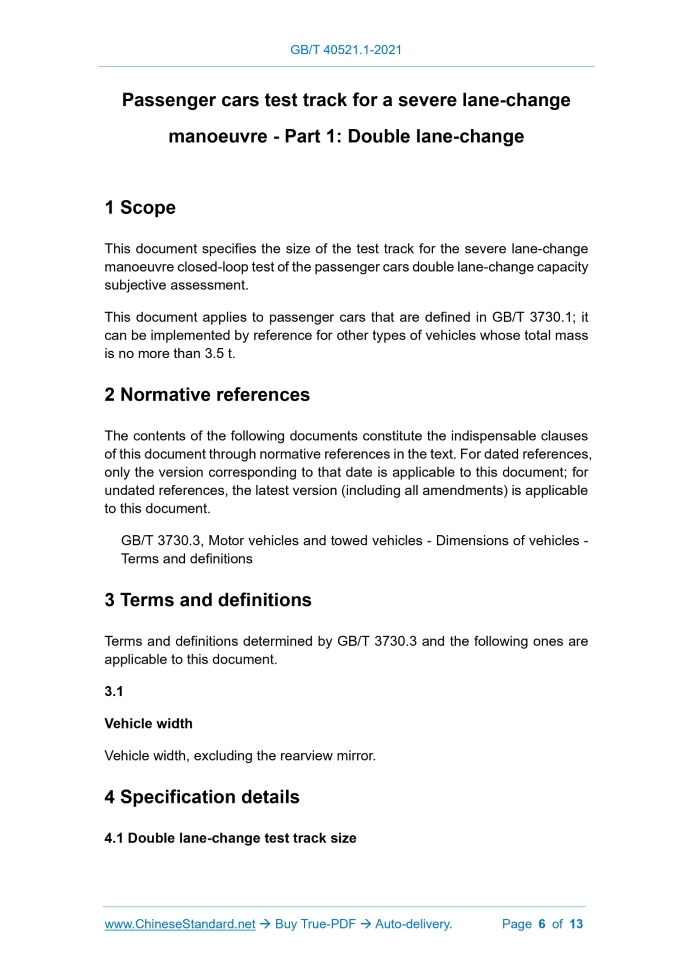
This document specifies the size of the test track for the severe lane-change manoeuvre closed-loop test of the passenger cars double lane-change capacity subjective assessment. This document applies to passenger cars that are defined in GB/T 3730.1; it can be implemented by reference for other types of vehicles whose total mass is no more than 3.5 t.2 Normative references
The contents of the following documents constitute the indispensable clauses of this document through normative references in the text. For dated references, only the version corresponding to that date is applicable to this document; for undated references, the latest version (including all amendments) is applicable to this document. GB/T 3730.3, Motor vehicles and towed vehicles - Dimensions of vehicles - Terms and definitions3 Terms and definitions
Terms and definitions determined by GB/T 3730.3 and the following ones are applicable to this document. 3.1 Vehicle width Vehicle width, excluding the rearview mirror.4 Specification details
4.1 Double lane-change test track sizeAppendix A
(Informative) Test method A.1 Severe lane-change manoeuvre of double lane-change A.1.1 Principle The severe lane-change manoeuvre of double lane-change is a dynamic evaluation method. The process is to drive the vehicle from the initial lane to the adjacent parallel lane quickly, and then back to the original lane, during which the vehicle shall not exceed the lane boundary. A.1.2 Some characteristics for evaluating lane-keeping ability The severe lane-change manoeuvre of double lane-change is used to reproduce the transient lane-keeping ability during emergency closed-loop control in actual driving. The driver can select the vehicle driving path in the set test track. For the performance of the "person-vehicle-road" system in actual driving, this kind of preview control is a very important evaluation method. After selecting a suitable driving path, the driver can repeat driving on this path at a certain degree of accuracy. A.1.3 Limitations This test is a closed-loop test. The driver's control strategy will have a significant impact on the test results. Objective measurement of vehicle dynamics-related performance should not be performed; only subjective evaluation is recommended. Due to the difference in the driving path of the vehicle during each measurement, the vehicle speed obtained from multiple tests will appear obvious dispersion. Even if the longitudinal control process of the vehicle is strictly limited, more consistent vehicle speed data cannot be obtained. Therefore, classification shall not be based on vehicle speed, and the minimum vehicle speed for testing shall not be specified. A.1.4 Conclusion This document only defines the geometric dimensions of the test track for subjective evaluation of vehicle dynamics. A.2 Examples of the test method A.2.1 Summary This test is often used for subjective evaluation of vehicles. Only drivers with corresponding skills are allowed to carry out this test. If any traffic cone placed according to 4.2 is not touched during the test, it is regarded as passed smoothly. The measuring distance (take the estimated average vehicle speed as an example) is from the start of the first section of the lane to the end of the fifth section. The gear, braking energy recovery mode, working status of ESP and other information used in the test shall be recorded in the test report. A.2.2 Test method 1 The recommended vehicle speed when entering section 1 is (80±3) km/h, or higher or lower, which shall be recorded in the test report. Throughout the test, the vehicle speed shall be kept as stable as possible. Other control methods (such as specific steering control) can also be used. The vehicle speed when driving out of section 5 shall be recorded in the test report. Some typical uses of this test are as follows: -- Analyze time-domain signals of steering input or body motion parameters; -- Evaluate driving control strategies; -- Subjective evaluation of vehicles. A.2.3 Test method 2 The speed of the vehicle entering section 1 shall be the maximum speed that can pass this test procedure smoothly. One of the following two accelerator positions can be selected: -- Keep the accelerator position as stable as possible throughout the test. If necessary, a trail test can be performed to determine the accelerator position. -- Any accelerator position can also be used in the test. ......Source: Above contents are excerpted from the full-copy PDF -- translated/reviewed by: www.ChineseStandard.net / Wayne Zheng et al.