GB/T 39498-2020 PDF English
Price & Delivery
US$265.00 · In stock · Download in 9 secondsGB/T 39498-2020: Guidelines for the Use and Control of Key Chemical Substances in Consumer Product
Delivery: 9 seconds. True-PDF full-copy in English & invoice will be downloaded + auto-delivered via email. See step-by-step procedure
Status: Valid
| Standard ID | USD | BUY PDF | Delivery | Standard Title (Description) | Status |
| GB/T 39498-2020 | 265 | Add to Cart | Auto, 9 seconds. | Guidelines for the Use and Control of Key Chemical Substances in Consumer Product | Valid |
Click to Preview this PDF
Similar standards
GB/T 39498-2020: Guidelines for the Use and Control of Key Chemical Substances in Consumer Product
---This is an excerpt. Full copy of true-PDF in English version (including equations, symbols, images, flow-chart, tables, and figures etc.), auto-downloaded/delivered in 9 seconds, can be purchased online: https://www.ChineseStandard.net/PDF.aspx/GBT39498-2020
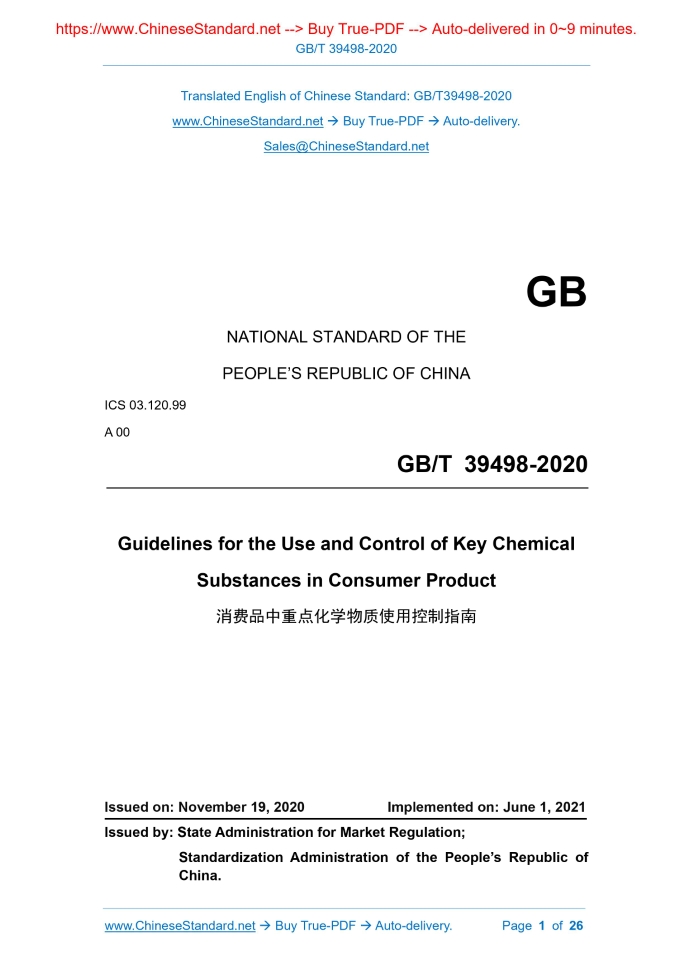
GB NATIONAL STANDARD OF THE PEOPLE’S REPUBLIC OF CHINA ICS 03.120.99 A 00 Guidelines for the Use and Control of Key Chemical Substances in Consumer Product Issued on. NOVEMBER 19, 2020 Implemented on. JUNE 1, 2021 Issued by. State Administration for Market Regulation; Standardization Administration of the People’s Republic of China.
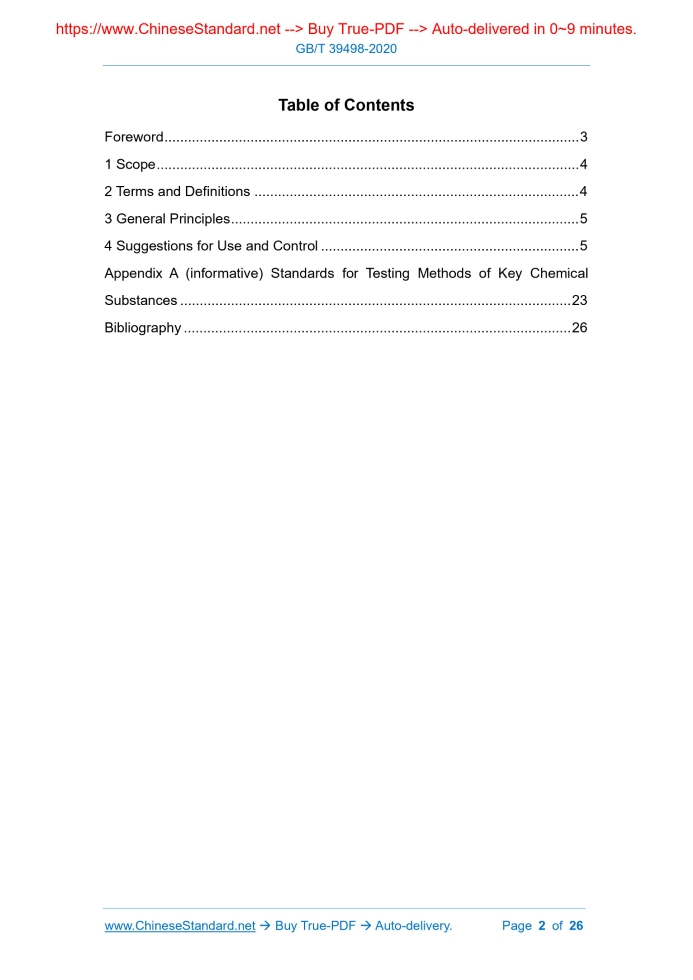
Table of Contents
Foreword... 3 1 Scope... 4 2 Terms and Definitions... 4 3 General Principles... 5 4 Suggestions for Use and Control... 5 Appendix A (informative) Standards for Testing Methods of Key Chemical Substances... 23 Bibliography... 26Foreword
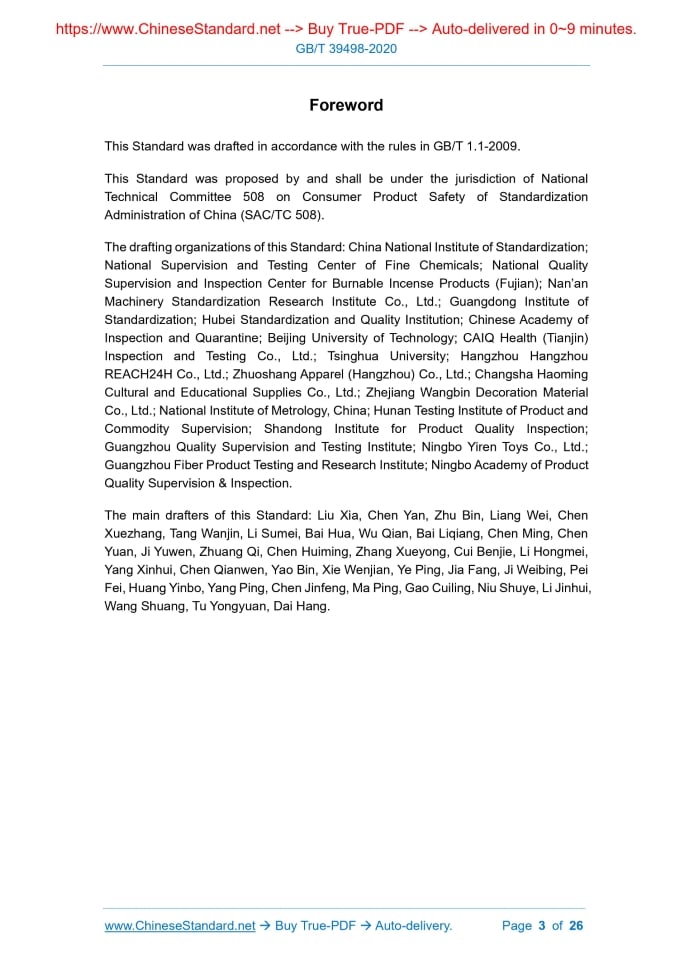
This Standard was drafted in accordance with the rules in GB/T 1.1-2009. This Standard was proposed by and shall be under the jurisdiction of National Technical Committee 508 on Consumer Product Safety of Standardization Administration of China (SAC/TC 508). The drafting organizations of this Standard. China National Institute of Standardization; National Supervision and Testing Center of Fine Chemicals; National Quality Supervision and Inspection Center for Burnable Incense Products (Fujian); Nan’an Machinery Standardization Research Institute Co., Ltd.; Guangdong Institute of Standardization; Hubei Standardization and Quality Institution; Chinese Academy of Inspection and Quarantine; Beijing University of Technology; CAIQ Health (Tianjin) Inspection and Testing Co., Ltd.; Tsinghua University; Hangzhou Hangzhou REACH24H Co., Ltd.; Zhuoshang Apparel (Hangzhou) Co., Ltd.; Changsha Haoming Cultural and Educational Supplies Co., Ltd.; Zhejiang Wangbin Decoration Material Co., Ltd.; National Institute of Metrology, China; Hunan Testing Institute of Product and Commodity Supervision; Shandong Institute for Product Quality Inspection; Guangzhou Quality Supervision and Testing Institute; Ningbo Yiren Toys Co., Ltd.; Guangzhou Fiber Product Testing and Research Institute; Ningbo Academy of Product Quality Supervision & Inspection. The main drafters of this Standard. Liu Xia, Chen Yan, Zhu Bin, Liang Wei, Chen Xuezhang, Tang Wanjin, Li Sumei, Bai Hua, Wu Qian, Bai Liqiang, Chen Ming, Chen Yuan, Ji Yuwen, Zhuang Qi, Chen Huiming, Zhang Xueyong, Cui Benjie, Li Hongmei, Yang Xinhui, Chen Qianwen, Yao Bin, Xie Wenjian, Ye Ping, Jia Fang, Ji Weibing, Pei Fei, Huang Yinbo, Yang Ping, Chen Jinfeng, Ma Ping, Gao Cuiling, Niu Shuye, Li Jinhui, Wang Shuang, Tu Yongyuan, Dai Hang. Guidelines for the Use and Control of Key Chemical Substances in Consumer Product1 Scope
This Standard provides general principles and suggestions for the use and control of key chemical substances in consumer products. This Standard is applicable to the use and control of key chemical substances in consumer products.2 Terms and Definitions
The following terms and definitions are applicable to this document. 2.1 Consumer Product Consumer product refers to product designed and produced for, but not limited to, personal use, including product components, parts, accessories, packaging and instructions for use. 2.2 Release Amounts Release amounts refers to the amount of a certain chemical substance released from a sample into a medium (for example, solvent, water or air), which is tested in accordance with the prescribed test method. 2.3 Migration Migration refers to the amount of a certain chemical substance migrated into a medium (for example, solvent, water or air) after being immersed or extracted in accordance with the prescribed test method. 2.4 Content Content refers to the ratio of the mass of a certain element or substance to the total mass of the sample. 2.5 Tolerable Risk Tolerable risk refers to a risk that is acceptable within a certain range in accordance with the current social value orientation. 2.6 Banned Substance Banned substance refers to a chemical substance that cannot be added. 2.7 Restricted Substance Restricted substance refers to a chemical substance that cannot exceed the limit requirements when present as an impurity or by-product.3 General Principles
3.1 The content of key chemical substances in consumer products is closely related to the protection of consumers’ personal health and safety, and ecological environment safety, 3.2 It is of great importance to control the safety risk level of key chemical substances in consumer products within the range of tolerable risks. 3.3 In terms of consumer products not covered by this Standard, the related chemical substances may be implemented with reference to similar products provided in this Standard.4 Suggestions for Use and Control
The suggestions for the use and control of key chemical substances in consumer products are shown in Table 1.Appendix A
(informative) Standards for Testing Methods of Key Chemical Substances The standards of testing methods that may be taken as a reference for key chemical substances are as follows. GB/T 4615-2013 Poly (vinyl chloride) - Determination of Residual Vinyl Chloride Monomer Gas - Chromatographic Method GB 6675.1-2014 Toy Safety - Party 1.Basic Code GB 6675.4-2014 Safety of Toys - Part 4.Migration of Certain Elements GB/T 7917.4-1987 Standard Methods of Hygienic Test for Cosmetics - Methanol GB/T 9722-2006 Chemical Reagent - General Rules for the Gas Chromatography GB/T 17657-2013 Test Methods of Evaluating the Properties of Wood-based Panels and Surface Decorated Wood-based Panels GB 21027-2007 Request in Common Use of Security for Students Articles GB/T 22048-2015 Determination of Certain Phthalate Esters in Toys and Children’s Products GB/T 22807-2008 Leather and Fur - Chemical Tests - Determination of Chromium VI Content GB/T 24153-2009 Rubber and Elastomer Materials - Determination of N-nitrosamines GB 24410-2009 Indoor Decorating and Refurbishing Materials - Limit of Harmful Substances of Water Based Woodenware Coatings GB 25038-2010 Rubber Shoes Healthy and Safe Specification GB/T 26125-2011 Electrical and Electronic Products - Determination of Six Regulated Substances (lead, mercury, cadmium, hexavalent chromium, polybrominated biphenyls, polybrominated diphenyl ethers) GB/T 26713-2011 Footwear - Chemical Tests - Determination of Dimethyl Fumarate (DMF) GB/T 28020-2011 Adornment - Determination of Baneful Elements - X-ray Fluorescence Spectrometric Method GB/T 28021-2011 Adornment - Determination of Baneful Elements - Method of Spectrometry GB 28480-2012 Adornment - Provision for Limit of Baneful Elements GB 28481-2012 Limit of Harmful Substances of Plastic Furniture GB 28482-2012 Safety Requirements of Soothers for Babies and Young Children GB 30585-2014 Safety Technical Specifications for Children’s Footwear GB/T 30795-2014 The Test Method of Food Detergents - Determination of Methanol GB/T 30797-2014 The Test Method of Foot Detergents - Determination of Total Arsenic SN/T 1545-2005 Method for the Concurrent Determination of Benzene Toluene Xylene and Diisocyanate in Solvent Coatings for Import and Export - Gas Chromatography Method ......Source: Above contents are excerpted from the full-copy PDF -- translated/reviewed by: www.ChineseStandard.net / Wayne Zheng et al.