GB/T 3903.2-2017 PDF English
Price & Delivery
US$75.00 · In stock · Download in 9 secondsGB/T 3903.2-2017: Footwear -- Test methods for whole shoe -- Abrasion resistance
Delivery: 9 seconds. True-PDF full-copy in English & invoice will be downloaded + auto-delivered via email. See step-by-step procedure
Status: Valid
GB/T 3903.2: Historical versions
| Standard ID | USD | BUY PDF | Delivery | Standard Title (Description) | Status |
| GB/T 3903.2-2017 | 75 | Add to Cart | Auto, 9 seconds. | Footwear -- Test methods for whole shoe -- Abrasion resistance | Valid |
| GB/T 3903.2-2008 | 70 | Add to Cart | Auto, 9 seconds. | Footwear -- General test methods -- Abrasion resistance | Obsolete |
| GB/T 3903.2-1994 | 199 | Add to Cart | 2 days | General test method for footwear - Test method of abrasion resistance | Obsolete |
Click to Preview this PDF
Similar standards
GB/T 3903.2-2017: Footwear -- Test methods for whole shoe -- Abrasion resistance
---This is an excerpt. Full copy of true-PDF in English version (including equations, symbols, images, flow-chart, tables, and figures etc.), auto-downloaded/delivered in 9 seconds, can be purchased online: https://www.ChineseStandard.net/PDF.aspx/GBT3903.2-2017GB NATIONAL STANDARD OF THE PEOPLE’S REPUBLIC OF CHINA ICS 61.060 Y 78 Replacing GB/T 3903.2-2008 Footwear -- Test methods for whole shoe -- Abrasion resistance Issued on. DECEMBER 29, 2017 Implemented on. JULY 1, 2018 Issued by. General Administration of Quality Supervision, Inspection and Quarantine of the People’s Republic of China; Standardization Administration of the People’s Republic of China.
Table of Contents
Foreword... 3 1 Scope... 4 2 Principle... 4 3 Equipment and materials... 4 4 Test piece... 5 5 Test conditions... 5 6 Test procedures... 5 7 Test results... 6 8 Test report... 7Foreword
This Standard was drafted in accordance with the rules given in GB/T 1.1-2009. This Standard supersedes GB/T 3903.2-2008 Footwear -- General test methods -- Abrasion resistance. Compared with GB/T 3903.2-2008, the main technical differences are as follows. — MODIFY the standard name; — MODIFY the scope of application; — DELETE the “Terms and definitions”; — MODIFY the requirements for the abrasion resistance tester; — MODIFY the requirements for sampling and environmental conditioning; — MODIFY the test conditions; — MODIFY the test procedures; — MODIFY the test results. Attention is drawn to the possibility that some of the elements of this document may be the subject of patent rights. The issuing authority shall not be held responsible for identifying any or all such patent rights. This Standard was proposed by the China National Light Industry Council. This Standard shall be under the jurisdiction of National Technical Committee for Standardization of Shoemaking (SAC/TC 305). Drafting organizations of this Standard. China Leather and Footwear Industry Research Institute, Anta (China) Co., Ltd, Shenzhen IMPAQ Testing Technology Co., Ltd, China Leather and Footwear Industry Research Institute (Jinjiang) Co., Ltd, Guangdong Wanlima Industry Co., Ltd. Main drafters of this Standard. Yu Shuxian, Li Su, Feng Xue, Zeng Jianwei, Shen Yimin, Wang Yaping. The previous released editions of this Standard are as follows. — GB 3905-1983; — GB/T 3903.2-1994, GB/T 3903.2-2008. Footwear -- Test methods for whole shoe -- Abrasion resistance1 Scope
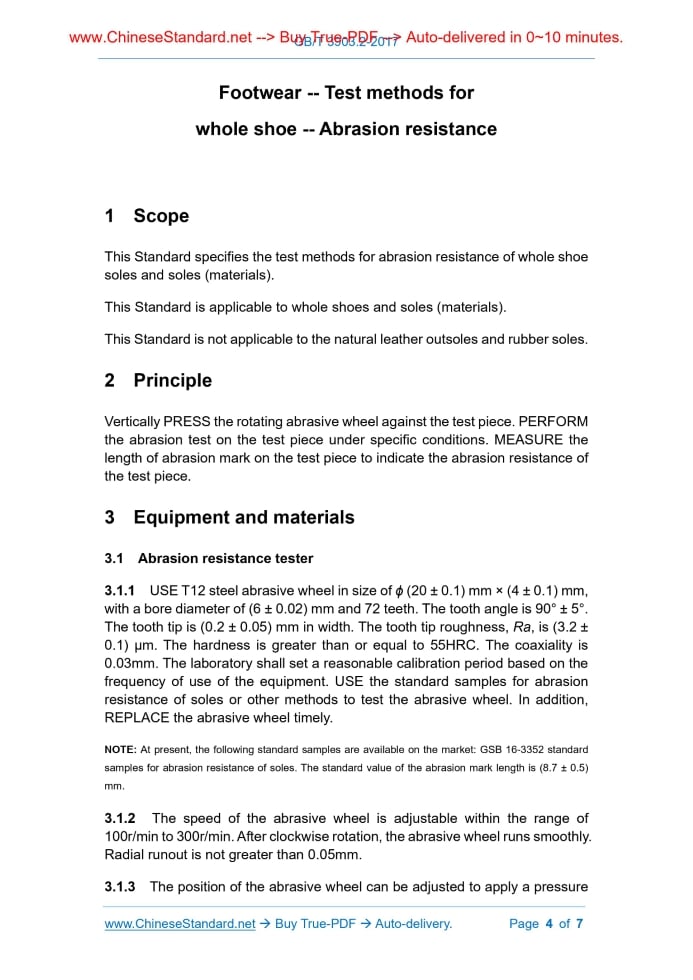
This Standard specifies the test methods for abrasion resistance of whole shoe soles and soles (materials). This Standard is applicable to whole shoes and soles (materials). This Standard is not applicable to the natural leather outsoles and rubber soles.2 Principle
Vertically PRESS the rotating abrasive wheel against the test piece. PERFORM the abrasion test on the test piece under specific conditions. MEASURE the length of abrasion mark on the test piece to indicate the abrasion resistance of the test piece.3 Equipment and materials
3.1 Abrasion resistance tester 3.1.1 USE T12 steel abrasive wheel in size of ϕ (20 ± 0.1) mm × (4 ± 0.1) mm, with a bore diameter of (6 ± 0.02) mm and 72 teeth. The tooth angle is 90° ± 5°. The tooth tip is (0.2 ± 0.05) mm in width. 3.1.3 The position of the abrasive wheel can be adjusted to apply a pressure of 0N to 19.6N to the test piece. 3.1.4 The tester shall be equipped with a test piece support device (such as last) and a test piece fixture so that the test piece’s outsole surface remains horizontal, and that no loosening or displacement will occur during the test. 3.2 Vernier caliper At least accurate to 0.02mm.4 Test piece
Each set of test pieces shall not be less than one pair of whole shoes or soles.5 Test conditions
5.1 The abrasive wheel applies a pressure of (4.9 ± 0.1) N to the test piece (in case of special requirements, it can be selected within the range of 0N to 19.6N). 5.2 The speed of the abrasive wheel is (191 ± 5) r/min (in case of special requirements, it can be selected within the allowable range of the tester). 5.3 The test is continuous for 20min, or the abrasive wheel’s total number of revolutions is 3,820 (in case of special requirements, it can be selected otherwise).6 Test procedures
6.1 Before the test, DETERMINE the test site first. If the outsole is made of single material, it can be tested at any flat part of the outsole. If the outsole’s origin of force in contact with the ground (e.g. the forefoot flexion area and the rear-foot landing area when the wearer is in a standing position) is composed of two or more materials, the abrasion resistance of each material shall be tested. 6.7 ADJUST the pressure that is applied to the test pieces by the abrasive wheel to the specified value. 6.8 ADJUST the test time or total number of revolutions to the specified value. 6.9 ADJUST the speed of the abrasive wheel to the specified value. RESET the time display. START the test afterwards. 6.10 After the tester is automatically shut down according to the set parameters, USE a Vernier caliper to measure the length of each side of the abrasion mark within 1h.7 Test results
7.1 The test result is expressed in the edge length of the abrasion mark, in millimeters. The result is retained to one decimal place. 7.2 There shall be at least two measuring points for each material. TAKE the arithmetic mean of four data measured at two points. 7.3 For outsoles consisting of two or more materials, the test results of each material are indicated separately. 7.4 If there are any conditions such as sticky abrasion part or sticking to the abrasive wheel, worn-out outsole, test piece being pressed by the abrasive wheel rod, etc., RECORD the test.8 Test report
The test report shall include at least the following. ......Source: Above contents are excerpted from the full-copy PDF -- translated/reviewed by: www.ChineseStandard.net / Wayne Zheng et al.