GB/T 37996-2019 PDF English
Price & Delivery
US$170.00 · In stock · Download in 9 secondsGB/T 37996-2019: Rubber seals used in the power lithium battery
Delivery: 9 seconds. True-PDF full-copy in English & invoice will be downloaded + auto-delivered via email. See step-by-step procedure
Status: Valid
| Standard ID | USD | BUY PDF | Delivery | Standard Title (Description) | Status |
| GB/T 37996-2019 | 170 | Add to Cart | Auto, 9 seconds. | Rubber seals used in the power lithium battery | Valid |
Click to Preview this PDF
Similar standards
GB/T 37996-2019: Rubber seals used in the power lithium battery
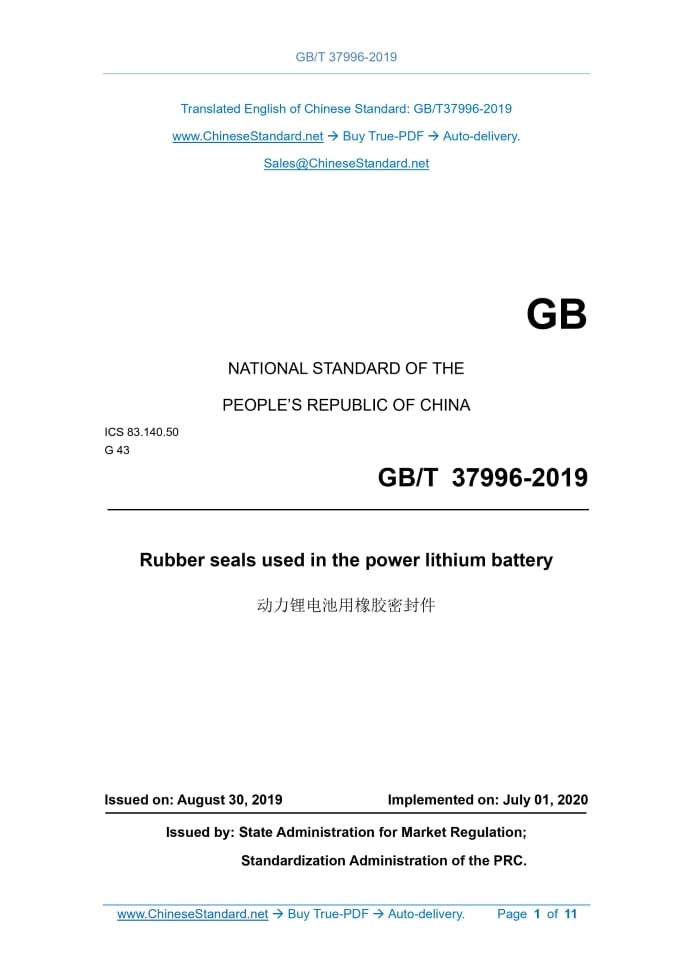
---This is an excerpt. Full copy of true-PDF in English version (including equations, symbols, images, flow-chart, tables, and figures etc.), auto-downloaded/delivered in 9 seconds, can be purchased online: https://www.ChineseStandard.net/PDF.aspx/GBT37996-2019GB NATIONAL STANDARD OF THE PEOPLE’S REPUBLIC OF CHINA ICS 83.140.50 G 43 Rubber seals used in the power lithium battery ISSUED ON: AUGUST 30, 2019 IMPLEMENTED ON: JULY 01, 2020 Issued by: State Administration for Market Regulation; Standardization Administration of the PRC.
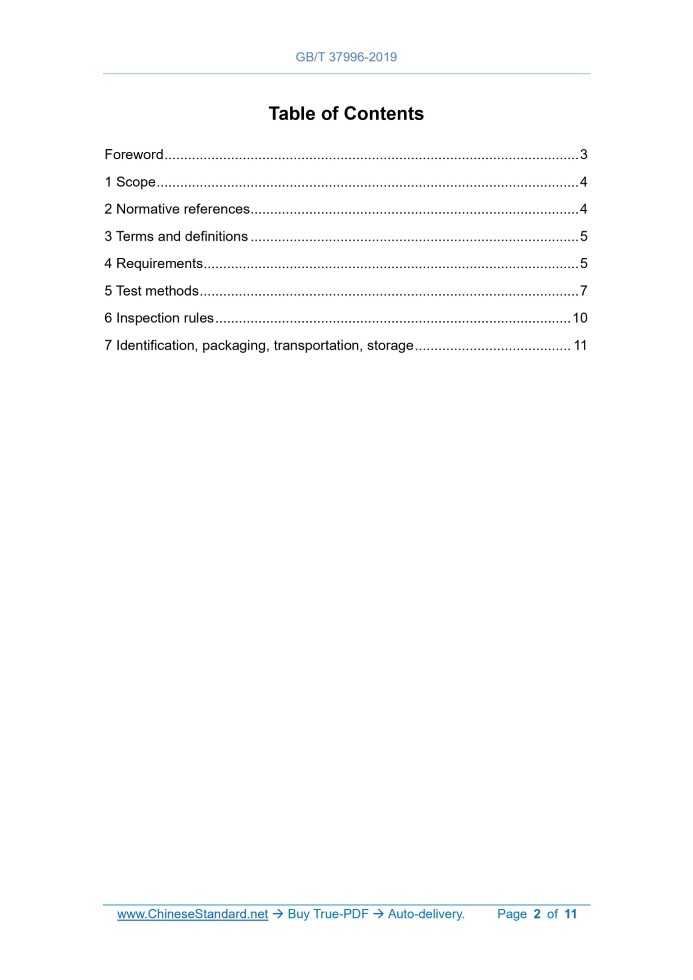
Table of Contents
Foreword ... 3 1 Scope ... 4 2 Normative references ... 4 3 Terms and definitions ... 5 4 Requirements ... 5 5 Test methods ... 7 6 Inspection rules ... 10 7 Identification, packaging, transportation, storage ... 11 Rubber seals used in the power lithium battery1 Scope
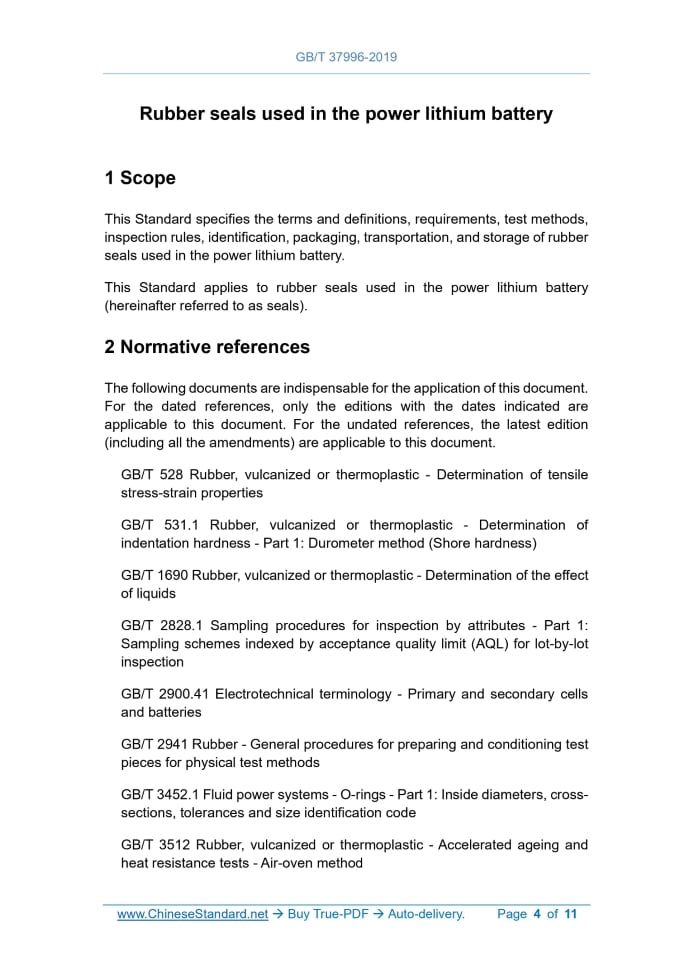
This Standard specifies the terms and definitions, requirements, test methods, inspection rules, identification, packaging, transportation, and storage of rubber seals used in the power lithium battery. This Standard applies to rubber seals used in the power lithium battery (hereinafter referred to as seals).2 Normative references
The following documents are indispensable for the application of this document. For the dated references, only the editions with the dates indicated are applicable to this document. For the undated references, the latest edition (including all the amendments) are applicable to this document. GB/T 528 Rubber, vulcanized or thermoplastic - Determination of tensile stress-strain properties GB/T 531.1 Rubber, vulcanized or thermoplastic - Determination of indentation hardness - Part 1: Durometer method (Shore hardness) GB/T 1690 Rubber, vulcanized or thermoplastic - Determination of the effect of liquids GB/T 2828.1 Sampling procedures for inspection by attributes - Part 1: Sampling schemes indexed by acceptance quality limit (AQL) for lot-by-lot inspection GB/T 2900.41 Electrotechnical terminology - Primary and secondary cells and batteries GB/T 2941 Rubber - General procedures for preparing and conditioning test pieces for physical test methods GB/T 3452.1 Fluid power systems - O-rings - Part 1: Inside diameters, cross- sections, tolerances and size identification code GB/T 3512 Rubber, vulcanized or thermoplastic - Accelerated ageing and heat resistance tests - Air-oven method GB/T 3672.1 Rubber - Tolerances of products - Part 1: Dimensional tolerances GB/T 5721 General rules of identification, packaging, transportation and storage for rubber sealing products GB/T 7759.1 Rubber, vulcanized or thermoplastic - Determination of compression set - Part 1: At ambient or elevated temperatures3 Terms and definitions
The terms and definitions defined in GB/T 2900.41 apply to this document.4 Requirements
4.1 Appearance There shall be no rubber edge, lack of rubber, cracks, air bubbles, impurities, and filler protrusions on the surface of seals. 4.2 Specification and dimension The dimensions and tolerances of the O-ring shall comply with the provisions of the G series in GB/T 3452.1. The dimensions and tolerances of the rectangular ring shall comply with the provisions of M2 level in GB/T 3672.1. 4.3 Insulation resistance The resistance index is negotiated by the manufacturer and the user. 4.4 Properties of rubber materials The seal is made of ethylene-propylene rubber or fluororubber as the base material. The property requirements are shown in Table 1 and Table 2. of GB/T 1690 (take the specimen out of the liquid until the measurement is completed; it shall not exceed 5 min); calculate the percentage of mass change.6 Inspection rules
6.1 For rubber materials produced in the same shift and machine, no more than 50 kg is a batch. For seals of the same specification produced from the same batch of rubber materials, no more than 5000 pieces are a batch. 6.2 500 g shall be randomly taken from each batch of rubber materials to prepare specimens. According to the requirements of items 1 to 4 in Table 1 or Table 2, carry out exit-factory inspection. 6.3 The appearance of seals shall be 100% inspected. The dimensions of seals shall be inspected according to GB/T 2828.1. The inspection level is II. The normal single inspection AQL=2.5. For the insulation resistance of seals, 3 seals shall be randomly selected from each batch for testing. 6.4 When one of the following conditions exists, all requirements of Clause 4 shall be inspected: - When the product is transferred to another factory for production or new product is subject to pattern evaluation; - When there are major changes in materials and processes that may affect product properties after formal production; - No less than once every six months during normal production; - When production resumes after a product has been discontinued for more than six months; - When there is a big difference between the exit-factory inspection result and the last type inspection. 6.5 If the appearance inspection of a seal is disqualified, this seal is disqualified. If the dimension of one of the seals is disqualified, this batch is disqualified. If the insulation resistance is disqualified, this batch of seals is disqualified. 6.6 When there is a nonconformity in the inspection results of rubber material, double number of specimens shall be taken for re-inspection of the nonconformity item. If the re-inspection is still disqualified, it is deemed disqualified. ......Source: Above contents are excerpted from the full-copy PDF -- translated/reviewed by: www.ChineseStandard.net / Wayne Zheng et al.