GB/T 34371-2017 PDF English
Price & Delivery
US$145.00 · In stock · Download in 9 secondsGB/T 34371-2017: Risk Assessment for Amusement Ride - General Principles
Delivery: 9 seconds. True-PDF full-copy in English & invoice will be downloaded + auto-delivered via email. See step-by-step procedure
Status: Valid
| Standard ID | USD | BUY PDF | Delivery | Standard Title (Description) | Status |
| GB/T 34371-2017 | 145 | Add to Cart | Auto, 9 seconds. | Risk Assessment for Amusement Ride - General Principles | Valid |
Click to Preview this PDF
Similar standards
GB/T 34371-2017: Risk Assessment for Amusement Ride - General Principles
---This is an excerpt. Full copy of true-PDF in English version (including equations, symbols, images, flow-chart, tables, and figures etc.), auto-downloaded/delivered in 9 seconds, can be purchased online: https://www.ChineseStandard.net/PDF.aspx/GBT34371-2017GB NATIONAL STANDARD OF THE PEOPLE’S REPUBLIC OF CHINA ICS 97.200.40 Y 57 Risk Assessment for Amusement Ride – General Principles Issued on. SEPTEMBER 29, 2017 Implemented on. APRIL 1, 2018 Issued by. General Administration of Quality Supervision, Inspection and Quarantine; Standardization Administration of PRC.
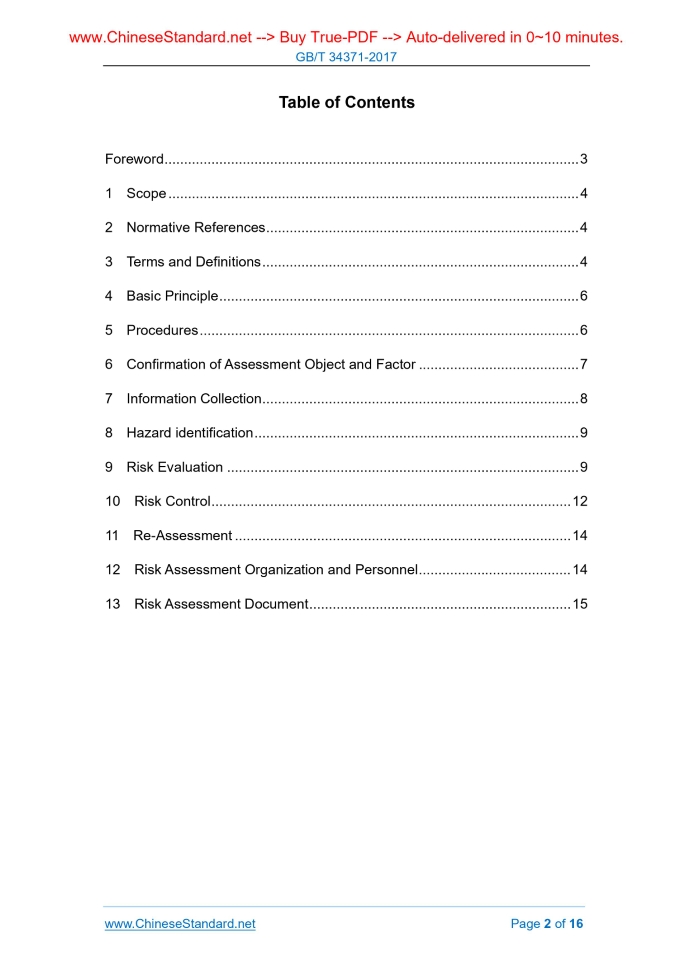
Table of Contents
Foreword... 3 1 Scope... 4 2 Normative References... 4 3 Terms and Definitions... 4 4 Basic Principle... 6 5 Procedures... 6 6 Confirmation of Assessment Object and Factor... 7 7 Information Collection... 8 8 Hazard identification... 9 9 Risk Evaluation... 9 10 Risk Control... 12 11 Re-Assessment... 14 12 Risk Assessment Organization and Personnel... 14 13 Risk Assessment Document... 15Foreword
This Standard was drafted as per the rules specified in GB/T 1.1-2009. This Standard was proposed by and under the jurisdiction of National Technical Committee for Standardization of Ropeway and Amusement Facilities (SAC/TC 250). Drafting organizations of this Standard. China Special Equipment Inspection Institute, Jiangsu Province Special Equipment Safety Supervisions and Inspection Institute, Special Equipment Inspection and Research Institute of Shandong Province, Zhongshan Golden Horse Technology Amusement Equipment Co., Ltd., Wenzhou South Amusement Equipment Engineering Co., Ltd., Shenzhen Huaqiang Fangte Culture & Technology Group Co., Ltd., Shenzhen Overseas Chinese Town Culture Tourism Technology Co., Ltd., Shanghai Special Equipment Supervision and Inspection Technology Research Institute, Chongqing Institute of Special Equipment inspection and Research, Guangdong Institute of Special Equipment Inspection and Research, Zhejiang Special Equipment Inspection and Research Institute, Wuhan Special Equipment Supervision and Inspection Institute, and Beijing Shibaolai Play Equipment Co., Ltd. Chief drafting staffs of this Standard. Zhang Yong, Xiao Yuan, Liu Ran, Li Xiangdong, Chen Hongjun, Xing Youxin, Liu Xiwang, Chen Jiansheng, Zhange Guozhong, Liang Chaohu, Deng Mingxu, Chen Shaopeng, Jia Guoliang, Chen Zheng, Liu Hui, Wen Hongguang, Hao Bingkun, Song Weike, Yi Shuihong, Li Yong, Zhang Xindong, Qian Jianxiong, Wu Zhanwen, and Zhang Bin. Risk Assessment for Amusement Ride – General Principles1 Scope
This Standard specifies the basic principle, procedures of risk assessment for amusement facilities, confirmation of assessment objects and factors, information collection, hazard identification, risk assessment, risk control, re-evaluation, risk assessment organizations and personnel, and risk assessment documents. This Standard is applicable to the risk assessment of amusement facilities.2 Normative References
The following documents are essential to the application of this document. For the dated documents, only the versions with the dates indicated are applicable to this document; for the undated documents, only the latest version (including all the amendments) are applicable to this document. GB 8408 Amusement Device Safety Code GB/T 20002.4-2015 Drafting for Special Aspects in Standards – Part 4.Safety Aspects for Their Inclusion in Standards3 Terms and Definitions
The following terms and definitions stipulated in GB/T 20002.4-2015 and GB/T 20236 are applicable to this document. For ese of use, the following terms and definitions in GB/T 20002.4-2015 are repeatedly listed. 3.1 Safety The state eliminating the unacceptable risk. 3.2 Risk The combination of probability and severity of injury. 3.3 Harm Damage or injury to human health; damage to property or environment. 3.4 Hazard Potential source that may lead to the injury. 3.5 Residual risk The risk that still exists after the implementation of the risk reduction measures. 3.6 Risk estimation Determine the severity that the injury may reach or probability of the injury.4 Basic Principle
4.1 Risk is the concept corresponding to safety. Safety is relative, there is no absolute safety. The safety indicated in this Standard is the state eliminate the unacceptable risk. Safety is reached through reducing the risk to the acceptable level. 4.2 Risk assessment indicates a series of logical procedures to analyze and assess the relevant risks of the assessment objects by the systematic method.5 Procedures
The contents of risk assessment include confirmation of assessment object and factor, information collection, hazard identification, risk evaluation and risk control; which is shown in Figure 1.6 Confirmation of Assessment Object and Factor
6.1 The assessment object shall indicate the characteristics, performance and 6.2 The assessment factor shall consider the equipment factor, personnel factor, environment factor and etc. during the whole life cycle period from design to reject. 6.3 The equipment generally includes but not limited to the following factors. 6.4 Personnel generally includes but not limited to the following factors. 6.5 Environment generally includes but not limited to the following factors.7 Information Collection
7.1 Information collection is a key step for the risk assessment; the accuracy, validity and comprehensiveness of the data are directly related to the correctness of the risk assessment results. 7.2 Amusement facilities risk assessment requires to collect the equipment own technical requirements, use condition, and the like information; generally, it includes but not limited to the following contents.8 Hazard identification
8.1 Hazard identification of amusement facilities shall, combine such facilities’ specific structure and characteristics, as well as typical hazard source, damage, failure and failure mode, identify the relevant hazards generated during the manufacturing, installing, using, maintaining, repairing and the like phases.9 Risk Evaluation
9.1 Each hazard found in the Clause 8 shall be conducted risk evaluation. 9.2 Risk depends on the severity and probability of the damage. 9.3 The damage severity shall be evaluated from the aspects of personal injury, social impact and economic loss, etc.; generally, it includes but not limited to the following factors. 9.4 Degree of damage severity can be divided into five grades, which is shown in Table 1. 9.6 The probability of damage occurrence shall be divided into 5 grades, which is shown in Table 2. 9.7 Risk classification is based on the damage severity (see 9.4) and evaluation results of the probability of damage occurrence (see 9.6), which is shown in Table 3. The risk level can be divided into four levels, namely, Level-I, Level-II, Level-III, and Level-IV. 9.8 According to different risk classification, the risk control measures are as follows. ......Source: Above contents are excerpted from the full-copy PDF -- translated/reviewed by: www.ChineseStandard.net / Wayne Zheng et al.