GB/T 34015-2017 PDF English
Price & Delivery
US$125.00 · In stock · Download in 9 secondsGB/T 34015-2017: Recycling of traction battery used in electric vehicle -- Test of residual capacity
Delivery: 9 seconds. True-PDF full-copy in English & invoice will be downloaded + auto-delivered via email. See step-by-step procedure
Status: Valid
| Standard ID | USD | BUY PDF | Delivery | Standard Title (Description) | Status |
| GB/T 34015-2017 | 125 | Add to Cart | Auto, 9 seconds. | Recycling of traction battery used in electric vehicle -- Test of residual capacity | Valid |
Click to Preview this PDF
Similar standards
GB/T 34015-2017: Recycling of traction battery used in electric vehicle -- Test of residual capacity
---This is an excerpt. Full copy of true-PDF in English version (including equations, symbols, images, flow-chart, tables, and figures etc.), auto-downloaded/delivered in 9 seconds, can be purchased online: https://www.ChineseStandard.net/PDF.aspx/GBT34015-2017
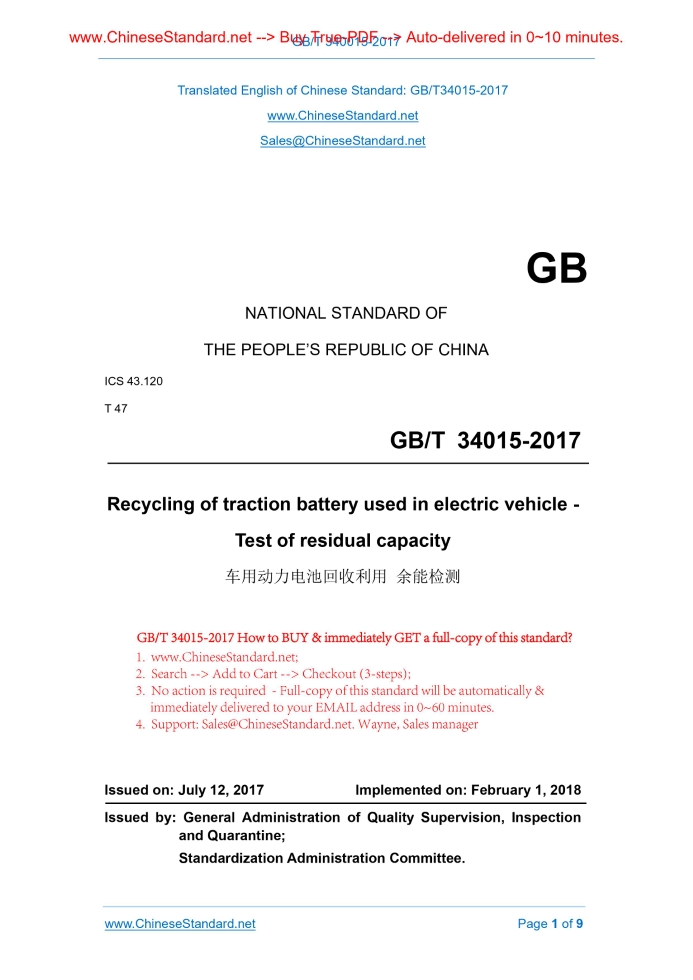
GB NATIONAL STANDARD OF THE PEOPLE’S REPUBLIC OF CHINA ICS 43.120 T 47 GB/T 34015-2017 Recycling of traction battery used in electric vehicle - Test of residual capacity Issued on. JULY 12, 2017 Implemented on. FEBRUARY 1, 2018 Issued by. General Administration of Quality Supervision, Inspection and Quarantine; Standardization Administration Committee.
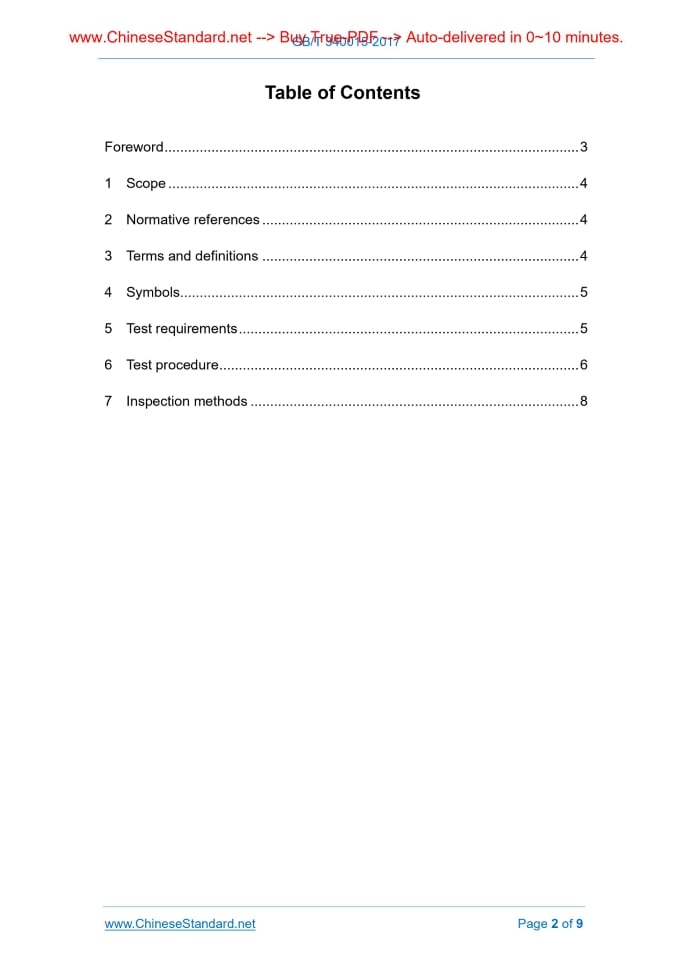
Table of Contents
Foreword... 3 1 Scope... 4 2 Normative references... 4 3 Terms and definitions... 4 4 Symbols... 5 5 Test requirements... 5 6 Test procedure... 6 7 Inspection methods... 8Foreword
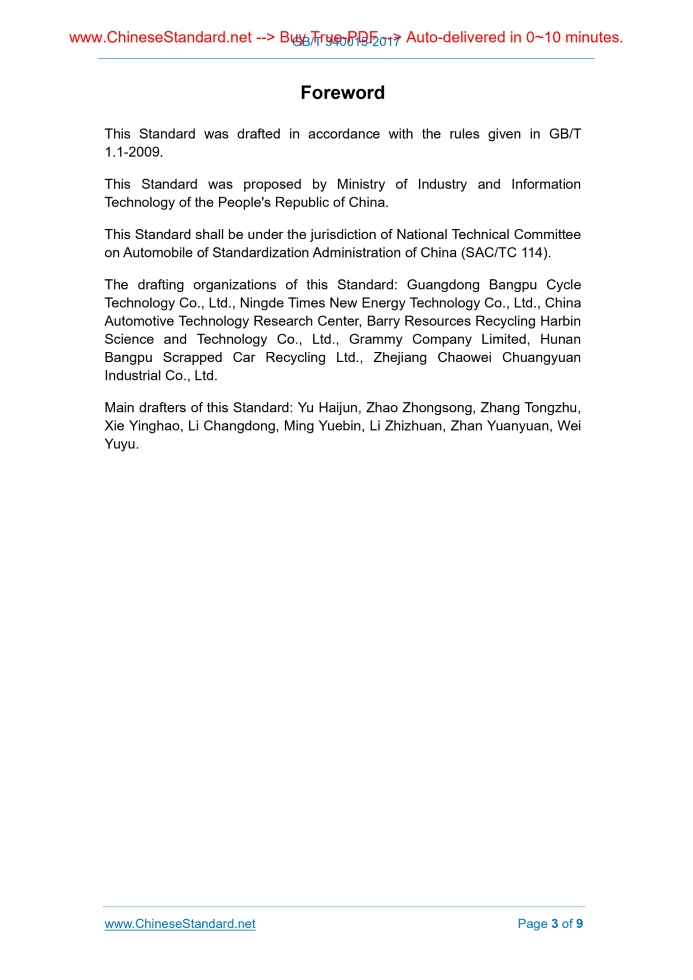
This Standard was drafted in accordance with the rules given in GB/T 1.1-2009. This Standard was proposed by Ministry of Industry and Information Technology of the People's Republic of China. This Standard shall be under the jurisdiction of National Technical Committee on Automobile of Standardization Administration of China (SAC/TC 114). The drafting organizations of this Standard. Guangdong Bangpu Cycle Technology Co., Ltd., Ningde Times New Energy Technology Co., Ltd., China Automotive Technology Research Center, Barry Resources Recycling Harbin Science and Technology Co., Ltd., Grammy Company Limited, Hunan Bangpu Scrapped Car Recycling Ltd., Zhejiang Chaowei Chuangyuan Industrial Co., Ltd. Main drafters of this Standard. Yu Haijun, Zhao Zhongsong, Zhang Tongzhu, Xie Yinghao, Li Changdong, Ming Yuebin, Li Zhizhuan, Zhan Yuanyuan, Wei Yuyu. Recycling of traction battery used in electric vehicle - Test of residual capacity1 Scope
This Standard specifies the terms and definitions, symbols, test requirements, test procedures and test methods for test of residual capacity of recycling of traction battery used in electric vehicle. This Standard applies to the test of residual capacity of recycling of lithium-ion traction battery and metal hydride nickel-powered battery cell, module used in electric vehicle.2 Normative references
The following referenced documents are indispensable for the application of this document. For dated references, only the edition cited applies. For undated references, the latest edition of the referenced document (including any amendments) applies. GB/T 19596, Terminology of electric vehicles GB/T 31486-2015, Technical requirements and test methods for traction battery of electric vehicle - Electrical performance3 Terms and definitions
For the purposes of this document, the terms and definitions defined in GB/T 19596 and the following ones apply. 3.1 residual capacity the actual capacity remaining after the traction battery is removed from the electric vehicle4 Symbols
The following symbols apply to this document. Cn - nominal capacity, in amperes (A·h). Wn - nominal energy, in Watts hours (W·h).5 Test requirements
5.1 Safety requirements 5.1.1 The entire testing process shall be monitored by professionals with knowledge of battery testing. 5.2 Environmental requirements The environmental requirements for traction battery during the process of test of residual capacity shall be in accordance with 6.1.1 of GB/T 31486-2015. 5.3 Measuring instruments, instrument accuracy requirements The measuring instruments, instrument accuracy for traction battery during the process of test of residual capacity shall be in accordance with 6.1.2 of GB/T 31486-2015.6 Test procedure
6.1 The test of residual capacity for traction battery used in electric vehicle shall be carried out according to the work flow shown as Figure 1. 6.2 Appearance inspection Traction battery 6.2.1 In good light conditions, visually inspect the appearance of traction battery module, the appearance of the monomer. If there are s deformation, cracks, leakage, etc., the test of residual capacity shall not be carried out. 6.3 Information collection 6.3.1 Observe the label on the traction battery. Collect the basic information of the battery, such as the nominal voltage, nominal capacity or nominal energy, etc. 6.5 Determination of first charge and discharge currents 6.5.1 Battery cell 6.5.2 Battery module 6.5.2.1 There is a label in which cell number, nominal voltage, nominal capacity or nominal energy and battery module nominal voltage, nominal capacity or nominal energy and other information can be obtained directly. The first charge and discharge currents shall be initially determined according to the information. 6.6 Determination of I5 Use electrical performance tester to carry out the charge-discharge test in a mode of first charge-discharge constant current. Calculate I5 according to equation (1).7 Inspection methods
7.1 Battery cell 7.1.1 Charging 7.1.2 Discharging capacity at room temperature The discharging capacity of battery cell at 25°C ± 2°C shall be in accordance with 6.2.5 of GB/T 31486-2015, discharging current using I5 (A). 7.1.3 Residual capacity of battery cell The discharging capacity at room temperature measured shall be the residual capacity of battery cell at room temperature, in A·h. 7.2 Battery module 7.2.1 Charging 7.2.1.1 The charging procedures of lithium-ion battery module shall be in accordance with 6.3.4 of GB/T 31486-2015, charging current using I5 (A). 7.2.2 Discharging capacity at room temperature The discharging capacity of battery module at 25°C±2°C shall be in accordance with 6.3.5 of GB/T 31486-2015, discharging current using I5 (A). 7.2.3 Discharging capacity at low temperature The discharging capacity of battery module at -20°C±2°C shall be in accordance with 6.3.8 of GB/T 31486-2015, discharging current using I5 (A). 7.2.4 Discharging capacity at high temperature The discharging capacity of battery module at 55°C±2°C shall be in accordance with 6.3.9 of GB/T 31486-2015, discharging current using I5 (A). ......Source: Above contents are excerpted from the full-copy PDF -- translated/reviewed by: www.ChineseStandard.net / Wayne Zheng et al.