GB/T 3209-2009 PDF English
Price & Delivery
US$110.00 · In stock · Download in 9 secondsGB/T 3209-2009: Method for determination the amount of distillation residual of benzene-type product
Delivery: 9 seconds. True-PDF full-copy in English & invoice will be downloaded + auto-delivered via email. See step-by-step procedure
Status: Valid
GB/T 3209: Historical versions
| Standard ID | USD | BUY PDF | Delivery | Standard Title (Description) | Status |
| GB/T 3209-2009 | 110 | Add to Cart | Auto, 9 seconds. | Method for determination the amount of distillation residual of benzene-type product | Valid |
| GB/T 3209-1982 | 199 | Add to Cart | 2 days | Method for determining the amount of distillation residual of benzene--Type products | Obsolete |
Click to Preview this PDF
GB/T 3209-2009: Method for determination the amount of distillation residual of benzene-type product
---This is an excerpt. Full copy of true-PDF in English version (including equations, symbols, images, flow-chart, tables, and figures etc.), auto-downloaded/delivered in 9 seconds, can be purchased online: https://www.ChineseStandard.net/PDF.aspx/GBT3209-2009
GB NATIONAL STANDARD OF THE PEOPLE’S REPUBLIC OF CHINA ICS 71.080.15 G 17 Replacing GB/T 3209-1982 Method for determination the amount of distillation residual of benzene-type product ISSUED ON: JULY 15, 2009 IMPLEMENTED ON: APRIL 01, 2010 Issued by: General Administration of Quality Supervision, Inspection and Quarantine of PRC; Standardization Administration of PRC.
Table of Contents
Foreword ... 3 1 Scope ... 4 2 Normative references ... 4 3 Principle ... 4 4 Reagents and materials ... 5 5 Instruments and equipment... 5 6 Sampling ... 6 7 Test procedure ... 6 8 Result calculation ... 7 9 Precision ... 8 Method for determination the amount of distillation residual of benzene-type product1 Scope
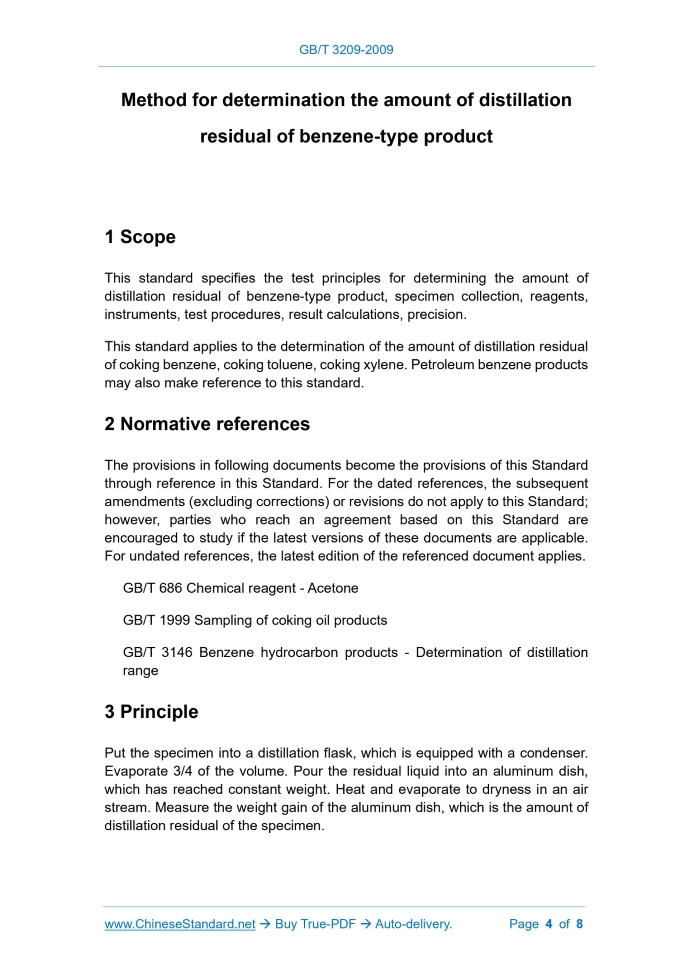
This standard specifies the test principles for determining the amount of distillation residual of benzene-type product, specimen collection, reagents, instruments, test procedures, result calculations, precision. This standard applies to the determination of the amount of distillation residual of coking benzene, coking toluene, coking xylene. Petroleum benzene products may also make reference to this standard.2 Normative references
The provisions in following documents become the provisions of this Standard through reference in this Standard. For the dated references, the subsequent amendments (excluding corrections) or revisions do not apply to this Standard; however, parties who reach an agreement based on this Standard are encouraged to study if the latest versions of these documents are applicable. For undated references, the latest edition of the referenced document applies. GB/T 686 Chemical reagent - Acetone GB/T 1999 Sampling of coking oil products GB/T 3146 Benzene hydrocarbon products - Determination of distillation range3 Principle
Put the specimen into a distillation flask, which is equipped with a condenser. Evaporate 3/4 of the volume. Pour the residual liquid into an aluminum dish, which has reached constant weight. Heat and evaporate to dryness in an air stream. Measure the weight gain of the aluminum dish, which is the amount of distillation residual of the specimen.4 Reagents and materials
Unless otherwise specified in the analysis, use only approved analytical reagents and distilled water or water of equivalent purity. 4.1 Acetone: GB/T 686 analytical grade. 4.2 Air: No dust particles and oil mist.5 Instruments and equipment
5.1 Aluminum dish: Flat bottom, outer diameter 80 mm ~ 100 mm, height 25 mm ~ 30 mm, weight about 2 g. 5.2 Electric heating constant temperature drying oven: It can maintain the temperature 105 °C ± 3 °C. 5.3 Analytical balance: Sensitivity 0.0001 g. 5.4 Distillation instrument: Comply with the requirements of GB/T 3146. 5.5 Measuring cylinder: 100 mL graduated cylinder. 5.6 Sealed evaporator: It is composed of an evaporation hood and an evaporating base. The hood and the bottom are connected by screws; there is no air leakage after tightening. The evaporation hood is made of organic glass or other transparent materials. There are air inlet pipe and an air outlet pipe, on the opposite locations at the upper part of the evaporation hood. The evaporation base is made of red copper plate. There are holes on the periphery of the base, which is connected to the evaporation hood AND sealed by bolts. The shape and size of the evaporator are as shown in Figure 1. ......Source: Above contents are excerpted from the full-copy PDF -- translated/reviewed by: www.ChineseStandard.net / Wayne Zheng et al.