GB/T 31927-2015 PDF English
Price & Delivery
US$90.00 · In stock · Download in 9 secondsGB/T 31927-2015: Zinc and Aluminum Based Coatings on Steel Sheets and Strips - Determination of Lead and Cadmium Contents - Inductively Coupled Plasma Mass Spectrometric Method
Delivery: 9 seconds. True-PDF full-copy in English & invoice will be downloaded + auto-delivered via email. See step-by-step procedure
Status: Valid
| Standard ID | USD | BUY PDF | Delivery | Standard Title (Description) | Status |
| GB/T 31927-2015 | 90 | Add to Cart | Auto, 9 seconds. | Zinc and Aluminum Based Coatings on Steel Sheets and Strips - Determination of Lead and Cadmium Contents - Inductively Coupled Plasma Mass Spectrometric Method | Valid |
Click to Preview this PDF
Similar standards
GB/T 31927-2015: Zinc and Aluminum Based Coatings on Steel Sheets and Strips - Determination of Lead and Cadmium Contents - Inductively Coupled Plasma Mass Spectrometric Method
---This is an excerpt. Full copy of true-PDF in English version (including equations, symbols, images, flow-chart, tables, and figures etc.), auto-downloaded/delivered in 9 seconds, can be purchased online: https://www.ChineseStandard.net/PDF.aspx/GBT31927-2015
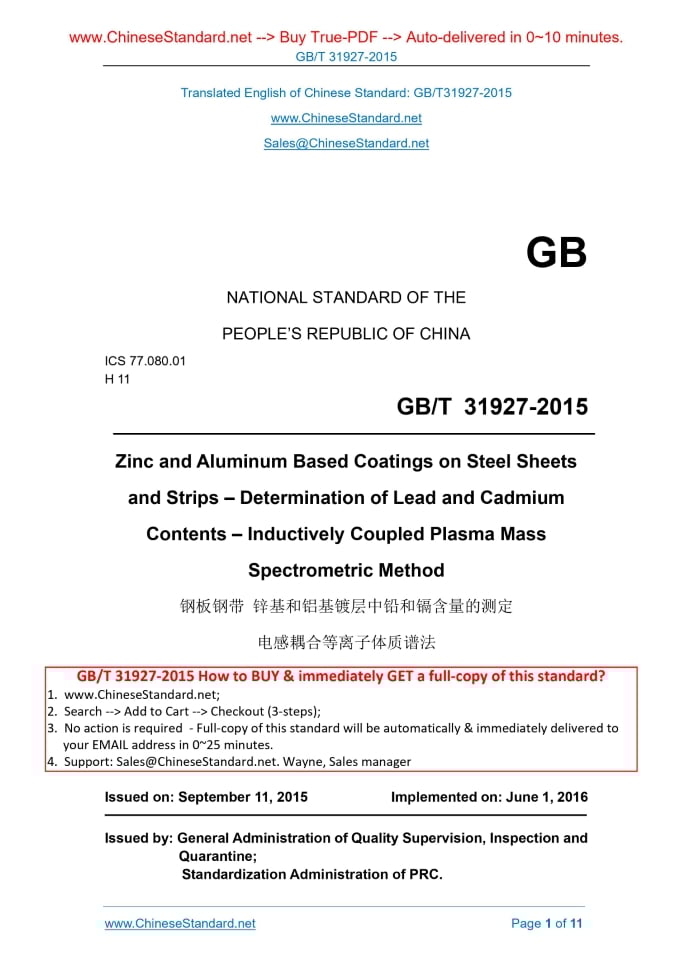
GB NATIONAL STANDARD OF THE PEOPLE’S REPUBLIC OF CHINA ICS 77.080.01 H 11 Zinc and Aluminum Based Coatings on Steel Sheets and Strips – Determination of Lead and Cadmium Contents – Inductively Coupled Plasma Mass Spectrometric Method Issued on: SEPTEMBER 11, 2015 Implemented on: JUNE 1, 2016 Issued by. General Administration of Quality Supervision, Inspection and Quarantine; Standardization Administration of PRC.
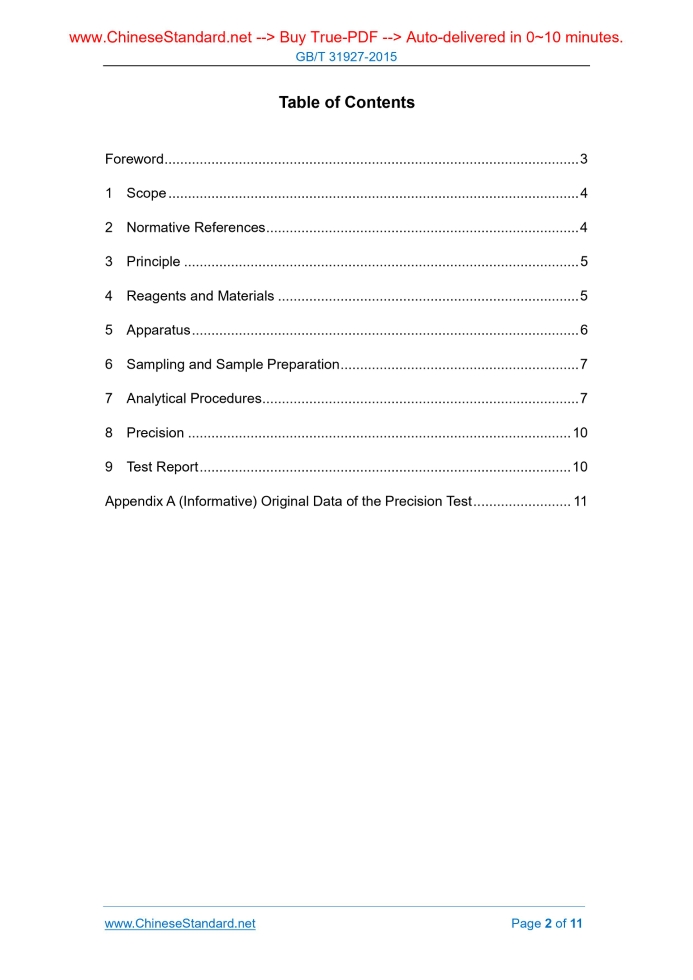
Table of Contents
Foreword ... 3 1 Scope ... 4 2 Normative References ... 4 3 Principle ... 5 4 Reagents and Materials ... 5 5 Apparatus ... 6 6 Sampling and Sample Preparation ... 7 7 Analytical Procedures ... 7 8 Precision ... 10 9 Test Report ... 10 Appendix A (Informative) Original Data of the Precision Test ... 11Foreword
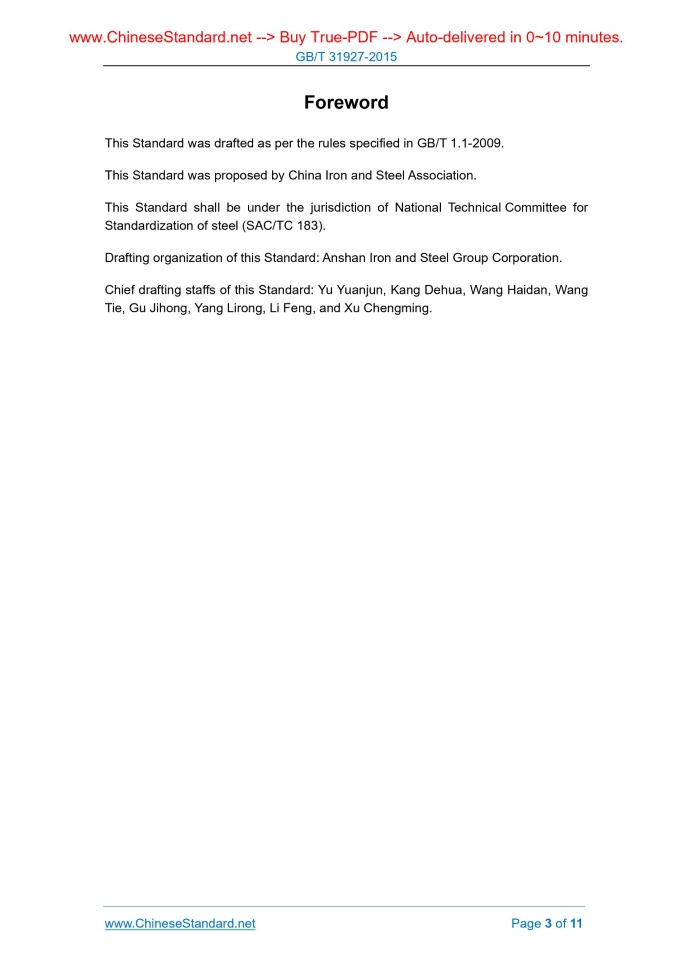
This Standard was drafted as per the rules specified in GB/T 1.1-2009. This Standard was proposed by China Iron and Steel Association. This Standard shall be under the jurisdiction of National Technical Committee for Standardization of steel (SAC/TC 183). Drafting organization of this Standard. Anshan Iron and Steel Group Corporation. Chief drafting staffs of this Standard. Yu Yuanjun, Kang Dehua, Wang Haidan, Wang Tie, Gu Jihong, Yang Lirong, Li Feng, and Xu Chengming. Zinc and Aluminum Based Coatings on Steel Sheets and Strips – Determination of Lead and Cadmium Contents – Inductively Coupled Plasma Mass Spectrometric Method Warning – Personnel using this Standard shall have practical experiences in the formal laboratory. This Standard doesn’t address all the possible safety issues. Users shall assume the responsibility to take appropriate safety and health measures, so that ensure the compliance with the relevant national regulations.1 Scope
This Standard specifies the method for the determination of lead and cadmium contents by inductively coupled plasma mass spectrometric method. This Standard is applicable to the determination of lead and cadmium contents in the pure zinc, zinc-iron, zinc-aluminum, and zinc alloy coatings of steel sheets and strips; the determining ranges are Pb. 20.0 µg/g~2000.0 µg/g, Cd. 5.0 µg/g~2000.0 µg/g respectively.2 Normative References
The following documents are essential to the application of this document. For the dated documents, only the versions with the dates indicated are applicable to this document; for the undated documents, only the latest version (including all the amendments) are applicable to this document. GB/T 6379.2 Accuracy (Trueness and Precision) of Measurement Methods and Results - Part 2. Basic Method for the Determination of Repeatability and Reproducibility of a Standard Measurement Method GB/T 6682 Water for Analytical Laboratory Use - Specification and Test Methods GB/T 12806-2011 Laboratory Glassware - One-Mark Volumetric Flasks GB/T 12808-1991 Laboratory Glassware-One-Mark Pipettes The same specimen shall be carried out two parallel determinations, and take their average value. 7.4 Coatings stripping Pure-zinc, zinc-iron, zinc-aluminum alloy coatings. place the specimen piece (see 7.1) into the beaker; add 50mL of stripping solution (see 4.7); the specimen is completely immersed in the solution at the room temperature; shake the beaker and flip the specimen from time to time, till the coating surface has no hydrogen evolution. Then wash the specimen; if necessary, use nylon brush to eliminate the loose attachments attached on the specimen surface; combine the lotion. After rapid drying of the specimen substrate, use balance to weigh the specimen substrate mass m2, accurate to 0.1mg. Transfer the solution into the volumetric flask, dilute to the mark, mix evenly, and work as the to-be-tested solution. Aluminum-zinc alloy coating. place the specimen piece (see 7.1) into 250 mL PTFE beaker; add 50 mL of sodium hydroxide solution (see 4.5), 3 mL of hydrogen peroxide solution (see 4.6); heat at low temperature, during which flip the specimen; when the specimen surface is completely bright, take out the specimen; use small amount of water to wash, the lotion there shall be combined into the beaker; continue to heat for 5min, take off and cool. After rapid drying the specimen substrate, use balance to weigh the specimen substrate mass m2, accurate to 0.1mg. Add 20 mL of hydrochloric acid (see 4.1) to the solution, after cool off to the room temperature, transfer the solution into a volumetric flask; dilute to the mark, mix evenly, and work as a to-be- tested solution. 7.5 Drawing a calibration curve Take seven 100 mL volumetric flasks; add the same amount of reagent during the specimen treatment period, and appropriate amount of zinc standard solution (see 4.10) and aluminum standard solution (see 4.11) used for matrix matching; so that the content of zinc and aluminum is equivalent to that in the test solution. Add the standard solution of the measured elements in seven 100 mL volumetric flasks according to Table 1 and 2; dilute with water to the mark, mix evenly. Measure the strength of standard series solution, minus the strength of calibration solution with zero concentration, then obtain the net strength; draw the calibration curve with concentration of to-be-measured elements (µg/mL) as the x-axis, while the corresponding net strength of to-be-measured elements as the y-axis. Table 1 Standard Solution Series I for Preparing the Calibration Curve Analytical Element Lead Cadmium Standard Solution Volume of Adding Standard Solution / mL Element Concentration /µg/mL ......Source: Above contents are excerpted from the full-copy PDF -- translated/reviewed by: www.ChineseStandard.net / Wayne Zheng et al.