GB/T 31586.1-2015 PDF English
Price & Delivery
US$90.00 · In stock · Download in 9 secondsGB/T 31586.1-2015: Corrosion protection of steel structures by protective paint systems -- Assessment of, and acceptance criteria for, the adhesion/cohesion (fracture strength) of a coating -- Part 1: Pull-off testing
Delivery: 9 seconds. True-PDF full-copy in English & invoice will be downloaded + auto-delivered via email. See step-by-step procedure
Status: Valid
| Standard ID | USD | BUY PDF | Delivery | Standard Title (Description) | Status |
| GB/T 31586.1-2015 | 90 | Add to Cart | Auto, 9 seconds. | Corrosion protection of steel structures by protective paint systems -- Assessment of, and acceptance criteria for, the adhesion/cohesion (fracture strength) of a coating -- Part 1: Pull-off testing | Valid |
Click to Preview this PDF
Similar standards
GB/T 31586.1-2015: Corrosion protection of steel structures by protective paint systems -- Assessment of, and acceptance criteria for, the adhesion/cohesion (fracture strength) of a coating -- Part 1: Pull-off testing
---This is an excerpt. Full copy of true-PDF in English version (including equations, symbols, images, flow-chart, tables, and figures etc.), auto-downloaded/delivered in 9 seconds, can be purchased online: https://www.ChineseStandard.net/PDF.aspx/GBT31586.1-2015
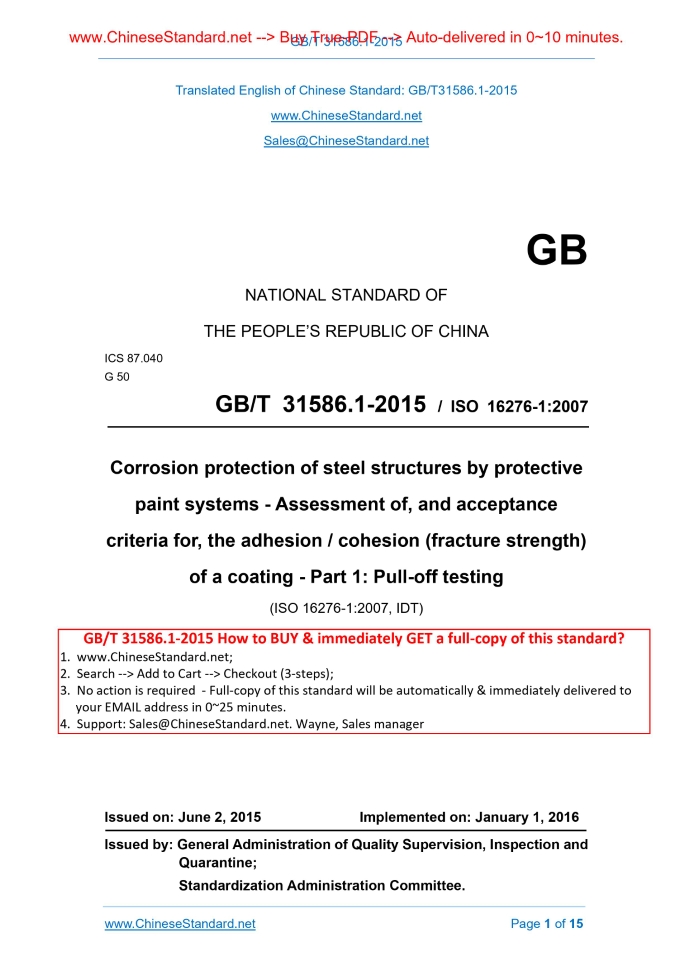
GB NATIONAL STANDARD OF THE PEOPLE’S REPUBLIC OF CHINA ICS 87.040 G 50 GB/T 31586.1-2015 / ISO 16276-1.2007 Corrosion protection of steel structures by protective paint systems - Assessment of, and acceptance criteria for, the adhesion / cohesion (fracture strength) of a coating - Part 1. Pull-off testing (ISO 16276-1.2007, IDT) Issued on: JUNE 2, 2015 Implemented on: JANUARY 1, 2016 Issued by. General Administration of Quality Supervision, Inspection and Quarantine; Standardization Administration Committee.
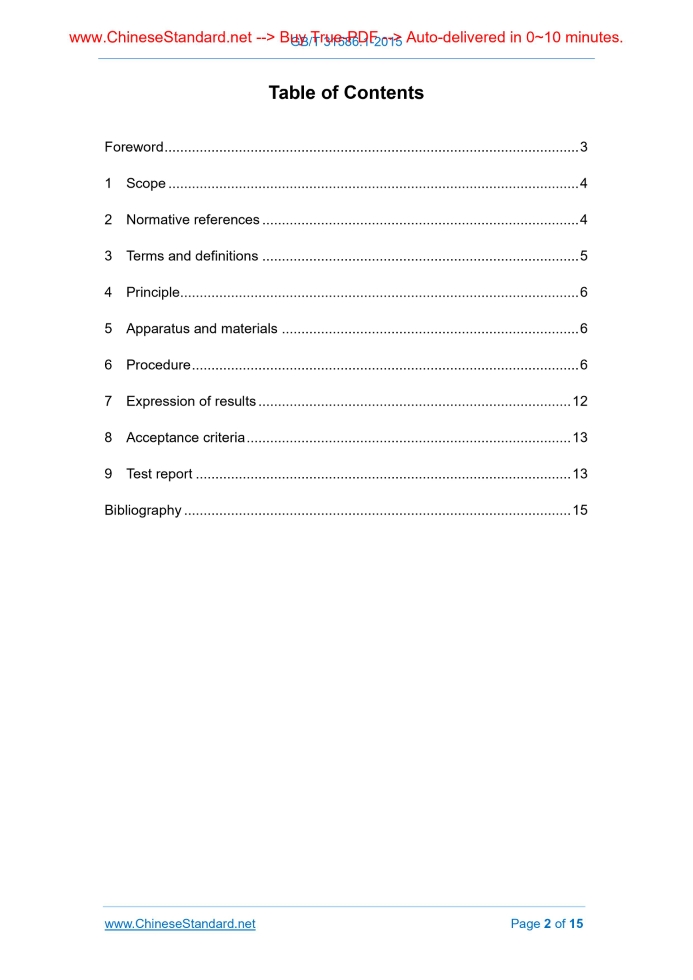
Table of Contents
Foreword ... 3 1 Scope ... 4 2 Normative references ... 4 3 Terms and definitions ... 5 4 Principle... 6 5 Apparatus and materials ... 6 6 Procedure ... 6 7 Expression of results ... 12 8 Acceptance criteria ... 13 9 Test report ... 13 Bibliography ... 15Foreword
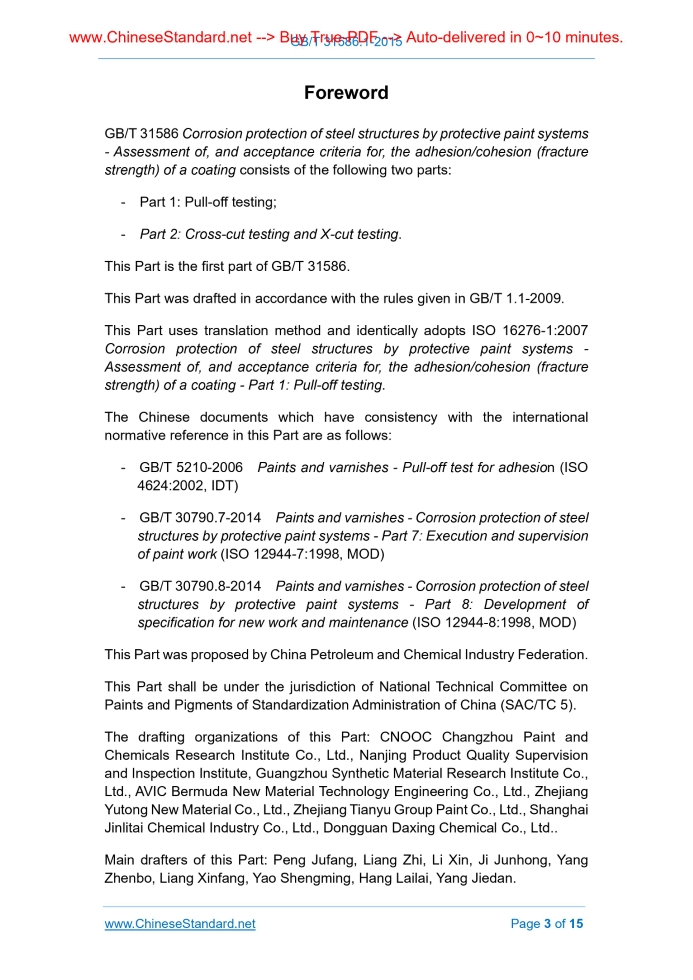
GB/T 31586 Corrosion protection of steel structures by protective paint systems - Assessment of, and acceptance criteria for, the adhesion/cohesion (fracture strength) of a coating consists of the following two parts. - Part 1. Pull-off testing; - Part 2. Cross-cut testing and X-cut testing. This Part is the first part of GB/T 31586. This Part was drafted in accordance with the rules given in GB/T 1.1-2009. This Part uses translation method and identically adopts ISO 16276-1.2007 Corrosion protection of steel structures by protective paint systems - Assessment of, and acceptance criteria for, the adhesion/cohesion (fracture strength) of a coating - Part 1. Pull-off testing. The Chinese documents which have consistency with the international normative reference in this Part are as follows. - GB/T 5210-2006 Paints and varnishes - Pull-off test for adhesion (ISO 4624.2002, IDT) - GB/T 30790.7-2014 Paints and varnishes - Corrosion protection of steel structures by protective paint systems - Part 7. Execution and supervision of paint work (ISO 12944-7.1998, MOD) - GB/T 30790.8-2014 Paints and varnishes - Corrosion protection of steel structures by protective paint systems - Part 8. Development of specification for new work and maintenance (ISO 12944-8.1998, MOD) This Part was proposed by China Petroleum and Chemical Industry Federation. This Part shall be under the jurisdiction of National Technical Committee on Paints and Pigments of Standardization Administration of China (SAC/TC 5). The drafting organizations of this Part. CNOOC Changzhou Paint and Chemicals Research Institute Co., Ltd., Nanjing Product Quality Supervision and Inspection Institute, Guangzhou Synthetic Material Research Institute Co., Ltd., AVIC Bermuda New Material Technology Engineering Co., Ltd., Zhejiang Yutong New Material Co., Ltd., Zhejiang Tianyu Group Paint Co., Ltd., Shanghai Jinlitai Chemical Industry Co., Ltd., Dongguan Daxing Chemical Co., Ltd.. Main drafters of this Part. Peng Jufang, Liang Zhi, Li Xin, Ji Junhong, Yang Zhenbo, Liang Xinfang, Yao Shengming, Hang Lailai, Yang Jiedan. Corrosion protection of steel structures by protective paint systems - Assessment of, and acceptance criteria for, the adhesion / cohesion (fracture strength) of a coating - Part 1. Pull-off testing1 Scope
This Part of GB/T 31586 specifies procedures for assessing the fracture strength of a protective paint coating of any thickness on a steel substrate of thickness not less than 10 mm. The procedures given in this Part of GB/T 31586 are based on methods used with different types of pull-off test equipment. The results obtained using such different types of equipment are not comparable. NOTE 1 Substrates of less than 10 mm in thickness can be tested if they are strengthened by the sandwich technique (see ISO 4624) or by the nature of the structure (e.g. I-beam or backing-plate). Otherwise, test panels with a thickness of at least 10 mm coated in the same way as the structure can be used, or the method specified GB/T 31586.2 can be used. This Part is only applicable if a fracture strength value is specified, together with the type of test equipment and the manufacturer of the equipment. Usually, this information is included in contract documentation. NOTE 2 A value for the fracture strength is only meaningful if the requirements concerning the ambient conditions (see 6.4.2) are met. This Part also specifies suitable equipment and defines inspection areas, sampling plans and acceptance/rejection criteria. It does not give any values of the fracture strength of different protective paint coatings.2 Normative references
The following referenced documents are indispensable for the application of this document. For dated references, only the edition cited applies. For undated references, the latest edition of the referenced document (including any amendments) applies. ......Source: Above contents are excerpted from the full-copy PDF -- translated/reviewed by: www.ChineseStandard.net / Wayne Zheng et al.