GB/T 2910.13-2009 PDF English
Price & Delivery
US$105.00 · In stock · Download in 9 secondsGB/T 2910.13-2009: Textiles -- Quantitative chemical analysis -- Part 14: Mixtures of certain chlorofibre and certain other fibers (method using carbon disulfide/acetone)
Delivery: 9 seconds. True-PDF full-copy in English & invoice will be downloaded + auto-delivered via email. See step-by-step procedure
Status: Valid
| Standard ID | USD | BUY PDF | Delivery | Standard Title (Description) | Status |
| GB/T 2910.13-2009 | 105 | Add to Cart | Auto, 9 seconds. | Textiles -- Quantitative chemical analysis -- Part 14: Mixtures of certain chlorofibre and certain other fibers (method using carbon disulfide/acetone) | Valid |
Click to Preview this PDF
Similar standards
GB/T 2910.13-2009: Textiles -- Quantitative chemical analysis -- Part 14: Mixtures of certain chlorofibre and certain other fibers (method using carbon disulfide/acetone)
---This is an excerpt. Full copy of true-PDF in English version (including equations, symbols, images, flow-chart, tables, and figures etc.), auto-downloaded/delivered in 9 seconds, can be purchased online: https://www.ChineseStandard.net/PDF.aspx/GBT2910.13-2009
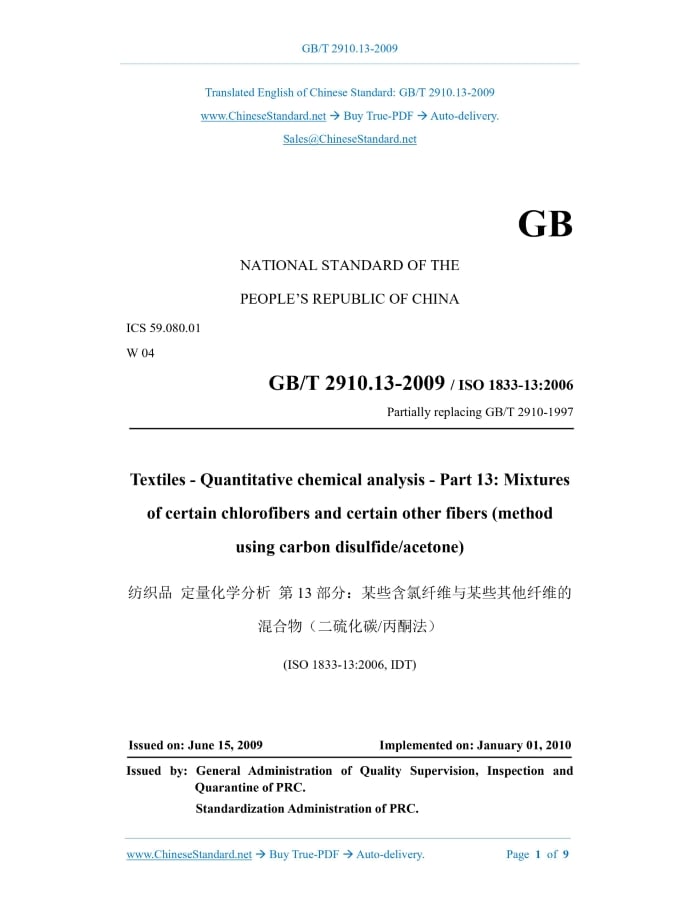
GB NATIONAL STANDARD OF THE PEOPLE’S REPUBLIC OF CHINA ICS 59.080.01 W 04 GB/T 2910.13-2009 / ISO 1833-13:2006 Partially replacing GB/T 2910-1997 Textiles - Quantitative chemical analysis - Part 13: Mixtures of certain chlorofibers and certain other fibers (method using carbon disulfide/acetone) (ISO 1833-13:2006, IDT) ISSUED ON: JUNE 15, 2009 IMPLEMENTED ON: JANUARY 01, 2010 Issued by: General Administration of Quality Supervision, Inspection and Quarantine of PRC. Standardization Administration of PRC.
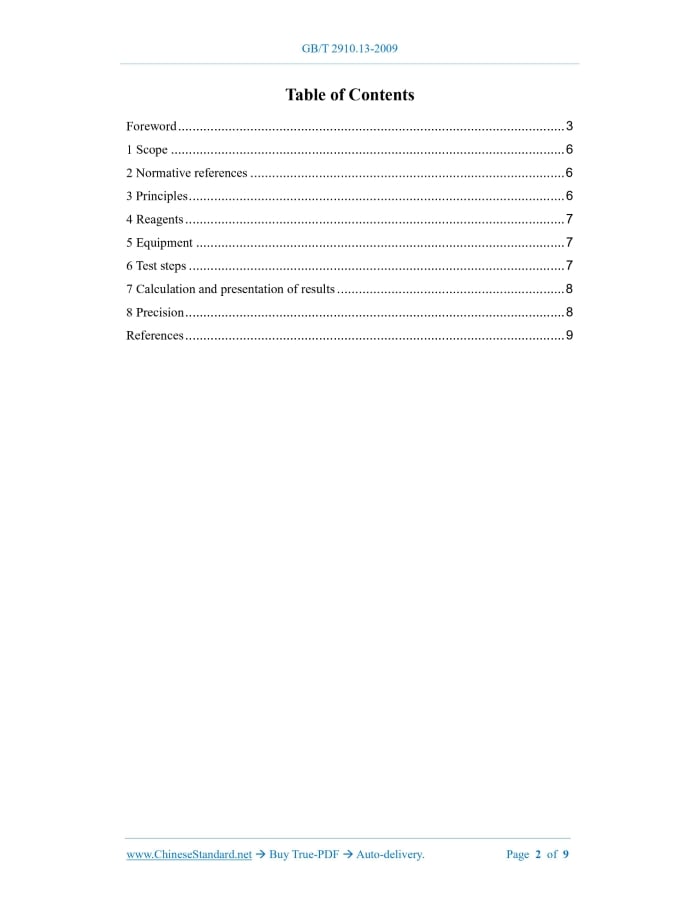
Table of Contents
Foreword ... 3 1 Scope ... 6 2 Normative references ... 6 3 Principles ... 6 4 Reagents ... 7 5 Equipment ... 7 6 Test steps ... 7 7 Calculation and presentation of results ... 8 8 Precision ... 8 References ... 9 Textiles - Quantitative chemical analysis - Part 13: Mixtures of certain chlorofibers and certain other fibers (method using carbon disulfide/acetone)1 Scope
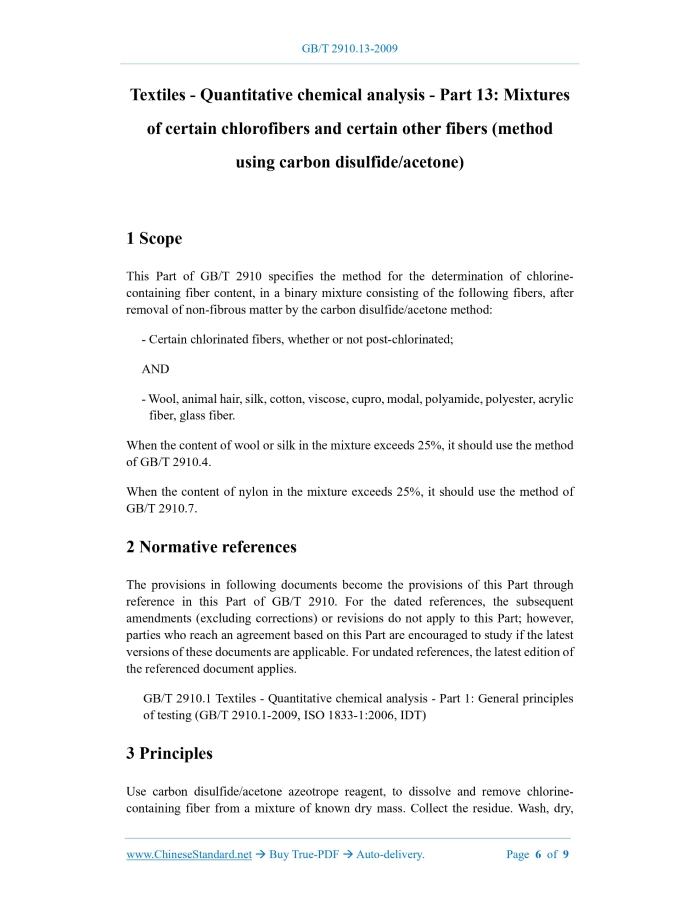
This Part of GB/T 2910 specifies the method for the determination of chlorine- containing fiber content, in a binary mixture consisting of the following fibers, after removal of non-fibrous matter by the carbon disulfide/acetone method: - Certain chlorinated fibers, whether or not post-chlorinated; AND - Wool, animal hair, silk, cotton, viscose, cupro, modal, polyamide, polyester, acrylic fiber, glass fiber. When the content of wool or silk in the mixture exceeds 25%, it should use the method of GB/T 2910.4. When the content of nylon in the mixture exceeds 25%, it should use the method of GB/T 2910.7.2 Normative references
The provisions in following documents become the provisions of this Part through reference in this Part of GB/T 2910. For the dated references, the subsequent amendments (excluding corrections) or revisions do not apply to this Part; however, parties who reach an agreement based on this Part are encouraged to study if the latest versions of these documents are applicable. For undated references, the latest edition of the referenced document applies. GB/T 2910.1 Textiles - Quantitative chemical analysis - Part 1: General principles of testing (GB/T 2910.1-2009, ISO 1833-1:2006, IDT)3 Principles
Use carbon disulfide/acetone azeotrope reagent, to dissolve and remove chlorine- containing fiber from a mixture of known dry mass. Collect the residue. Wash, dry, weigh it. Use the corrected mass to calculate its percentage of the dry mass in the mixture. Obtain the mass percentage of the chlorine-containing fibers, through the difference.4 Reagents
Use the reagents, which are specified in GB/T 2910.1 and 4.1 and 4.2 of this Part. 4.1 Azeotropic mixture of carbon disulfide/acetone. Mix 555 mL of carbon disulfide and 445 mL of acetone. Safety warning: The reagent is poisonous, so perfect protective measures shall be taken when using it. 4.2 Ethanol.5 Equipment
Use the equipment, which is specified in GB/T 2910.1 and 5.1, 5.2, 5.3 of this Part. 5.1 Conical flask with a stopper, which has a capacity of not less than 200 mL. 5.2 Mechanical oscillator. 5.3 Watch glass.6 Test steps
Follow the general procedures, which are specified in GB/T 2910.1. Then follow the steps below: Put the specimen into a stoppered conical flask. Add 100 mL of carbon disulfide/acetone mixed solution (4.1) per gram of specimen. Close the cork tightly. Oscillate it on a mechanical oscillator for 20 minutes. At the beginning of the oscillation, it may loosen the cork once or twice, to release excessive pressure. Filter the solution through a glass fritted crucible of known dry mass. Then use 100 mL solution (4.1), to repeat the above operation. Repeat the above operation several times, until no trace of chlorine-containing fibers remains, after a drop of the solution is evaporated on a watch glass. Use some more solution (4.1), to wash the residue from the conical flask with a stopper, ......Source: Above contents are excerpted from the full-copy PDF -- translated/reviewed by: www.ChineseStandard.net / Wayne Zheng et al.