GB/T 2651-2023 PDF English
Price & Delivery
US$200.00 · In stock · Download in 9 secondsGB/T 2651-2023: Destructive tests on welds in metallic materials - Transverse tensile test
Delivery: 9 seconds. True-PDF full-copy in English & invoice will be downloaded + auto-delivered via email. See step-by-step procedure
Status: Valid
GB/T 2651: Historical versions
| Standard ID | USD | BUY PDF | Delivery | Standard Title (Description) | Status |
| GB/T 2651-2023 | 200 | Add to Cart | Auto, 9 seconds. | Destructive tests on welds in metallic materials - Transverse tensile test | Valid |
| GB/T 2651-2008 | 359 | Add to Cart | 3 days | Tensile test method on welded joints | Obsolete |
| GB/T 2651-1989 | 199 | Add to Cart | 2 days | Method of tensile test for welded joint | Obsolete |
Click to Preview this PDF
GB/T 2651-2023: Destructive tests on welds in metallic materials - Transverse tensile test
---This is an excerpt. Full copy of true-PDF in English version (including equations, symbols, images, flow-chart, tables, and figures etc.), auto-downloaded/delivered in 9 seconds, can be purchased online: https://www.ChineseStandard.net/PDF.aspx/GBT2651-2023GB NATIONAL STANDARD OF THE PEOPLE’S REPUBLIC OF CHINA ICS 25.160.40 CCS J 33 Replacing GB/T 2651-2008 Destructive tests on welds in metallic materials - Transverse tensile test (ISO 4136:2022, MOD) ISSUED ON: MAY 23, 2023 IMPLEMENTED ON: DECEMBER 01, 2023 Issued by: State Administration for Market Regulation; Standardization Administration of the People's Republic of China.
Table of Contents
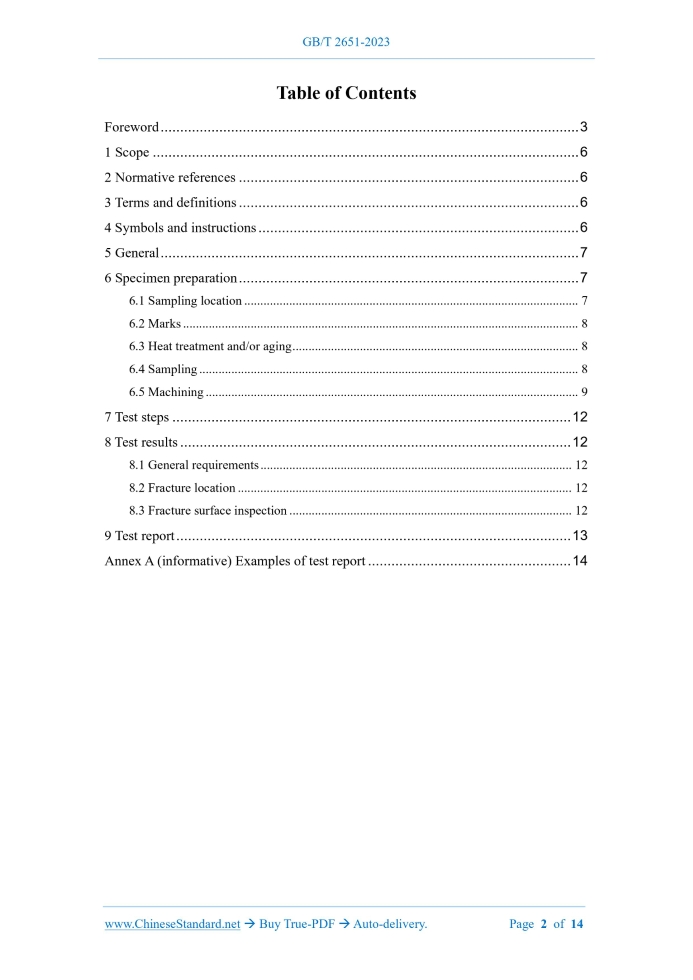
Foreword ... 3 1 Scope ... 6 2 Normative references ... 6 3 Terms and definitions ... 6 4 Symbols and instructions ... 6 5 General ... 7 6 Specimen preparation ... 7 6.1 Sampling location ... 7 6.2 Marks ... 8 6.3 Heat treatment and/or aging ... 8 6.4 Sampling ... 8 6.5 Machining ... 9 7 Test steps ... 12 8 Test results ... 12 8.1 General requirements ... 12 8.2 Fracture location ... 12 8.3 Fracture surface inspection ... 12 9 Test report ... 13 Annex A (informative) Examples of test report ... 14Foreword
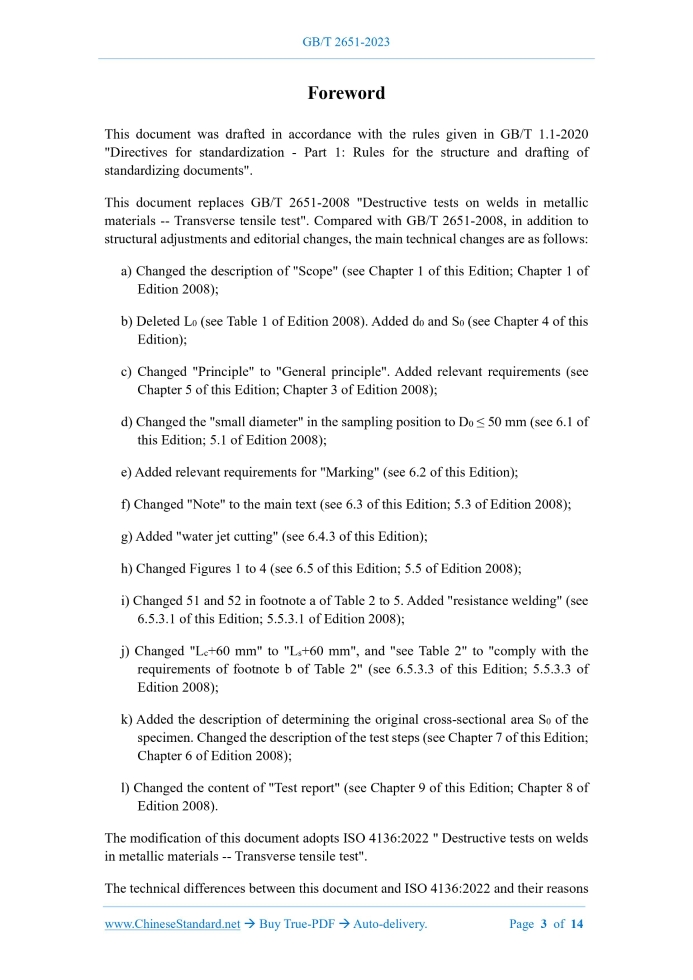
This document was drafted in accordance with the rules given in GB/T 1.1-2020 "Directives for standardization - Part 1: Rules for the structure and drafting of standardizing documents". This document replaces GB/T 2651-2008 "Destructive tests on welds in metallic materials -- Transverse tensile test". Compared with GB/T 2651-2008, in addition to structural adjustments and editorial changes, the main technical changes are as follows: a) Changed the description of "Scope" (see Chapter 1 of this Edition; Chapter 1 of Edition 2008); b) Deleted L0 (see Table 1 of Edition 2008). Added d0 and S0 (see Chapter 4 of this Edition); c) Changed "Principle" to "General principle". Added relevant requirements (see Chapter 5 of this Edition; Chapter 3 of Edition 2008); d) Changed the "small diameter" in the sampling position to D0 ≤ 50 mm (see 6.1 of this Edition; 5.1 of Edition 2008); e) Added relevant requirements for "Marking" (see 6.2 of this Edition); f) Changed "Note" to the main text (see 6.3 of this Edition; 5.3 of Edition 2008); g) Added "water jet cutting" (see 6.4.3 of this Edition); h) Changed Figures 1 to 4 (see 6.5 of this Edition; 5.5 of Edition 2008); i) Changed 51 and 52 in footnote a of Table 2 to 5. Added "resistance welding" (see 6.5.3.1 of this Edition; 5.5.3.1 of Edition 2008); j) Changed "Lc+60 mm" to "Ls+60 mm", and "see Table 2" to "comply with the requirements of footnote b of Table 2" (see 6.5.3.3 of this Edition; 5.5.3.3 of Edition 2008); k) Added the description of determining the original cross-sectional area S0 of the specimen. Changed the description of the test steps (see Chapter 7 of this Edition; Chapter 6 of Edition 2008); l) Changed the content of "Test report" (see Chapter 9 of this Edition; Chapter 8 of Edition 2008). The modification of this document adopts ISO 4136:2022 " Destructive tests on welds in metallic materials -- Transverse tensile test". The technical differences between this document and ISO 4136:2022 and their reasons Destructive tests on welds in metallic materials - Transverse tensile test1 Scope
This document specifies the specimen preparation and test procedures for transverse tensile test of welded butt joints, so as to determine their tensile strength and fracture location. This document applies to transverse tensile tests on all welded butt joints.2 Normative references
The following referenced documents are indispensable for the application of this document. For dated references, only the edition cited applies. For undated references, the latest edition of the referenced document (including any amendments) applies. GB/T 228.1, Metallic materials -- Tensile testing -- Part 1: Method of test at room temperature (GB/T 228.1-2021, ISO 6892-1:2019, MOD) GB/T 228.2, Metallic materials -- Tensile testing -- Part 2: Method of test at elevated temperature (GB/T 228.2-2015, ISO 6892-2:2011, MOD) GB/T 5185, Welding and allied processes -- Nomenclature of processes and reference numbers (GB/T5185-2005, ISO 4063:1998, IDT)3 Terms and definitions
There are no terms or definitions that require definition in this document.4 Symbols and instructions
The symbols used in the transverse tensile test and their corresponding descriptions are shown in Table 1. These symbols are used in Figures 1 to 4. specimen is processed, the weld axis is located in the middle of the parallel length of the specimen. For small diameter pipes, pipe section specimens may be used (see Figure 3). When no provisions are made in the relevant application standards or agreements, "small diameter" means D0 ≤ 50 mm. 6.2 Marks Each test piece shall be marked so as to identify the exact position from which it is removed from the finished product or joint. If required by the relevant application standard, the direction of processing (e.g. rolling or extrusion) of the parent material shall be marked. Each specimen shall also be marked so that its exact location within the specimen can be identified. Each specimen shall be marked when it is removed from the test piece. 6.3 Heat treatment and/or aging Welded joints or test specimens shall not be heat treated. However, the relevant application standards stipulate or allow heat treatment of test welded joints, in which case the heat treatment process parameters shall be recorded in detail in the test report. If the aluminum alloy undergoes natural aging, the interval between welding and the start of the test shall be recorded. The presence of hydrogen in steel weld metal will have an adverse effect on the test results. Appropriate methods must be adopted for dehydrogenation treatment. 6.4 Sampling 6.4.1 General requirements The mechanical or thermal processing method used for sampling shall not have any effect on the properties of the specimen. 6.4.2 Steel When the thickness exceeds 8 mm, shearing shall not be used. When cutting specimens from welded test plates or test pieces by thermal cutting or other cutting methods that affect the properties of the cut surface, it shall be ensured that all cut surfaces are at least 8 mm from the surface of the final parallel length of the specimen. For cuts parallel to the original surface of the welded test plate or test piece, thermal cutting shall not be used. ......Source: Above contents are excerpted from the full-copy PDF -- translated/reviewed by: www.ChineseStandard.net / Wayne Zheng et al.