GB/T 25036-2021 PDF English
Price & Delivery
US$110.00 · In stock · Download in 9 secondsGB/T 25036-2021: Children canvas rubber footwear
Delivery: 9 seconds. True-PDF full-copy in English & invoice will be downloaded + auto-delivered via email. See step-by-step procedure
Status: Valid
GB/T 25036: Historical versions
| Standard ID | USD | BUY PDF | Delivery | Standard Title (Description) | Status |
| GB/T 25036-2021 | 110 | Add to Cart | Auto, 9 seconds. | Children canvas rubber footwear | Valid |
| GB 25036-2010 | 85 | Add to Cart | Auto, 9 seconds. | Children canvas rubber footwear (shoes) | Obsolete |
Click to Preview this PDF
Similar standards
GB/T 25036-2021: Children canvas rubber footwear
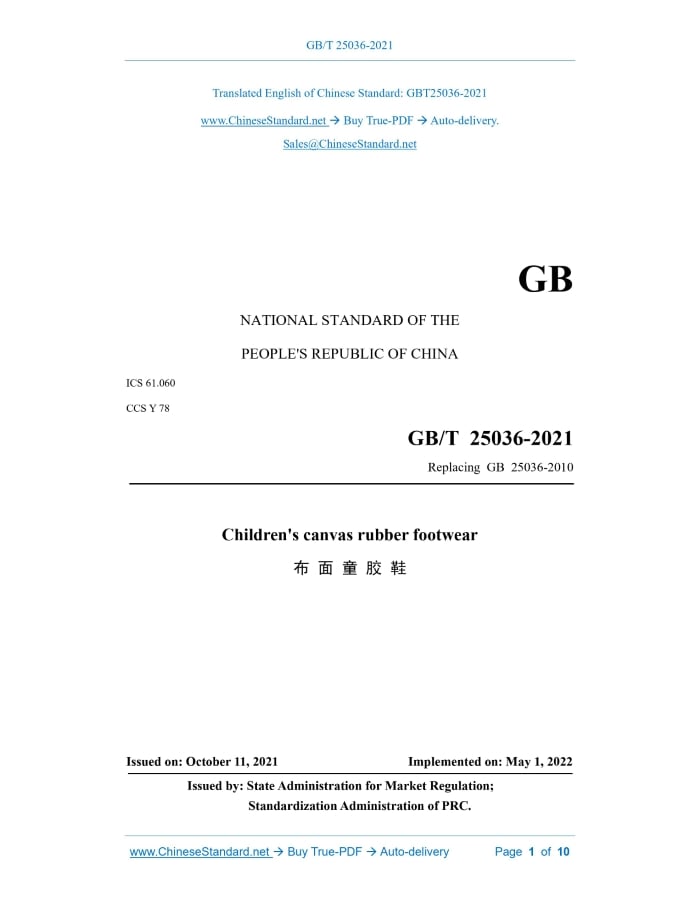
---This is an excerpt. Full copy of true-PDF in English version (including equations, symbols, images, flow-chart, tables, and figures etc.), auto-downloaded/delivered in 9 seconds, can be purchased online: https://www.ChineseStandard.net/PDF.aspx/GBT25036-2021GB NATIONAL STANDARD OF THE PEOPLE'S REPUBLIC OF CHINA ICS 61.060 CCS Y 78 Replacing GB 25036-2010 Children's canvas rubber footwear Issued on. OCTOBER 11, 2021 Implemented on. MAY 1, 2022 Issued by. State Administration for Market Regulation; Standardization Administration of PRC.
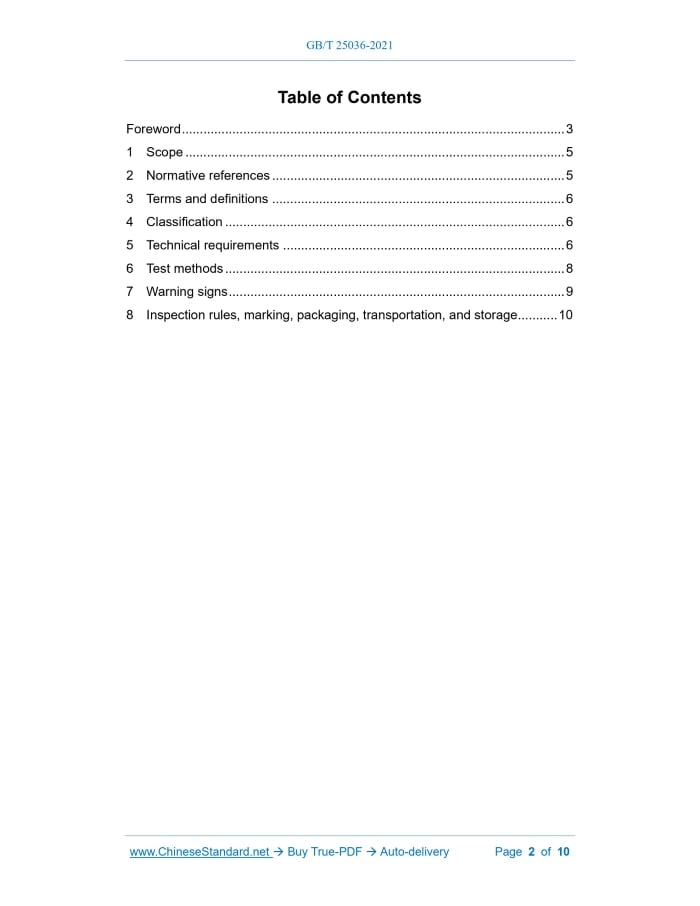
Table of Contents
Foreword... 3 1 Scope... 5 2 Normative references... 5 3 Terms and definitions... 6 4 Classification... 6 5 Technical requirements... 6 6 Test methods... 8 7 Warning signs... 9 8 Inspection rules, marking, packaging, transportation, and storage... 10Foreword
This document was drafted in accordance with the provisions of GB/T 1.1-2020 Directives for standardization - Part 1.Rules for the structure and drafting of standardizing documents. This document replaces GB 25036-2010 Children's canvas rubber footwear (shoes). Compared with GB 25036-2010, in addition to structural adjustments and editorial changes, the main technical changes are as follows. a) The terms and definitions are changed (see Chapter 3; see Chapter 3 of the 2010 edition); b) The definition of "base thickness", requirements, and test methods for outsole thickness are deleted (see 3.3, 5.5, and 6.3.6 of the 2010 edition); c) The content of "Classification" is changed (see Chapter 4; see Chapter 4 of the 2010 edition); d) The requirements for "shoe size and model" are changed (see 5.1; see 5.1 of the 2010 edition); e) The requirements and test methods for abrasion resistance are changed (see Table 1 and 6.1.3; see Table 3 and 6.3.3 of the 2010 edition); f) The requirements and test methods for hardness of cellular soles are added (see Table 1 and 6.1.4); g) The requirements and test methods for the anti-slip performance of outsoles are added (see Table 1 and 6.1.5); h) "Adhesion strength between the foxing and the upper" is changed to the "adhesive strength between the foxing and the upper" and the test method is changed (see Tables 1 and 6.1.6; see Tables 3 and 6.3.5 in the 2010 edition); i) The safety performance item "color fastness to rubbing of interlining and insole" is changed to a physical performance item (see Table 1; see Table 3 of the 2010 edition); j) The appearance quality requirements are changed (see 5.3; see 5.6 of the 2010 edition); k) The physical safety performance requirements and test methods are changed (see 5.4 and 6.3; see Tables 2 and 6.2 of the 2010 edition); l) The health and safety performance items and technical requirements are deleted (see Table 1 of the 2010 edition); m) The "warning signs" is added (see Chapter 7); n) The inspection rules, markings, packaging, transportation, and storage requirements are changed (see Chapter 8; see Chapter 7 of the 2010 edition); o) Appendix A and Appendix B are deleted (see Appendix A and Appendix B of the 2010 edition). Please note that some content in this document may be subject to patents. The publisher of this document assumes no responsibility for identifying patents. This document was proposed by China Petroleum and Chemical Industry Federation. This document is under the jurisdiction of the National Rubber and Rubber Products Standardization Technical Committee (SAC/TC35). Drafting organization of this document. Jordan Sports Co., Ltd., Fujian Hongxing Erke Sports Goods Co., Ltd., Fujian Huafeng Jiete Sporting Goods Co., Ltd., Taizhou Baolite Shoes Co., Ltd., Qibu Co., Ltd., Jinjiang Kenmu Outdoor Products Co., Ltd., SGS- CSTC Standards Technical Services (Shanghai) Co., Ltd., Zhejiang Tianhong Shoes Co., Ltd., Quanzhou Institute of Standardization, Ruian Shoe Leather Industry Association, Fujian Footwear Product Quality Supervision and Inspection Center, Fujian Huafeng Industrial Co., Ltd. Main drafters of this document. You Yongyi, Zou Fuxiang, Huang Maosheng, Yao Qifeng, Xie Ping, Lei Dan, Chen Zhaoyuan, Zhang Yahong, Lin Zhijie, Jin Duhai, Xu Chunshu, Wang Xiaonan, Zhang Zhilei, Zhang Beizhan, Ma Yanhong. The previous versions of this document and the documents it replaces are as follows. -- First released in 2010 as GB 25036-2010; -- This is the first revision. Children's canvas rubber footwear1 Scope
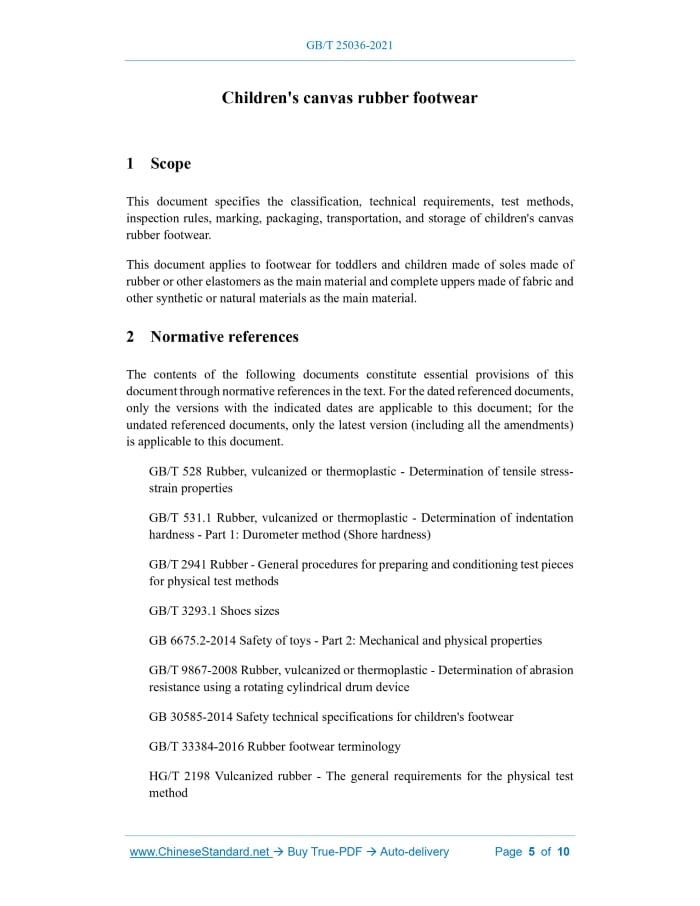
This document specifies the classification, technical requirements, test methods, inspection rules, marking, packaging, transportation, and storage of children's canvas rubber footwear. This document applies to footwear for toddlers and children made of soles made of rubber or other elastomers as the main material and complete uppers made of fabric and other synthetic or natural materials as the main material.2 Normative references
The contents of the following documents constitute essential provisions of this document through normative references in the text. For the dated referenced documents, only the versions with the indicated dates are applicable to this document; for the undated referenced documents, only the latest version (including all the amendments) is applicable to this document. GB/T 528 Rubber, vulcanized or thermoplastic - Determination of tensile stress- strain properties GB/T 531.1 Rubber, vulcanized or thermoplastic - Determination of indentation hardness - Part 1.Durometer method (Shore hardness) GB/T 2941 Rubber - General procedures for preparing and conditioning test pieces for physical test methods GB/T 3293.1 Shoes sizes3 Terms and definitions
The terms and definitions defined in GB/T 33384-2016 and the following apply to this document. 3.1 children's canvas rubber footwear Canvas rubber shoes for children wearing, with a shoe size below 245.4 Classification
4.1 Products are divided into two categories according to their wearing objects. 4.2 Products are divided into solid soles and cellular soles according to outsole materials.5 Technical requirements
5.1 Shoe size and model They shall be in accordance with GB/T 3293.1. 5.2 Physical properties Physical properties shall comply with the requirements in Table 1. 5.3 Appearance quality Appearance quality shall meet the following requirements. 5.4 Physical security performance6 Test methods
6.1 Physical properties 6.1.1 Test conditions They shall comply with the regulations of GB/T 2941 and HG/T 2198.The storage time of the sample before testing shall not be less than 6 hours, and the pieces taken from finished products shall be cut along the direction of the outsole. 6.1.3 Abrasion resistance 6.1.4 Hardness For solid soles, the test shall comply with the provisions of GB/T 531.1, and for cellular soles, the test shall comply with the provisions of HG/T 2489. 6.1.5 Anti-slip performance The test shall be complied with the provisions of 8.2.1 in HG/T 3780-2005. 6.1.6 Adhesion strength The test shall comply with the provisions of HG/T 4805. 6.2 Appearance quality Appearance quality inspection shall be carried out in a place with sufficient light and away from direct sunlight. The inspection method is mainly visual inspection. 6.3 Physical security performance7 Warning signs
Warning signs on toddler's canvas rubber footwear shall include the following.8 Inspection rules, marking, packaging, transportation, and storage
They shall comply with the provisions of HG/T 2403. ......Source: Above contents are excerpted from the full-copy PDF -- translated/reviewed by: www.ChineseStandard.net / Wayne Zheng et al.