GB/T 22731-2022 PDF English
Price & Delivery
US$410.00 · In stock · Download in 9 secondsGB/T 22731-2022: Fragrance compound
Delivery: 9 seconds. True-PDF full-copy in English & invoice will be downloaded + auto-delivered via email. See step-by-step procedure
Status: Valid
GB/T 22731: Historical versions
| Standard ID | USD | BUY PDF | Delivery | Standard Title (Description) | Status |
| GB/T 22731-2022 | 410 | Add to Cart | Auto, 9 seconds. | Fragrance compound | Valid |
| GB/T 22731-2017 | 225 | Add to Cart | Auto, 9 seconds. | Fragrance Compound | Obsolete |
| GB/T 22731-2008 | 799 | Add to Cart | 4 days | Fragrance compound | Obsolete |
Click to Preview this PDF
Similar standards
GB/T 22731-2022: Fragrance compound
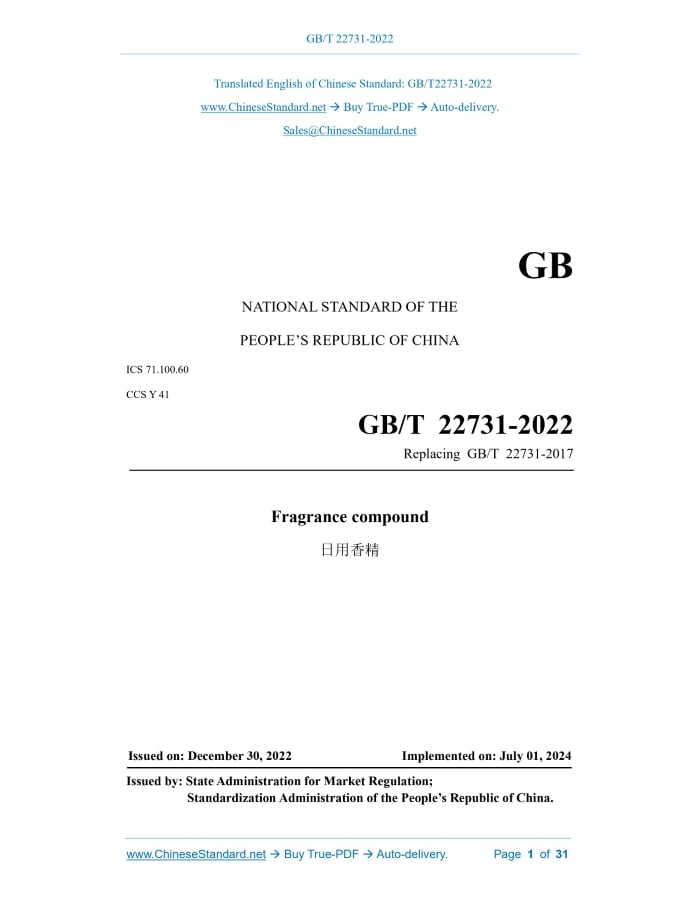
---This is an excerpt. Full copy of true-PDF in English version (including equations, symbols, images, flow-chart, tables, and figures etc.), auto-downloaded/delivered in 9 seconds, can be purchased online: https://www.ChineseStandard.net/PDF.aspx/GBT22731-2022GB NATIONAL STANDARD OF THE PEOPLE’S REPUBLIC OF CHINA ICS 71.100.60 CCS Y 41 Replacing GB/T 22731-2017 Fragrance compound Issued on. DECEMBER 30, 2022 Implemented on. JULY 01, 2024 Issued by. State Administration for Market Regulation; Standardization Administration of the People’s Republic of China.
Table of Contents
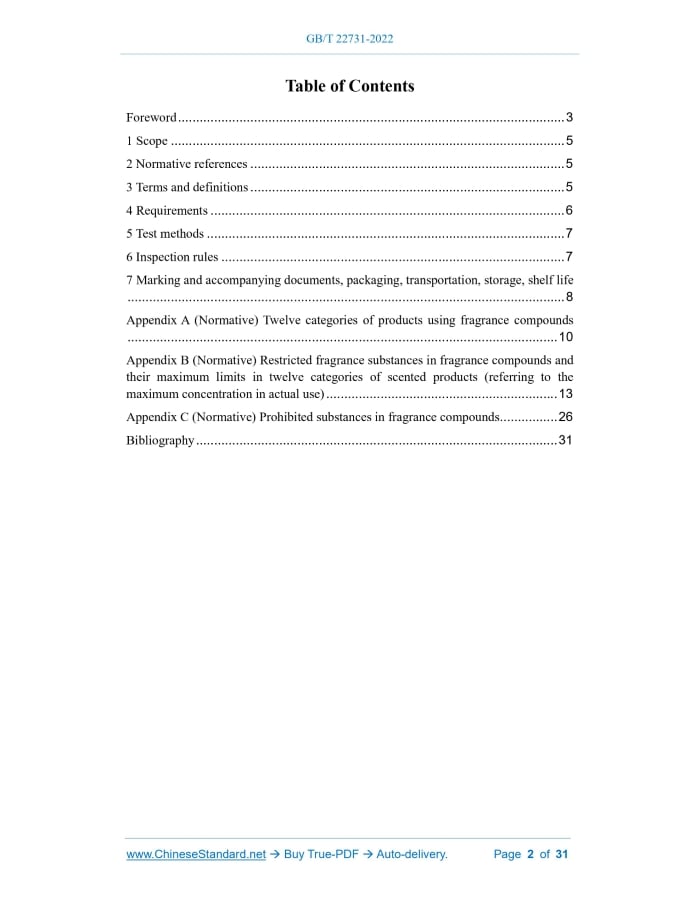
Foreword... 3 1 Scope... 5 2 Normative references... 5 3 Terms and definitions... 5 4 Requirements... 6 5 Test methods... 7 6 Inspection rules... 7 7 Marking and accompanying documents, packaging, transportation, storage, shelf life ... 8 Appendix A (Normative) Twelve categories of products using fragrance compounds ... 10 Appendix B (Normative) Restricted fragrance substances in fragrance compounds and their maximum limits in twelve categories of scented products (referring to the maximum concentration in actual use)... 13 Appendix C (Normative) Prohibited substances in fragrance compounds... 26 Bibliography... 31Foreword
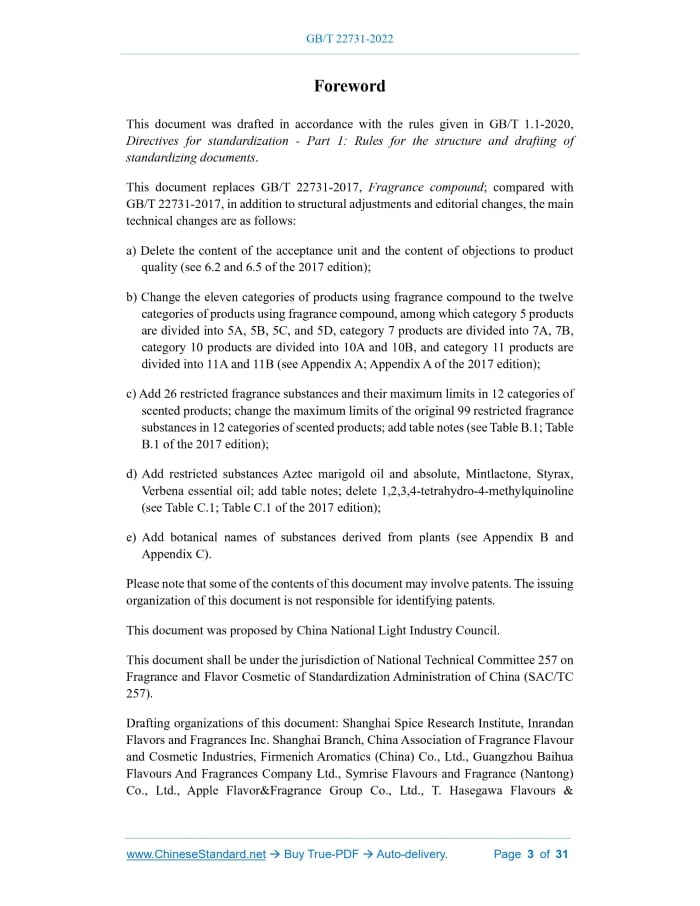
This document was drafted in accordance with the rules given in GB/T 1.1-2020, Directives for standardization - Part 1.Rules for the structure and drafting of standardizing documents. This document replaces GB/T 22731-2017, Fragrance compound; compared with GB/T 22731-2017, in addition to structural adjustments and editorial changes, the main technical changes are as follows. a) Delete the content of the acceptance unit and the content of objections to product quality (see 6.2 and 6.5 of the 2017 edition); b) Change the eleven categories of products using fragrance compound to the twelve categories of products using fragrance compound, among which category 5 products are divided into 5A, 5B, 5C, and 5D, category 7 products are divided into 7A, 7B, category 10 products are divided into 10A and 10B, and category 11 products are divided into 11A and 11B (see Appendix A; Appendix A of the 2017 edition); c) Add 26 restricted fragrance substances and their maximum limits in 12 categories of scented products; change the maximum limits of the original 99 restricted fragrance substances in 12 categories of scented products; add table notes (see Table B.1; Table B.1 of the 2017 edition); d) Add restricted substances Aztec marigold oil and absolute, Mintlactone, Styrax, Verbena essential oil; add table notes; delete 1,2,3,4-tetrahydro-4-methylquinoline (see Table C.1; Table C.1 of the 2017 edition); e) Add botanical names of substances derived from plants (see Appendix B and Appendix C). Please note that some of the contents of this document may involve patents. The issuing organization of this document is not responsible for identifying patents. This document was proposed by China National Light Industry Council. This document shall be under the jurisdiction of National Technical Committee 257 on Fragrance and Flavor Cosmetic of Standardization Administration of China (SAC/TC 257). Drafting organizations of this document. Shanghai Spice Research Institute, Inrandan Flavors and Fragrances Inc. Shanghai Branch, China Association of Fragrance Flavour and Cosmetic Industries, Firmenich Aromatics (China) Co., Ltd., Guangzhou Baihua Flavours And Fragrances Company Ltd., Symrise Flavours and Fragrance (Nantong) Co., Ltd., Apple Flavor&Fragrance Group Co., Ltd., T. Hasegawa Flavours & Fragrances (Shanghai) Co., Ltd., Frutarom Flavors and Fragrances (Yiwu) Co., Ltd., Shanghai Institute of Technology. Main drafters of this document. Jin Qizhang, Mu Min, Yang Bin, Yang Haihua, Wen Yan, Jiang Min, Li Zehong, Gu Jun, Huang Jian, Ning Yuexiong, Xu Wei, Niu Yunwei, Ni Weiwei, Yuan Yuan. The previous versions of this document and the documents which are replaced by this document are as follows. -- It was first published as GB/T 22731-2008 in 2008, and first revised in 2017; -- This is the second revision. Fragrance compound1 Scope
This document stipulates the requirements, test methods, inspection rules and marking, packaging, transportation, storage and shelf life of fragrance compound. This document applies to the production, inspection and sales of various types of fragrance compounds.2 Normative references
The following documents are referred to in the text in such a way that some or all of their content constitutes requirements of this document. For dated references, only the version corresponding to that date is applicable to this document; for undated references, the latest version (including all amendments) is applicable to this document. GB 2760, National Food Safety Standard - Standards for Uses of Food Additives GB 5009.74, National Food Safety Standard - Method for limit test of heavy metals in food additives GB 5009.76, National Food Safety Standard - Determination of arsenic in food additives GB/T 11540, Fragrance/Flavor substances - Determination of relative density GB/T 14454.2, Fragrance/Flavor substances - Method for valuation of odour GB/T 14454.4, Fragrance/Flavor substances - Determination of refractive index GB 30616, National food safety standard - Food flavor3 Terms and definitions
For the purposes of this document, the following terms and definitions apply. 3.1 fragrance compound; fragrance mixture A mixture of fragrance substances and auxiliary materials prepared according to a certain formula. 3.2 reference sample Specific substance used as a control during the inspection, which is determined through fragrance testing and evaluation by the technical department, together with relevant departments/personnel. 3.3 test sample Sample taken for inspection from the samples taken.4 Requirements
4.1 Color and state. shall meet the color and state requirements of the same type of reference sample. 4.2 Odor. shall meet the characteristic odor requirements of the same type of reference sample. 4.5 Heavy metal (calculated as Pb) content. shall not be greater than 10 mg/kg (except for Category 12 products in Appendix A). 4.6 Arsenic (calculated as As) content. shall not be greater than 5 mg/kg (except for Class 12 products in Appendix A). 4.8 Restricted fragrance substances in fragrance compounds and their maximum limits in twelve categories of scented products shall comply with the provisions of Appendix B. 4.9 Prohibited substances in fragrance compounds shall comply with the provisions of Appendix C.5 Test methods
5.1 Test of color and state Place the test sample and the reference sample in colorimetric tubes of the same size to the same scale respectively; observe in the horizontal direction against a white background; compare the color and state of the reference sample and the test sample. 5.2 Evaluation of odor According to the provisions of GB/T 14454.2. 5.5 Determination of heavy metal (calculated as Pb) content According to the provisions of GB 5009.74. 5.6 Determination of arsenic (calculated as As) content According to the provisions of GB 5009.76.6 Inspection rules
6.1 Inspection classification It is classified into type inspection and ex-factory inspection. Type inspection is carried out once a year. Ex-factory inspection is based on batch sampling inspection. 6.2 Inspection items The inspection items and test methods for type inspection and ex-factory inspection are shown in Table 1. 6.3 Batching rules and sampling methods An inspection lot can consist of a production lot. For each batch of 1 ~ 2 packaging units, take all units; of 3 ~ 100 units, take 2 units; of more than 100 units, add some above 100 and take 3%. 6.4 Determination rules If one of the indicators in the inspection results does not meet the requirements of this document, work with the manufacturer to re-sample double samples for re-inspection. If there are still unqualified indicators in the re-inspection results, judge the batch of products to be unqualified.7 Marking and accompanying documents, packaging,
transportation, storage, shelf life 7.1 Markings and accompanying documents The outside of the product package shall be indicated with the product name, manufacturer name and address, trademark, batch number, net content, production date and shelf life, standard number and related markings, which shall comply with the regulations of the relevant departments. Each batch of products leaving the factory shall be accompanied by a quality certificate; besides, customers shall be informed in writing of the maximum dosage of the fragrance compound in the twelve categories of fragranced products or designated products. 7.2 Packaging Fragrance compounds shall be packed in clean and odorless glass bottles, polyethylene hard plastic bottles or barrels, galvanized iron barrels, plastic-plated iron barrels, aluminum barrels, or packaged according to customer requirements. 7.4 Storage Products shall be stored in a cool, dry and ventilated warehouse to avoid air pollution and away from fire sources. 7.5 Shelf life As long as the specified storage and transportation conditions are met, the packaging is complete and unopened, the shelf life is determined by the manufacturer according to the characteristics of the specific product, which shall range from six months to three years.Appendix A
(Normative) Twelve categories of products using fragrance compounds Twelve categories of products using fragrance compounds shall comply with the provisions of Table A.1. ......Source: Above contents are excerpted from the full-copy PDF -- translated/reviewed by: www.ChineseStandard.net / Wayne Zheng et al.