GB/T 223.25-1994 PDF English
Price & Delivery
US$70.00 · In stock · Download in 9 secondsGB/T 223.25-1994: Methods for chemical analysis of iron, steel and alloy. The dimethylglyoxime gravimetric method for the determination of nickel content
Delivery: 9 seconds. True-PDF full-copy in English & invoice will be downloaded + auto-delivered via email. See step-by-step procedure
GB/T 223.25: Historical versions
| Standard ID | USD | BUY PDF | Delivery | Standard Title (Description) | Status |
| GB/T 223.25-1994 | 70 | Add to Cart | Auto, 9 seconds. | Methods for chemical analysis of iron, steel and alloy. The dimethylglyoxime gravimetric method for the determination of nickel content | |
| GB 223.25-1984 | RFQ | ASK | 3 days | Methods for chemical analysis of iron, steel and alloy--The dimethylglyoxime gravimetric method for the determination of nickel content | Obsolete |
Click to Preview this PDF
Similar standards
GB/T 223.25-1994: Methods for chemical analysis of iron, steel and alloy. The dimethylglyoxime gravimetric method for the determination of nickel content
---This is an excerpt. Full copy of true-PDF in English version (including equations, symbols, images, flow-chart, tables, and figures etc.), auto-downloaded/delivered in 9 seconds, can be purchased online: https://www.ChineseStandard.net/PDF.aspx/GBT223.25-1994
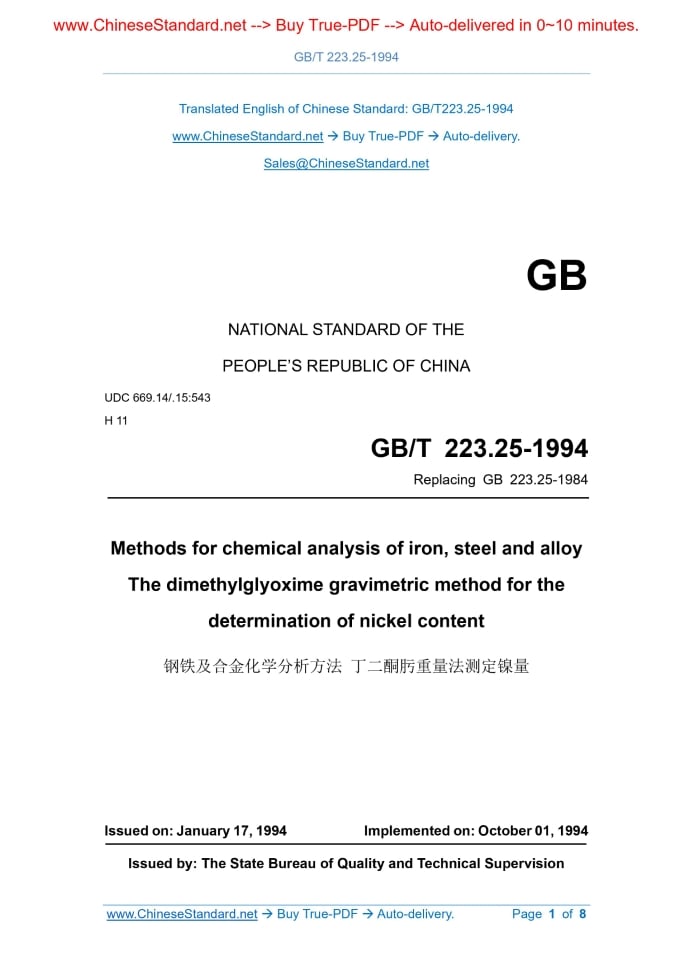
GB NATIONAL STANDARD OF THE PEOPLE’S REPUBLIC OF CHINA UDC 669.14/.15:543 H 11 Replacing GB 223.25-1984 Methods for chemical analysis of iron, steel and alloy The dimethylglyoxime gravimetric method for the determination of nickel content ISSUED ON: JANUARY 17, 1994 IMPLEMENTED ON: OCTOBER 01, 1994 Issued by: The State Bureau of Quality and Technical Supervision
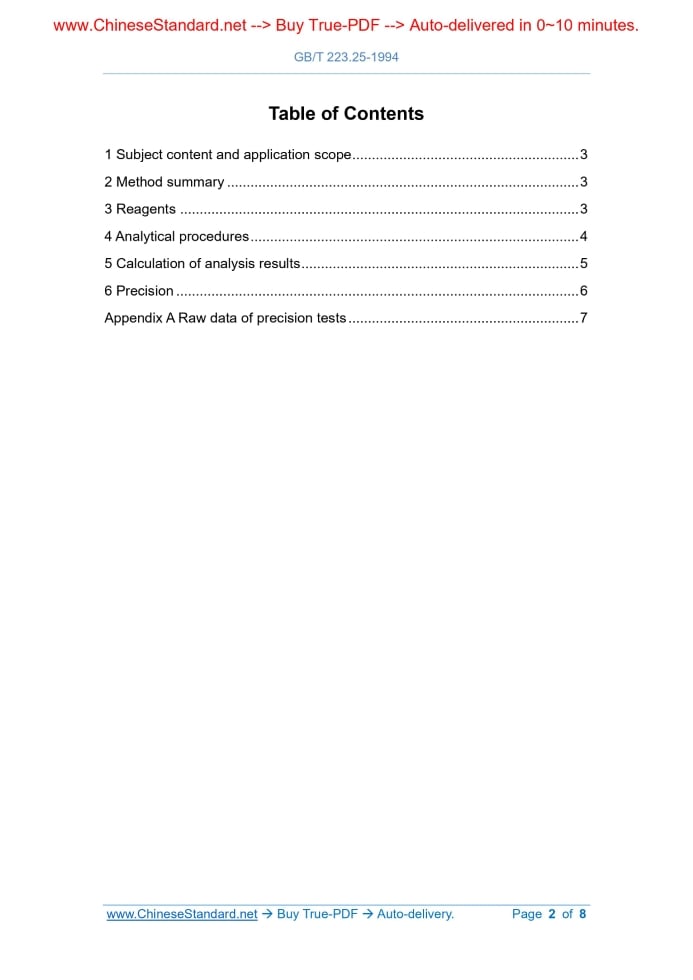
Table of Contents
1 Subject content and application scope ... 3 2 Method summary ... 3 3 Reagents ... 3 4 Analytical procedures ... 4 5 Calculation of analysis results ... 5 6 Precision ... 6 Appendix A Raw data of precision tests ... 7 Methods for chemical analysis of iron, steel and alloy The dimethylglyoxime gravimetric method for the determination of nickel content1 Subject content and application scope
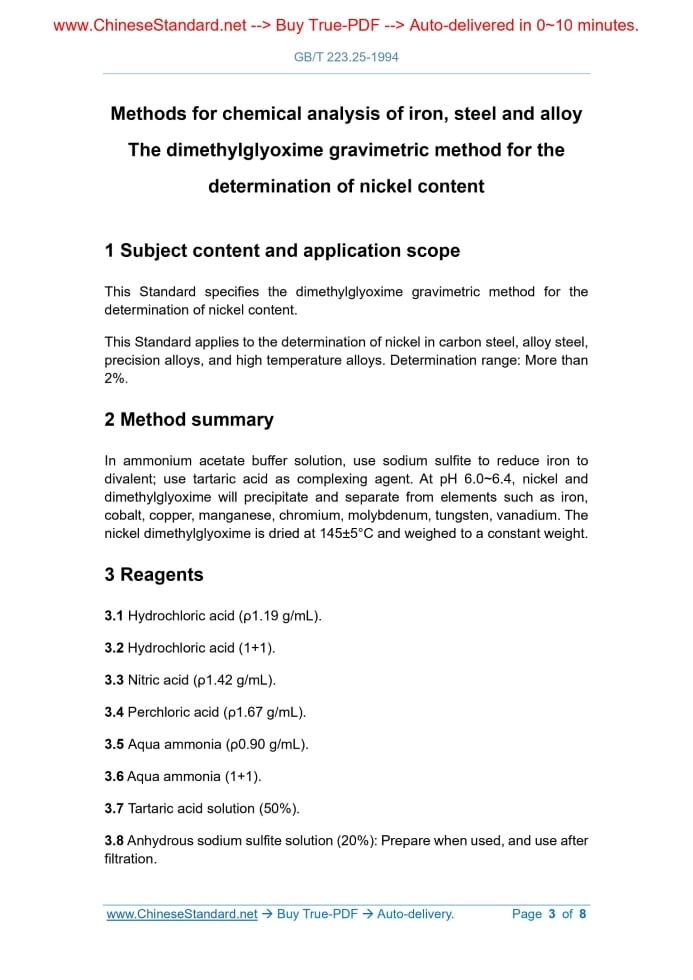
This Standard specifies the dimethylglyoxime gravimetric method for the determination of nickel content. This Standard applies to the determination of nickel in carbon steel, alloy steel, precision alloys, and high temperature alloys. Determination range: More than 2%.2 Method summary
In ammonium acetate buffer solution, use sodium sulfite to reduce iron to divalent; use tartaric acid as complexing agent. At pH 6.0~6.4, nickel and dimethylglyoxime will precipitate and separate from elements such as iron, cobalt, copper, manganese, chromium, molybdenum, tungsten, vanadium. The nickel dimethylglyoxime is dried at 145±5°C and weighed to a constant weight.3 Reagents
3.1 Hydrochloric acid (ρ1.19 g/mL). 3.2 Hydrochloric acid (1+1). 3.3 Nitric acid (ρ1.42 g/mL). 3.4 Perchloric acid (ρ1.67 g/mL). 3.5 Aqua ammonia (ρ0.90 g/mL). 3.6 Aqua ammonia (1+1). 3.7 Tartaric acid solution (50%). 3.8 Anhydrous sodium sulfite solution (20%): Prepare when used, and use after filtration. 4.2.3 USE slow-speed filter paper to filter; PLACE the filtrate in a 600 mL beaker; USE hot water to wash the beaker; WASH the filter paper and precipitate 7~8 times. The total volume of the solution is controlled to about 250 mL. 4.2.4 Under constant stirring, use hydrochloric acid (3.2) to acidify the solution to about pH 3.5; ADD 20 mL of anhydrous sodium sulfite solution (3.8) and stir for a while; USE aqua ammonia (3.6) to adjust the solution to pH 4.5. When heated to 45~50°C, add sodium thiosulfate solution (3.9) (when the copper content is less than 30 mg, add 10 mL; when it exceeds 30 mg, add 20 mL); STIR for a while and place 5 min. 4.2.5 ADD dimethylglyoxime ethanol solution (3.11) (calculated according to adding 0.6 mL per 1 mg of nickel, cobalt and copper, and with an excess of 10 mL). Under constant stirring, add 20 mL of ammonium acetate solution (3.10). At this time, the pH of the solution shall be 6.0~6.4. If it is lower than this range, it can be adjusted with aqua ammonia (3.6). 4.2.6 Adjust the total volume of the solution to about 400 mL (the samples containing cobalt or copper can be controlled at about 500 mL); LET it stand and age for 30 min (the samples containing cobalt and copper are aged for 1 h). 4.2.7 COOL down to room temperature; USE a constant weight of No. 4 glass crucible for vacuum filtration (the speed should not be too fast; the precipitate must not be sucked dry). USE cold water to wash the beaker and the precipitate (to prevent the precipitate from being sucked dry. It is better to wash with a small amount of water in many times and make the precipitate disperse. The total amount of washing water is generally controlled at about 200 mL). 4.2.8 PUT the glass crucible in an oven; DRY it at 145±5°C for about 2 h; COOL it in a desiccator; WEIGH it, and dry it repeatedly to a constant weight.5 Calculation of analysis results
Calculate the percentage content of nickel according to the following formula: Where: m1 - Mass of glass crucible and dimethylglyoxime nickel precipitation, g m2 - Mass of glass crucible, g; ......Source: Above contents are excerpted from the full-copy PDF -- translated/reviewed by: www.ChineseStandard.net / Wayne Zheng et al.