GB/T 223.14-2000 PDF English
Price & Delivery
US$70.00 · In stock · Download in 9 secondsGB/T 223.14-2000: Methods for chemical analysis of iron, steel and alloy. The N-benzoyl-N-phenylhydroxylamine extraction photometric method for the determination of vanadium content
Delivery: 9 seconds. True-PDF full-copy in English & invoice will be downloaded + auto-delivered via email. See step-by-step procedure
GB/T 223.14: Historical versions
| Standard ID | USD | BUY PDF | Delivery | Standard Title (Description) | Status |
| GB/T 223.14-2000 | 70 | Add to Cart | Auto, 9 seconds. | Methods for chemical analysis of iron, steel and alloy. The N-benzoyl-N-phenylhydroxylamine extraction photometric method for the determination of vanadium content | |
| GB/T 223.14-1989 | RFQ | ASK | 3 days | Methods for chemical analysis of iron, steel and alloy--The N-benzoyl-N-phenylhydroxylamine extraction photometric method for the determination of vanadium content | Obsolete |
Click to Preview this PDF
Similar standards
GB/T 223.14-2000: Methods for chemical analysis of iron, steel and alloy. The N-benzoyl-N-phenylhydroxylamine extraction photometric method for the determination of vanadium content
---This is an excerpt. Full copy of true-PDF in English version (including equations, symbols, images, flow-chart, tables, and figures etc.), auto-downloaded/delivered in 9 seconds, can be purchased online: https://www.ChineseStandard.net/PDF.aspx/GBT223.14-2000
GB NATIONAL STANDARD OF THE PEOPLE’S REPUBLIC OF CHINA ICS 77.040.30 H 11 Replacing GB/T 223.14-1989 Methods for Chemical Analysis of Iron, Steel and Alloy - The N-benzoy-N-phenylhydroxylamine Extraction Photometric Method for the Determination of Vanadium Content Issued on: APRIL 11, 2000 Implemented on: NOVEMBER 1, 2000 Issued by. Quality and Technology Supervision Bureau of the People’s Republic of China
Table of Contents
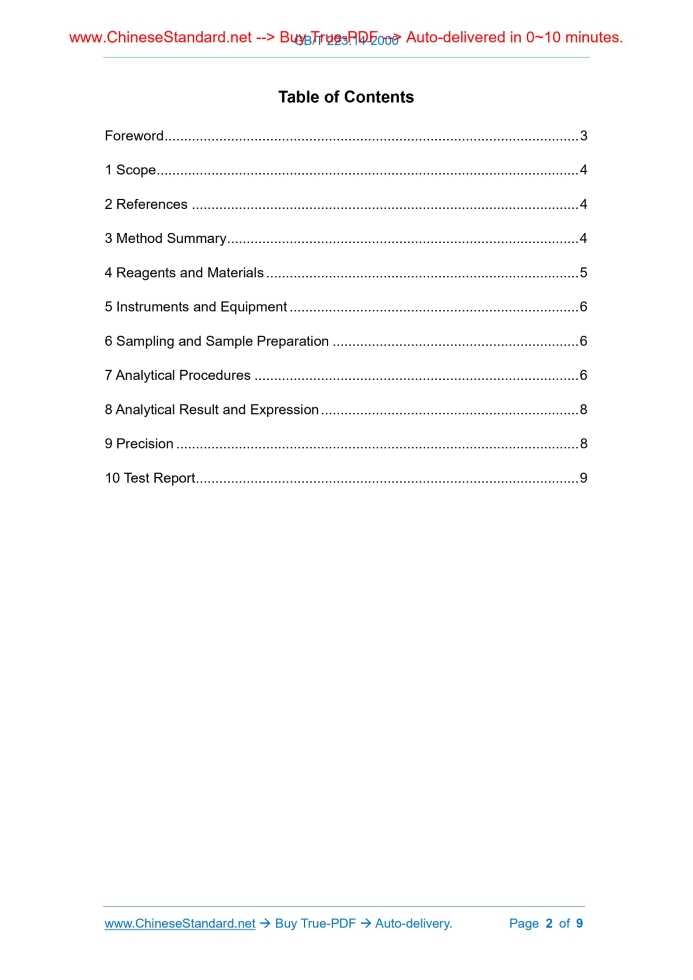
Foreword ... 3 1 Scope ... 4 2 References ... 4 3 Method Summary ... 4 4 Reagents and Materials ... 5 5 Instruments and Equipment ... 6 6 Sampling and Sample Preparation ... 6 7 Analytical Procedures ... 6 8 Analytical Result and Expression ... 8 9 Precision ... 8 10 Test Report ... 9Foreword
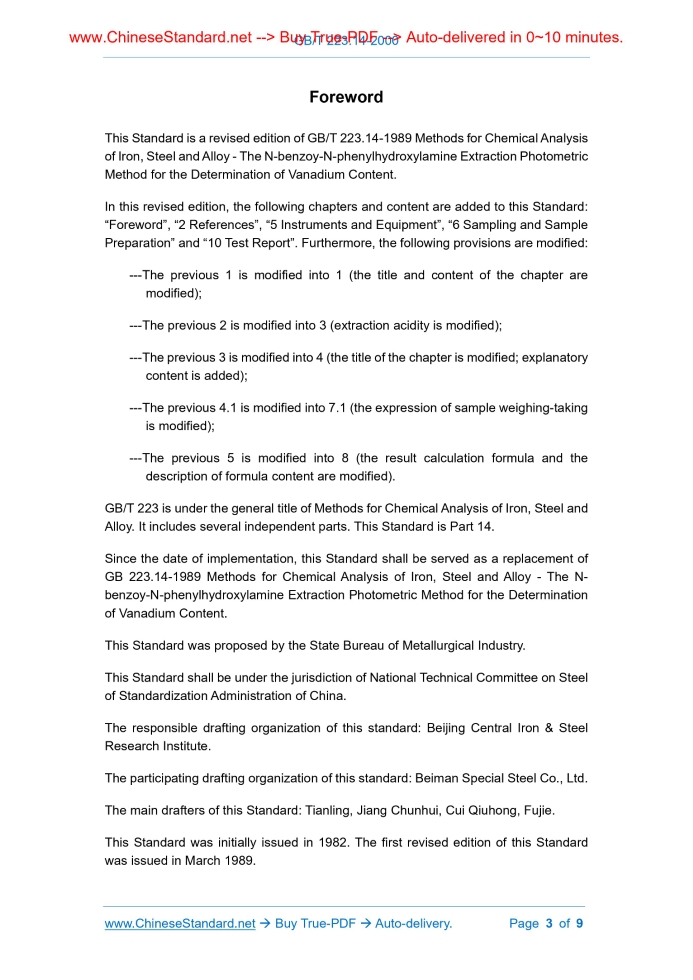
This Standard is a revised edition of GB/T 223.14-1989 Methods for Chemical Analysis of Iron, Steel and Alloy - The N-benzoy-N-phenylhydroxylamine Extraction Photometric Method for the Determination of Vanadium Content. In this revised edition, the following chapters and content are added to this Standard. “Foreword”, “2 References”, “5 Instruments and Equipment”, “6 Sampling and Sample Preparation” and “10 Test Report”. Furthermore, the following provisions are modified. ---The previous 1 is modified into 1 (the title and content of the chapter are modified); ---The previous 2 is modified into 3 (extraction acidity is modified); ---The previous 3 is modified into 4 (the title of the chapter is modified; explanatory content is added); ---The previous 4.1 is modified into 7.1 (the expression of sample weighing-taking is modified); ---The previous 5 is modified into 8 (the result calculation formula and the description of formula content are modified). GB/T 223 is under the general title of Methods for Chemical Analysis of Iron, Steel and Alloy. It includes several independent parts. This Standard is Part 14. Since the date of implementation, this Standard shall be served as a replacement of GB 223.14-1989 Methods for Chemical Analysis of Iron, Steel and Alloy - The N- benzoy-N-phenylhydroxylamine Extraction Photometric Method for the Determination of Vanadium Content. This Standard was proposed by the State Bureau of Metallurgical Industry. This Standard shall be under the jurisdiction of National Technical Committee on Steel of Standardization Administration of China. The responsible drafting organization of this standard. Beijing Central Iron & Steel Research Institute. The participating drafting organization of this standard. Beiman Special Steel Co., Ltd. The main drafters of this Standard. Tianling, Jiang Chunhui, Cui Qiuhong, Fujie. This Standard was initially issued in 1982. The first revised edition of this Standard was issued in March 1989. Methods for Chemical Analysis of Iron, Steel and Alloy The N-benzoy-N-phenylhydroxylamine Extraction Photometric Method for the Determination of Vanadium Content1 Scope
This Standard specifies the N-benzoy-N-phenylhydroxylamine extraction photometric method for the determination of vanadium content. This Standard is applicable to the determination of vanadium content in iron, steel and alloy under the range of 0.0050% (m/m) ~ 0.50% (m/m).2 References
Provisions that are included in the following standards constitute the provisions of this Standard through the reference in this Standard. When this Standard was published, all the announced versions were valid. All the standards will be revised. Parties that adopt this Standard shall discuss the possibility of adopting the latest versions of the following standards. GB/T 222-1984 Method of Sampling Steel for Determination of Chemical Composition and Permissible Variations for Product Analysis GB/T 6379-1986 Precision of Test Methods Determination of Repeatability and Reproducibility for a Standard Test Method by Interlaboratory Tests3 Method Summary
After dissolving test piece with acid, in the medium of sulfuric acid-phosphoric acid, use potassium permanganate to oxidize vanadium and pentavalent at room temperature. Add tantalum reagent-trichloromethane solution; extract the complex of vanadium into trichloromethane. Then, measure the absorbance at the wavelength of 530 nm. Interference determination of color developing solution that contains over 1 mg of molybdenum and titanium. when hydrochloric acid concentration in the extract rises to 6 mol/L, the permissible amount of molybdenum can be raised to 2.5 mg. Use sulfuric acid-hydrogen peroxide solution to rinse the organic phase, then, the permissible amount of titanium can be increased to 5 mg. 8 mL of sulfuric acid (4.5) and 8 mL of phosphoric acid (4.7); continue to heat it up, evaporate it, till it emits smoke. At this moment, if there is carbide that is not damaged, add drops of nitric acid (4.4), then, re-evaporate it, till it emits smoke. Repeat this step till carbide is completely damaged. Wait till it is slightly cooled down, then, add 50 mL of water; heat it up to dissolve salt, then, cool it down to room temperature. Transfer it into a 100 mL volumetric flask; use water to dilute to the constant volume, then, mix it up. When there is precipitation, start dry filtration. 7.3.2 Oxidization of vanadium 7.3.2.1 Transfer-take 10.00 mL of test solution (7.3.1), place it in a 60 mL separating funnel. Add 1 mL of copper solution (4.8); shake it while adding drops of potassium permanganate solution (4.9), till it manifests steady red; maintain for 2 ~ 3 min. 7.3.2.2 Add 2 mL of uric acid solution (4.10); shake it continuously while adding drops of sodium nitrite solution (4.11) [in terms of sample that contains over 1 mg of chromium, add 5 drops of sodium arsenite solution (4.12) to restore surplus potassium permanganate before adding drops of sodium nitrite solution, till the pink color completely vanishes]. 7.3.3 Color development, extraction 7.3.3.1 General sample Add 10.00 mL of tantalum reagent-trichloromethane solution (4.13), then, add 15 mL of hydrochloric acid (4.3); immediately start oscillation for 1 min; place it evenly for stratification. 7.3.3.2 Molybdenum-containing sample When the transferred test solution contains 1 ~ 5 mg of molybdenum, add 10.00 mL of tantalum reagent-trichloromethane solution (4.13), then, add 10 mL of hydrochloric acid (4.2). Immediately start oscillation for 1 min; place it statically for stratification. 7.3.3.3 Titanium-containing sample When the transferred test solution contains 1 ~ 5 mg of titanium, add 10.00 mL of tantalum reagent-trichloromethane solution (4.13), then, add 15 mL of hydrochloric acid (4.3). Immediately start oscillation for 1 min; place it statically for stratification. Then, transfer organic phase into another 60 mL separating funnel. Add 10 mL of sulfuric acid-hydrogen peroxide lotion (4.14); start rinsing and oscillation for 30 s; place it statically for stratification. 7.3.4 Measurement of absorbance 7.3.4.1 Use filter paper or absorbent cotton to dry-filter the lower layer of organic phase solution (7.3.3) in a 1 cm (or an appropriate size) absorption vessel. Take ......Source: Above contents are excerpted from the full-copy PDF -- translated/reviewed by: www.ChineseStandard.net / Wayne Zheng et al.