GB/T 223.12-1991 PDF English
Price & Delivery
US$70.00 · In stock · Download in 9 secondsGB/T 223.12-1991: Methods for chemical analysis of iron, steel and alloy. The sodium carbonate separation-diphenyl carbazide photometric method for the determination of chromium content
Delivery: 9 seconds. True-PDF full-copy in English & invoice will be downloaded + auto-delivered via email. See step-by-step procedure
| Standard ID | USD | BUY PDF | Delivery | Standard Title (Description) | Status |
| GB/T 223.12-1991 | 70 | Add to Cart | Auto, 9 seconds. | Methods for chemical analysis of iron, steel and alloy. The sodium carbonate separation-diphenyl carbazide photometric method for the determination of chromium content |
Click to Preview this PDF
Similar standards
GB/T 223.12-1991: Methods for chemical analysis of iron, steel and alloy. The sodium carbonate separation-diphenyl carbazide photometric method for the determination of chromium content
---This is an excerpt. Full copy of true-PDF in English version (including equations, symbols, images, flow-chart, tables, and figures etc.), auto-downloaded/delivered in 9 seconds, can be purchased online: https://www.ChineseStandard.net/PDF.aspx/GBT223.12-1991
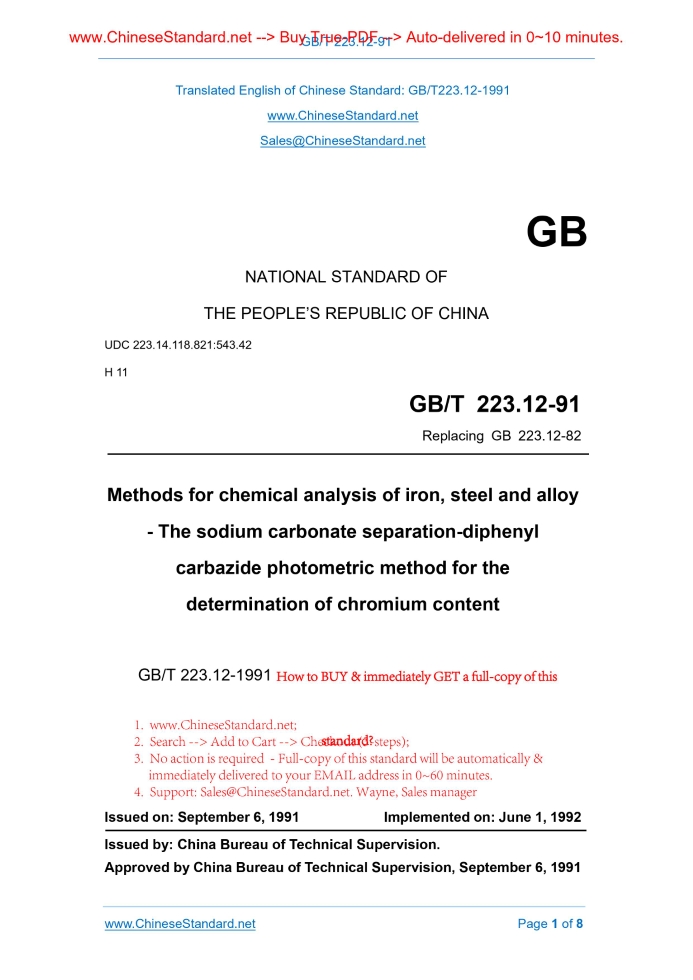
GB NATIONAL STANDARD OF THE PEOPLE’S REPUBLIC OF CHINA UDC 223.14.118.821.543.42 H 11 Replacing GB 223.12-82 Methods for chemical analysis of iron, steel and alloy - The sodium carbonate separation-diphenyl carbazide photometric method for the determination of chromium content Issued on: SEPTEMBER 6, 1991 Implemented on: JUNE 1, 1992 Issued by. China Bureau of Technical Supervision. Approved by China Bureau of Technical Supervision, September 6, 1991
Table of Contents
Additional Information ... 3 1 Subject and scope ... 4 2 Method summary ... 4 3 Reagents ... 4 4 Analysis steps ... 5 5 Calculation of analysis results ... 6 6 Precisions ... 7 Annex A (Supplement) Original data for precision test ... 8 Additional Information This Standard was proposed by Ministry of Metallurgical Industry of People's Republic of China. This Standard shall be under the technical jurisdiction of Metallurgical Industry Research Institute of Iron and Steel. Main drafting organization of this Standard. Metallurgical Industry Research Institute of Iron and Steel. Main drafter of this Standard. Cao Hongyao. This Standard level mark. GB 223.12-91 I Methods for chemical analysis of iron, steel and alloy - The sodium carbonate separation-diphenyl carbazide photometric method for the determination of chromium content1 Subject and scope
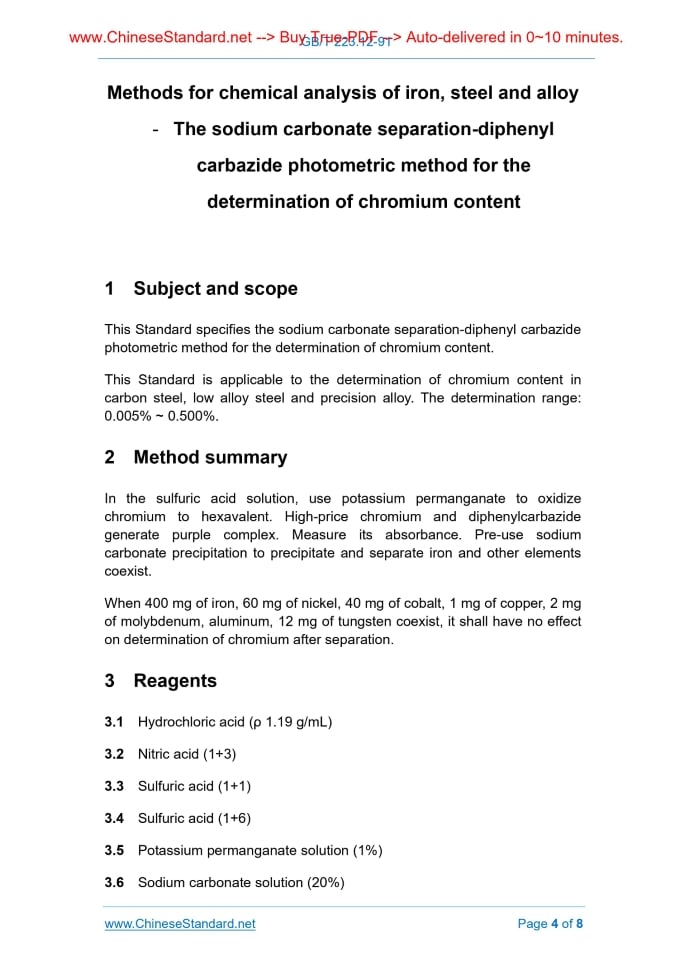
This Standard specifies the sodium carbonate separation-diphenyl carbazide photometric method for the determination of chromium content. This Standard is applicable to the determination of chromium content in carbon steel, low alloy steel and precision alloy. The determination range. 0.005% ~ 0.500%.2 Method summary
In the sulfuric acid solution, use potassium permanganate to oxidize chromium to hexavalent. High-price chromium and diphenylcarbazide generate purple complex. Measure its absorbance. Pre-use sodium carbonate precipitation to precipitate and separate iron and other elements coexist. When 400 mg of iron, 60 mg of nickel, 40 mg of cobalt, 1 mg of copper, 2 mg of molybdenum, aluminum, 12 mg of tungsten coexist, it shall have no effect on determination of chromium after separation.3 Reagents
3.1 Hydrochloric acid (ρ 1.19 g/mL) 3.2 Nitric acid (1+3) 3.3 Sulfuric acid (1+1) 3.4 Sulfuric acid (1+6) 3.5 Potassium permanganate solution (1%) 3.6 Sodium carbonate solution (20%) 3.7 Urea solution (20%) 3.8 Diphenyl carbazide solution (0.25%). weigh 0.25 g of diphenyl carbazide to dissolve in 94 mL of absolute ethanol and 6 mL of glacial acetic acid (ρ 1.05 g/mL). Store in a brown bottle. 3.9 Sodium nitrite solution (2%) 3.10 Chromium standard solution 3.10.1 Weigh 0.2829 g of potassium dichromate (reference) that have been dried to constant weight at 150°C. Dissolve in water. Remove to a 1000 mL volumetric flask. Use water to dilute to scale. Well mix. This solution shall contain 100 µg of chromium per 1 mL. 3.10.2 Weigh 20.00 mL of chromium standard solution (3.10.1) into a 1000 mL volumetric flask. Use water to dilute to scale. Well mix. This solution shall contain 2 µg of chromium per 1 mL.4 Analysis steps
4.1 Sample quantity Weigh 0.2000 ~ 0.3000 g of sample (when the chromium content in the sample is less than 0.01%, it shall weigh 0.3000 or 0.4000 g of sample). 4.2 Blank test Perform the blank test with sample. 4.3 Determination 4.3.1 Sample dissolving Place the sample (4.1) in to a 200 mL beaker. Add into 10 mL of nitric acid (3.2) to heat and dissolve [it shall add hydrochloric acid (3.1) to assist dissolving it is difficult to dissolve]. Add 5 mL of sulfuric acid (3.3). Heat to evaporate till sulfuric acid smokes. Cool for little while. Add 30 mL of water to heat and dissolve the salt. 4.3.2 Oxidation and separation Add 2 mL of potassium permanganate solution (3.5). Boil till manganese dioxide is completely precipitated. Use water to dilute to 80 ~ 90 mL. While stirring, slowly add 30 mL of sodium carbonate solution (3.6) (30 mL of sodium carbonate solution is usually sufficient, but it shall have an excess of 5 mL when sodium carbonate solution precipitates; if 30 mL is not enough, add a few milliliters). Slowly to heat till it is boiling 2 ~ 3 min. Cool to room temperature. Move to a 250 mL volumetric flask. Dilute with water to scale and mix well. Use double-layer medium-density filter paper to carry out the dry filtration. Discard the original filtrate. Pipette the filtrate (pipette 50.00 mL when the chromium content is less than 0.01%, 25.00 mL when it is between 0.01% ~ 0.1%, 10.00 mL when it is between 0.1% ~ 0.2%, 5.00 mL when it is more than 0.2%) into a 100 mL volumetric flask. Add 4.0 mL of sulfuric acid (3.4). At this point, if the solution is pink, there may be some potassium permanganate is not decomposed, then add 5 mL of urea solution (3.7). Carefully drop sodium nitrite solution (3.9) until the test solution is colorless and then an excess of 1 drop. 4.3.3 Color Use water to dilute to about 90 mL. Add 3.0 mL of diphenyl carbazide solution (3.8). Well mix. Use water to dilute to scale. Well mix. 4.3.4 Absorbance measurement Move the partial solution into a 2 ~ 3 cm absorption dish. Take water as a reference. Measure its absorbance at a wavelength of 540 nm on spectrophotometer. Subtract the absorbance of the blank solution along with the sample, and check the corresponding chromium content in the color developing solution from the working curve. 4.4 Drawing of working curve Pipette 0, 1.00, 2.00, 4.00, 7.00, 10.00 mL of chromium standard solution (3.10.2) into 6 100 mL flasks, respectively. Add 4.0 mL of sulfuric acid (3.4). The followings shall be carried out according to 4.3.3 and 4.3.4. Use reagent blank as reference to measure its absorbance. Take absorbance as the vertical axis, the corresponding chromium content as abscissa to draw the working curve.5 Calculation of analysis results
Calculate the percentage of chromium by the following formula. where, V1 - volume of sub-test solution, mL; V - total volume of test solution, mL; m1 - chromium content checked from working curve, g; m - sample weighing amount, g.6 Precisions
The precisions of this Standard were determined in 1989 by a joint test of eight laboratories at seven levels. The precisions are shown in the following table. Level rang, % (m/m) Repeatability r Reproducibility R 0.005 ~ 0.50 lg r = -1.5589 + 0.6552 lg m lg R = -1.3721 + 0.6245 lg m If the difference between two independent test results exceeds the repeatability or reproducibility value calculated by the precision function listed in the table, the two results shall be considered suspicious.Annex A
(Supplement) Original data for precision test Data Level Laboratory ......Source: Above contents are excerpted from the full-copy PDF -- translated/reviewed by: www.ChineseStandard.net / Wayne Zheng et al.