GB/T 22105.3-2008 PDF English
Price & Delivery
US$110.00 · In stock · Download in 9 secondsGB/T 22105.3-2008: Soil quality -- Analysis of total mercury, arsenic and lead contents -- Atomic fluorescence spectrometry -- Part 3: Analysis of total lead contents in soils
Delivery: 9 seconds. True-PDF full-copy in English & invoice will be downloaded + auto-delivered via email. See step-by-step procedure
Status: Valid
| Standard ID | USD | BUY PDF | Delivery | Standard Title (Description) | Status |
| GB/T 22105.3-2008 | 110 | Add to Cart | Auto, 9 seconds. | Soil quality -- Analysis of total mercury, arsenic and lead contents -- Atomic fluorescence spectrometry -- Part 3: Analysis of total lead contents in soils | Valid |
Click to Preview this PDF
Similar standards
GB/T 22105.3-2008: Soil quality -- Analysis of total mercury, arsenic and lead contents -- Atomic fluorescence spectrometry -- Part 3: Analysis of total lead contents in soils
---This is an excerpt. Full copy of true-PDF in English version (including equations, symbols, images, flow-chart, tables, and figures etc.), auto-downloaded/delivered in 9 seconds, can be purchased online: https://www.ChineseStandard.net/PDF.aspx/GBT22105.3-2008
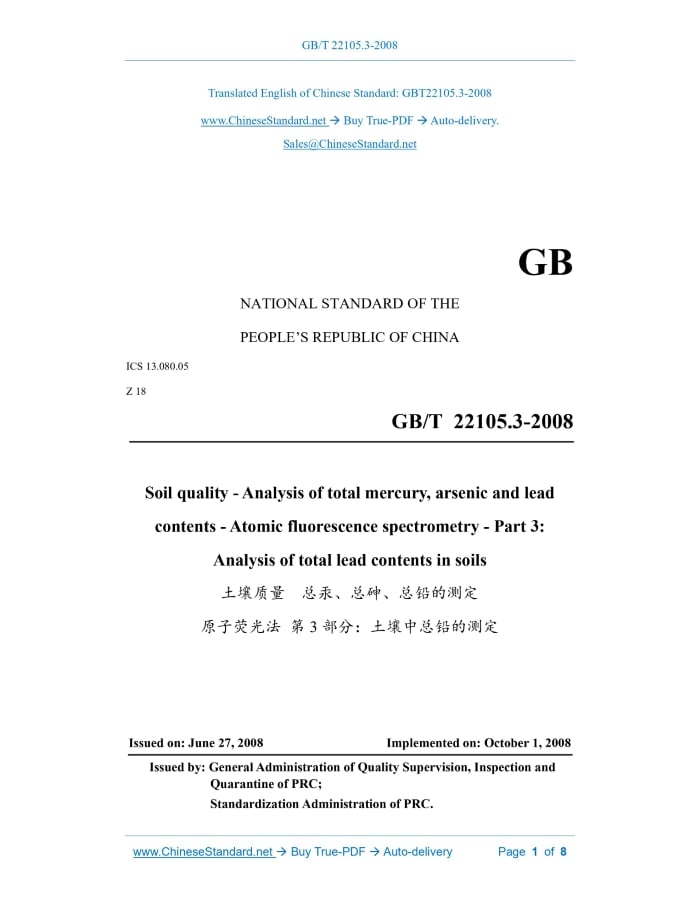
GB NATIONAL STANDARD OF THE PEOPLE’S REPUBLIC OF CHINA ICS 13.080.05 Z 18 Soil quality - Analysis of total mercury, arsenic and lead contents - Atomic fluorescence spectrometry - Part 3: Analysis of total lead contents in soils ISSUED ON: JUNE 27, 2008 IMPLEMENTED ON: OCTOBER 1, 2008 Issued by: General Administration of Quality Supervision, Inspection and Quarantine of PRC; Standardization Administration of PRC.
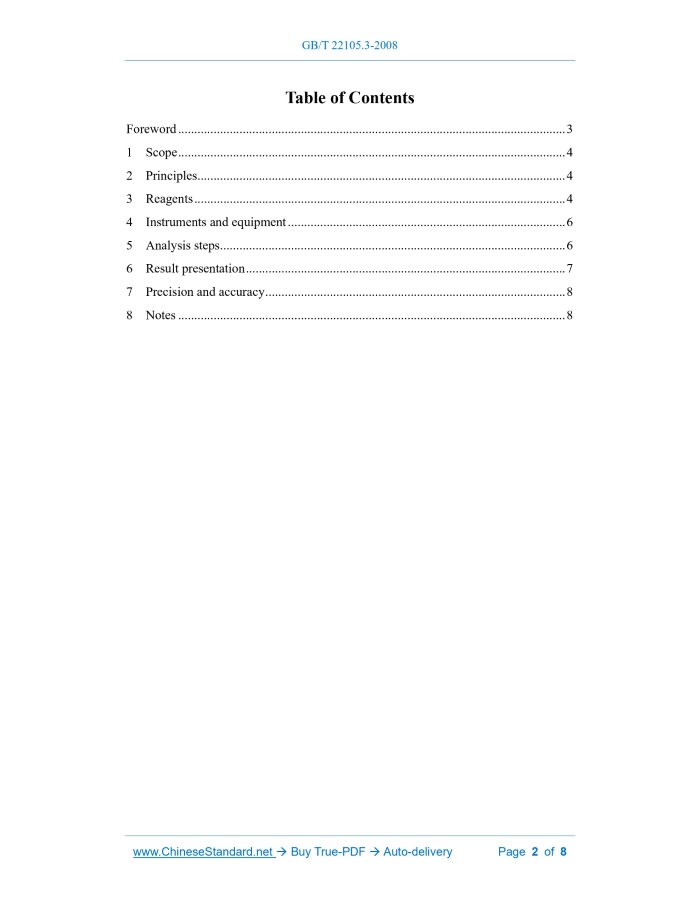
Table of Contents
Foreword ... 3 1 Scope ... 4 2 Principles ... 4 3 Reagents ... 4 4 Instruments and equipment ... 6 5 Analysis steps ... 6 6 Result presentation ... 7 7 Precision and accuracy ... 8 8 Notes ... 8 Soil quality - Analysis of total mercury, arsenic and lead contents - Atomic fluorescence spectrometry - Part 3: Analysis of total lead contents in soils1 Scope
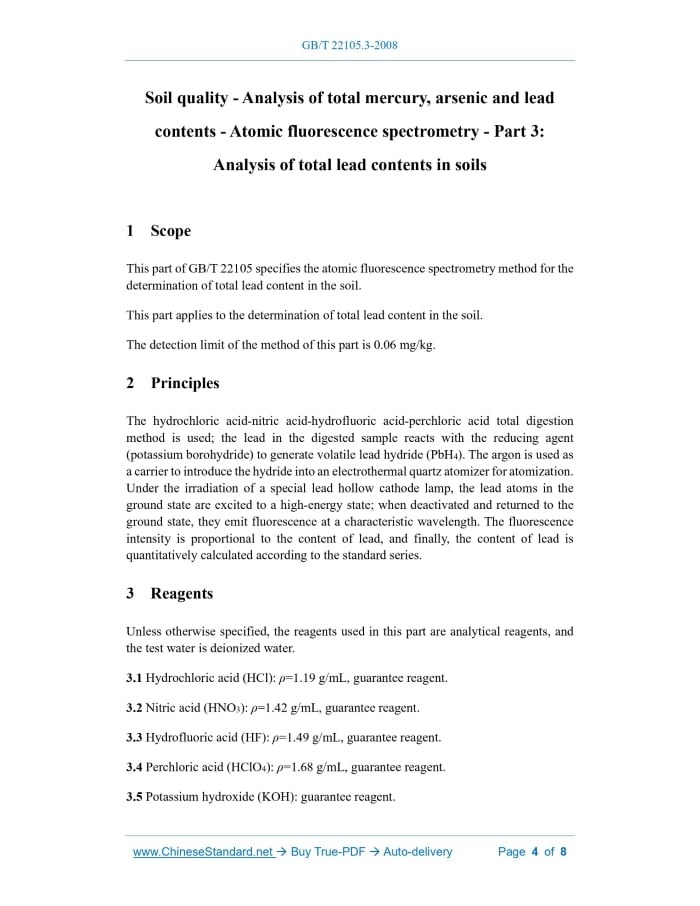
This part of GB/T 22105 specifies the atomic fluorescence spectrometry method for the determination of total lead content in the soil. This part applies to the determination of total lead content in the soil. The detection limit of the method of this part is 0.06 mg/kg.2 Principles
The hydrochloric acid-nitric acid-hydrofluoric acid-perchloric acid total digestion method is used; the lead in the digested sample reacts with the reducing agent (potassium borohydride) to generate volatile lead hydride (PbH4). The argon is used as a carrier to introduce the hydride into an electrothermal quartz atomizer for atomization. Under the irradiation of a special lead hollow cathode lamp, the lead atoms in the ground state are excited to a high-energy state; when deactivated and returned to the ground state, they emit fluorescence at a characteristic wavelength. The fluorescence intensity is proportional to the content of lead, and finally, the content of lead is quantitatively calculated according to the standard series.3 Reagents
Unless otherwise specified, the reagents used in this part are analytical reagents, and the test water is deionized water. 3.1 Hydrochloric acid (HCl): ρ=1.19 g/mL, guarantee reagent. 3.2 Nitric acid (HNO3): ρ=1.42 g/mL, guarantee reagent. 3.3 Hydrofluoric acid (HF): ρ=1.49 g/mL, guarantee reagent. 3.4 Perchloric acid (HClO4): ρ=1.68 g/mL, guarantee reagent. 3.5 Potassium hydroxide (KOH): guarantee reagent. 3.6 Potassium borohydride (KBH4): guarantee reagent. 3.7 Potassium ferricyanide (K3Fe(CN)6): guarantee reagent. 3.8 Hydrochloric acid solution (1+1): Take a certain volume of hydrochloric acid (3.1) and add the same volume of water to prepare the solution. 3.9 Hydrochloric acid solution (1+66): Take 1.5 mL of hydrochloric acid (3.1), add water to make up to 100 mL and mix well. 3.10 Nitric acid solution (1+1): Take a certain volume of nitric acid (3.2) and add the same volume of water to prepare the solution. 3.11 Oxalic acid solution (100 g/L): Weigh 10 g of oxalic acid, dissolve it in water and dilute it to 100 mL. 3.12 Potassium ferricyanide solution (100 g/L): Weigh 10 g of potassium ferricyanide (3.7), dissolve it in water and dilute it to 100 mL. 3.13 Reducing agent [2% potassium borohydride (KBH4) + 0.5% potassium hydroxide (KOH) solution]: Weigh 0.5 g of potassium hydroxide (3.5), put it into a beaker, and dissolve it with a small amount of water; weigh 2.0 g of potassium borohydride (3.6), put it into the potassium hydroxide solution, dissolve it and dilute to 100 mL with water; prepare this solution for current use. 3.14 Carrier solution: Take 3 mL of hydrochloric acid solution (3.8), 2 mL of oxalic acid solution (3.11), and 4 mL of potassium ferricyanide solution (3.12), put them into a beaker, dilute the solution to 100 mL with water, and mix well. 3.15 Lead standard stock solution: Weigh 0.5000 g of spectroscopically pure metal lead, add a small amount of (1+1) nitric acid solution (3.10) a few times, and if necessary, heat it until the lead dissolves completely. Transfer the solution to a 500 mL volumetric flask, dilute to the mark with water, and shake well. The concentration of lead in this standard solution is 1.00 mg/mL (the able organizations can directly purchase the standard stock solution from the department recognized by the country). 3.16 Lead standard intermediate solution: Pipette 10.00 mL of lead standard stock solution (3.15) into a 1000 mL volumetric flask, dilute to the mark with the hydrochloric acid solution (3.9), and shake well. The concentration of lead in this standard solution is 10.00 μg/mL. 3.17 Lead standard working solution: Pipette 2.00 mL of lead standard intermediate solution (3.16) into a 100 mL volumetric flask, dilute to the mark with the hydrochloric acid solution (3.9), and shake well. The concentration of lead in this standard solution is 0.20 μg/mL. ......Source: Above contents are excerpted from the full-copy PDF -- translated/reviewed by: www.ChineseStandard.net / Wayne Zheng et al.