GB/T 21510-2024 PDF English
Price & Delivery
US$275.00 · In stock · Download in 9 secondsGB/T 21510-2024: Antimicrobial property testing and evaluation methods for nano-inorganic materials
Delivery: 9 seconds. True-PDF full-copy in English & invoice will be downloaded + auto-delivered via email. See step-by-step procedure
Status: Valid
GB/T 21510: Historical versions
| Standard ID | USD | BUY PDF | Delivery | Standard Title (Description) | Status |
| GB/T 21510-2024 | 275 | Add to Cart | Auto, 9 seconds. | Antimicrobial property testing and evaluation methods for nano-inorganic materials | Valid |
| GB/T 21510-2008 | 150 | Add to Cart | Auto, 9 seconds. | Antimicrobial property detection methods for nano inorganic materials | Valid |
Click to Preview this PDF
Similar standards
GB/T 21510-2024: Antimicrobial property testing and evaluation methods for nano-inorganic materials
---This is an excerpt. Full copy of true-PDF in English version (including equations, symbols, images, flow-chart, tables, and figures etc.), auto-downloaded/delivered in 9 seconds, can be purchased online: https://www.ChineseStandard.net/PDF.aspx/GBT21510-2024
GB NATIONAL STANDARD OF THE PEOPLE’S REPUBLIC OF CHINA ICS 11.080.99 CCS G 70 Replacing GB/T 21510-2008 Antimicrobial property testing and evaluation methods for nano-inorganic materials Issued on. JULY 24, 2024 Implemented on. FEBRUARY 01, 2025 Issued by. State Administration for Market Regulation; Standardization Administration of the People’s Republic of China.
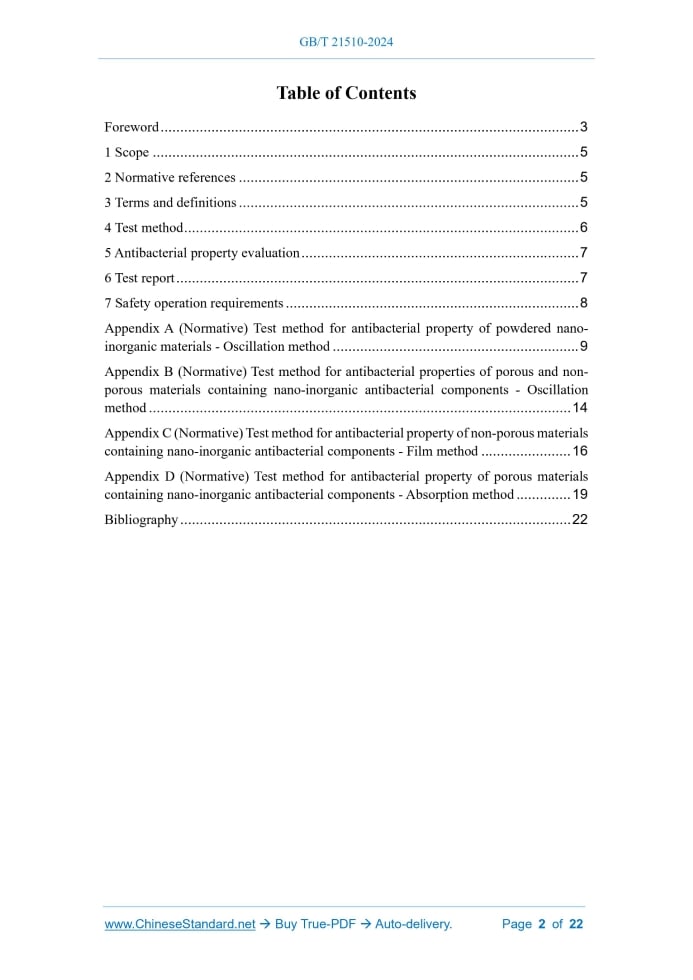
Table of Contents
Foreword... 3 1 Scope... 5 2 Normative references... 5 3 Terms and definitions... 5 4 Test method... 6 5 Antibacterial property evaluation... 7 6 Test report... 7 7 Safety operation requirements... 8 Appendix A (Normative) Test method for antibacterial property of powdered nano- inorganic materials - Oscillation method... 9 Appendix B (Normative) Test method for antibacterial properties of porous and non- porous materials containing nano-inorganic antibacterial components - Oscillation method... 14 Appendix C (Normative) Test method for antibacterial property of non-porous materials containing nano-inorganic antibacterial components - Film method... 16 Appendix D (Normative) Test method for antibacterial property of porous materials containing nano-inorganic antibacterial components - Absorption method... 19 Bibliography... 221 Scope
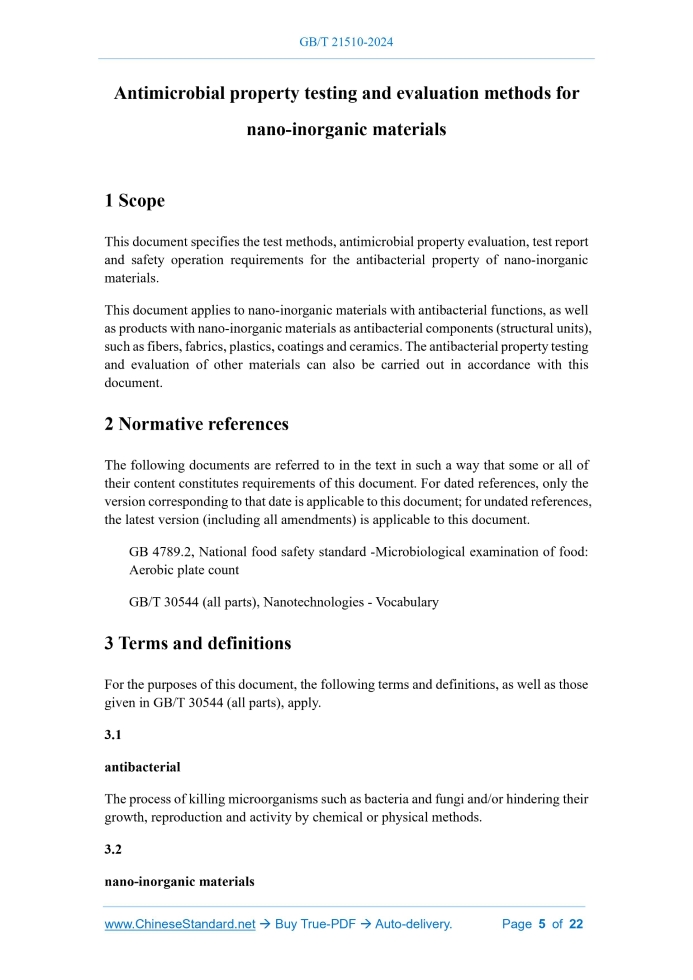
This document specifies the test methods, antimicrobial property evaluation, test report and safety operation requirements for the antibacterial property of nano-inorganic materials. This document applies to nano-inorganic materials with antibacterial functions, as well as products with nano-inorganic materials as antibacterial components (structural units), such as fibers, fabrics, plastics, coatings and ceramics. The antibacterial property testing and evaluation of other materials can also be carried out in accordance with this document.2 Normative references
The following documents are referred to in the text in such a way that some or all of their content constitutes requirements of this document. For dated references, only the version corresponding to that date is applicable to this document; for undated references, the latest version (including all amendments) is applicable to this document. GB 4789.2, National food safety standard -Microbiological examination of food. Aerobic plate count GB/T 30544 (all parts), Nanotechnologies - Vocabulary3 Terms and definitions
For the purposes of this document, the following terms and definitions, as well as those given in GB/T 30544 (all parts), apply. 3.1 antibacterial The process of killing microorganisms such as bacteria and fungi and/or hindering their growth, reproduction and activity by chemical or physical methods.4 Test method
4.1 Procedure 4.1.1 The test of the antibacterial property of powdered nano-inorganic materials shall be carried out according to the method specified in Appendix A. 4.2 Test data processing Multiply the number of colonies on each plate by the dilution factor to get the actual number of colonies recovered from the sample. 4.3 Calculation of test results 4.3.1 Calculation of colony counts Multiply the colony counts on each plate by the dilution factor to get the actual number of bacteria recovered from the sample. 4.3.3 Calculation of antibacterial logarithm value Calculate the antibacterial logarithm value according to Formula (2).5 Antibacterial property evaluation
The antibacterial property evaluation of products using nano-inorganic materials as antibacterial components (structural units) shall comply with the following regulations and indicate the bacterial species.6 Test report
The test report shall include the following.7 Safety operation requirements
7.1 All microbiological testing operations shall be carried out in a biological safety cabinet. 7.2 When dripping the bacterial liquid onto the sample, do not let it overflow outside the sample. 7.3 Before shaking, the conical flask shall be firmly fixed on the shaking table to avoid breakage.Appendix A
(Normative) Test method for antibacterial property of powdered nano-inorganic materials - Oscillation method A.1 Applicability This test method applies to the determination of antibacterial property of powdered nano-inorganic materials. A.2 Test equipment and materials A.2.3 Culture medium and reagents A.2.3.1 Ordinary nutrient broth culture medium A.3 Test procedure A.3.1 Preparation of bacterial slants A.3.1.1 Bacterial activation Take a tube of dry culture; open it under sterile operation; add an appropriate amount of nutrient broth with a capillary pipette; gently pipette several times to melt and disperse the culture. Take a test tube containing 5.0 mL ~ 10.0 mL of nutrient broth; drop a small amount of bacterial suspension into it; culture it at 37 ℃ ± 1 ℃ for 18 h ~ 24 h. A.4 Test requirements A.4.1 The colony count of the control group at “0” contact time shall be between 1×10⁴ cfu/mL and 5×10⁴ cfu/mL. The negative control shall show no sterile growth. A.4.2 The control sample shall not have obvious antibacterial effect. After shaking, the number of colonies recovered in the control group shall not be less than 1×10³ cfu/mL, otherwise the test will be invalid.Appendix B
(Normative) Test method for antibacterial properties of porous and non-porous materials containing nano-inorganic antibacterial components - Oscillation method B.1 Applicability This test method is applicable to the determination of the antibacterial property of porous and non-porous materials (including dissolvable and non-dissolvable fibers, fabrics, plastic powders, microporous filter materials, etc.) containing antibacterial components of nano-inorganic materials. B.2 Test equipment and materials B.3 Test procedure B.3.1 Preparation of bacterial slants The preparation of bacterial slant shall comply with the requirements of A.3.1. B.3.2 Test steps B.4 Test requirements The test requirements shall comply with the provisions of A.4.Appendix C
(Normative) Test method for antibacterial property of non-porous materials containing nano- inorganic antibacterial components - Film method C.1 Applicability This test method is applicable to the determination of the antibacterial property of non- porous materials (such as plastics, ceramics, paint films, plates, metals and other hard surface materials) containing antibacterial components of nano-inorganic materials. C.2 Test equipment and materials C.3 Test procedure C.3.1 Preparation of bacterial slants The preparation of bacterial slant shall comply with the requirements of A.3.1. C.3.2 Test steps C.3.2.1 Preparation of covering film The covering film is made of polyethylene film with a size of (40±2) mm × (40±2) mm and a thickness of 0.05 mm ~ 0.10 mm. If the test sample is small, the size of the covering film can be reduced according to its surface area to prevent the bacterial suspension from overflowing. ......Source: Above contents are excerpted from the full-copy PDF -- translated/reviewed by: www.ChineseStandard.net / Wayne Zheng et al.