GB/T 19951-2019 PDF English
Price & Delivery
US$345.00 · In stock · Download in 9 secondsGB/T 19951-2019: Road vehicles - Disturbances test methods for electrical/electronic component from electrostatic discharge
Delivery: 9 seconds. True-PDF full-copy in English & invoice will be downloaded + auto-delivered via email. See step-by-step procedure
Status: Valid
GB/T 19951: Historical versions
| Standard ID | USD | BUY PDF | Delivery | Standard Title (Description) | Status |
| GB/T 19951-2019 | 345 | Add to Cart | Auto, 9 seconds. | Road vehicles - Disturbances test methods for electrical/electronic component from electrostatic discharge | Valid |
| GB/T 19951-2005 | 85 | Add to Cart | Auto, 9 seconds. | Road vehicles -- Test methods for electrical disturbances from electrostatic discharge | Obsolete |
Click to Preview this PDF
Similar standards
GB/T 19951-2019: Road vehicles - Disturbances test methods for electrical/electronic component from electrostatic discharge
---This is an excerpt. Full copy of true-PDF in English version (including equations, symbols, images, flow-chart, tables, and figures etc.), auto-downloaded/delivered in 9 seconds, can be purchased online: https://www.ChineseStandard.net/PDF.aspx/GBT19951-2019
NATIONAL STANDARD OF THE PEOPLE’S REPUBLIC OF CHINA ICS 43.040.10 T 36 Replacing GB/T 19951-2005 Road vehicles - Disturbances test methods for electrical/electronic component from electrostatic discharge (ISO 10605.2008, Road vehicles - Test methods for electrical disturbances from electrostatic discharge, MOD) Issued on. JUNE 04, 2019 Implemented on. JANUARY 01, 2020 Issued by. State Administration for Market Regulation; Standardization Administration of the PRC.
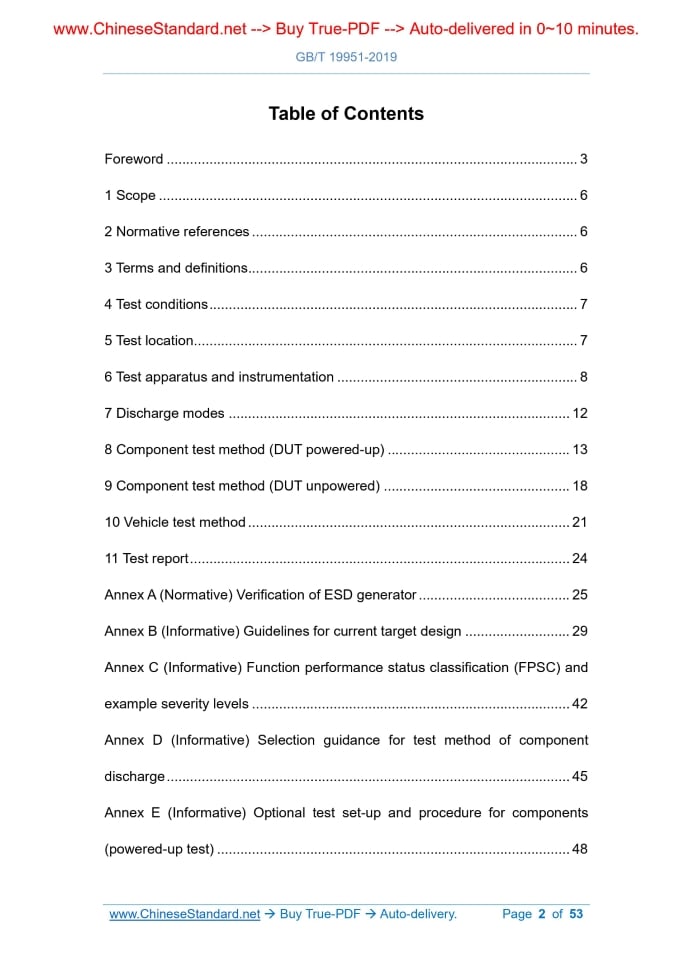
Table of Contents
Foreword... 3 1 Scope... 6 2 Normative references... 6 3 Terms and definitions... 6 4 Test conditions... 7 5 Test location... 7 6 Test apparatus and instrumentation... 8 7 Discharge modes... 12 8 Component test method (DUT powered-up)... 13 9 Component test method (DUT unpowered)... 18 10 Vehicle test method... 21 11 Test report... 24 Annex A (Normative) Verification of ESD generator... 25 Annex B (Informative) Guidelines for current target design... 29 Annex C (Informative) Function performance status classification (FPSC) and example severity levels... 42 Annex D (Informative) Selection guidance for test method of component discharge... 45 Annex E (Informative) Optional test set-up and procedure for components (powered-up test)... 48Foreword
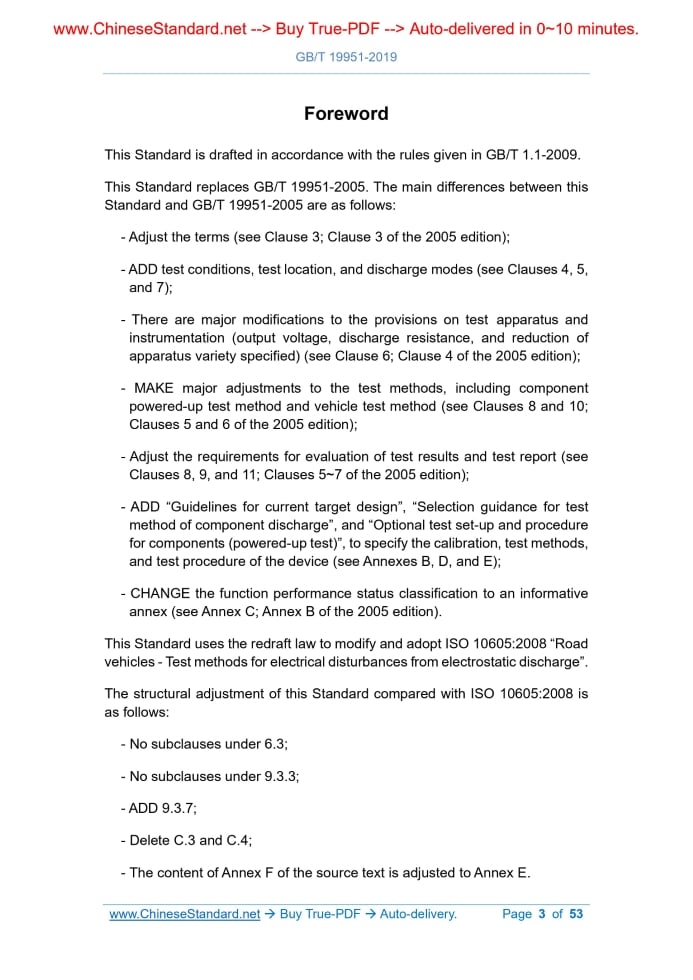
This Standard is drafted in accordance with the rules given in GB/T 1.1-2009. This Standard replaces GB/T 19951-2005.The main differences between this Standard and GB/T 19951-2005 are as follows. - Adjust the terms (see Clause 3; Clause 3 of the 2005 edition); - ADD test conditions, test location, and discharge modes (see Clauses 4, 5, and 7); - There are major modifications to the provisions on test apparatus and instrumentation (output voltage, discharge resistance, and reduction of apparatus variety specified) (see Clause 6; Clause 4 of the 2005 edition); - MAKE major adjustments to the test methods, including component powered-up test method and vehicle test method (see Clauses 8 and 10; Clauses 5 and 6 of the 2005 edition); - Adjust the requirements for evaluation of test results and test report (see Clauses 8, 9, and 11; Clauses 5~7 of the 2005 edition); - ADD “Guidelines for current target design”, “Selection guidance for test method of component discharge”, and “Optional test set-up and procedure for components (powered-up test)”, to specify the calibration, test methods, and test procedure of the device (see Annexes B, D, and E); - CHANGE the function performance status classification to an informative annex (see Annex C; Annex B of the 2005 edition). This Standard uses the redraft law to modify and adopt ISO 10605.2008 “Road vehicles - Test methods for electrical disturbances from electrostatic discharge”. The structural adjustment of this Standard compared with ISO 10605.2008 is as follows. - No subclauses under 6.3; - No subclauses under 9.3.3; - ADD 9.3.7; - Delete C.3 and C.4; - The content of Annex F of the source text is adjusted to Annex E. There are technical differences between this Standard and ISO 10605.2008. The clauses involved in these differences have been marked by a vertical single line (|) at the blank of the outer margin. The technical differences between this Standard and ISO 10605.2008 and their reasons are as follows. - About normative references, this Standard has made adjustments with technical differences, to adapt to the technical conditions of China. The adjustments are reflected in Clause 2 “Normative references”, as follows. Delete ISO 7637-1 and ISO 11452-1; ADD a reference to GB/T 29259-2012. - GB/T 29259-2012 has included the terms of electrostatic discharge, human ESD model, reference plane, and electrostatic discharge simulator (generator), so delete the 3.5, 3.6, 3.7, and 3.10 contents of the source text. - In order to clearly describe the contact discharge current waveform, and to facilitate understanding of the meanings of t1 and t2 in Table 2, with reference to the relevant standard, below Table 2, ADD Figure 3 “Schematic diagram for contact discharge mode waveform parameters”. The subsequent figure numbers change in order. - ADD the functional requirements after component test, as post-test result judgement, see 9.3.7. - The 6.3.2 content of the source text is unnecessary statement, and is easy to cause misunderstanding, so it is deleted. This Standard makes the following editorial changes. - Modify the standard name; - INCORPORATE the amendments of ISO 10605.2008/Amd 1.2014 and ISO 10605.2008/Cor. 1.2010.The clauses involved in these amendments have been marked by a vertical double line (ǁ) at the blank of the outer margin; - For ease of understanding, GIVE a note to the current/test voltage (A/kV) in Table 2; - The description of test voltage in 8.4.5 of the source text is the same as that in 8.3.6.This Standard does not repeat the description but refers to 8.3.6 instead. 9.3.3, 9.3.4, 9.3.5, 9.3.6, 10.3.3 are all treated in this way; - Delete the comment for “1” in Figure B.1c) “Cut side view” in Annex B of the source text and change “1” to “M3 screw hole”; - In order to maintain the unification of expression and understanding of function performance status classification (FPSC) between several standards of electromagnetic immunity series, the content of function performance status classification (FPSC) of Annex C is directly referred to GB/T 33014.1; - The source text’s Annex E “Rationale for air discharge generator verification” is not directly related to the technical requirements and test methods of the standard, and the drafting is extremely non-standard and so deleted. This Standard was proposed by Ministry of Industry and Information Technology of the PRC. This Standard shall be under the jurisdiction of National Technical Committee of Auto Standardization (SAC/TC 114). Responsible drafting organizations of this Standard. China Automotive Technology and Research Center Co., Ltd., Suzhou 3C-Test Electronic Co., Ltd., China Electronics Standardization Institute, Changchun Automotive Test Center Co., Ltd., Shanghai Volkswagen Co., Ltd., Xiangfan Da An Automobile Test Center, Shanghai Electrical Apparatus Research Institute, Yanfeng Visteon Electronics Technology (Shanghai) Co., Ltd., SAIC GM Wuling Automobile Co., Ltd., Zhengzhou Yutong Bus Co., Ltd., SAIC Motor Passenger Vehicle Company, SAIC Motor Commercial Vehicle Technical Center, Brilliance Auto Group Holdings Co., Ltd., Pan Asia Technical Automotive Center Co., Ltd., Centre Testing International Group Co., Ltd., Anhui Jianghuai Automobile Group Corp., Ltd., Shenzhen Hangsheng Electronics Co., Ltd., FAW-Volkswagen Automotive Co., Ltd., Chery Automobile Co., Ltd., Guangqi Honda Automobile Co., Ltd., Great Wall Motor Co., Ltd., Guangzhou GRG Metrology & Test Co., Ltd. Participating drafting organizations of this Standard. Bosch Automotive Products (Suzhou) Co., Ltd., Toyota Motor Technical Center (China) Co., Ltd., BMW (China) Services Ltd., Mercedes-Benz (China) Automobile Sales Co., Ltd., Volkswagen (China) Investment Co., Ltd., Ford Motor (China) Co., Ltd., Jaguar Land Rover China, Daimler Greater China Ltd., Peugeot Citroen (Shanghai) Management Co., Ltd. Main drafters of this Standard. Xu Xiuxiang, Hu Xiaojun, Cui Qiang, Liu Xin, Lin Yanping, Liu Xinliang, Liu Ketao, Liu Yuan, Cui Weidong, Deng Fuqi, Lu Changjun, Wu Dingchao, Cao Shanggui, Zou Aihua, Chu Yangang, Li Zheng, Liu Yingli. Road vehicles - Disturbances test methods for electrical/electronic component from electrostatic discharge1 Scope
This Standard specifies the test methods for the tolerance of vehicle’s electrical/electronic components against electrostatic discharge (ESD), which may be caused by assembly, service, and occupants inside and outside the vehicle, including component and vehicle level tests.2 Normative references
The following documents are indispensable for the application of this document. For the dated references, only the editions with the dates indicated are applicable to this document. For the undated references, the latest edition (including all the amendments) are applicable to this document. GB/T 29259-2012 Road vehicle - Electromagnetic compatibility terminology3 Terms and definitions
The terms and definitions defined in GB/T 29259-2012 and the following apply to this document. Interval of time within which the decrease of the test voltage due to leakage, prior to the discharge, is 10 %.4 Test conditions
The environmental conditions during the test are as follows. When other test conditions are used, they shall be recorded in the test report.5 Test location
It shall be carried out in a laboratory which meets environmental conditions. Special locations, such as a shielded room or an anechoic chamber, may be used.6 Test apparatus and instrumentation
The contact discharge mode currents shall be verified according to Annex A. Insulation support, if used, shall be constructed of clean non-hygroscopic material (e.g. polyethylene) with a relative permittivity between 1 and 5.The support shall be between 2 mm and 3 mm in thickness and project beyond the test set-up by at least 20 mm on all sides.7 Discharge modes
The speed of approach of the discharge electrode is a critical factor in the rise time and amplitude of the injected current during an air discharge. The speed of approach should be between 0.1 m/s and 0.5 m/s. In practice the ESD generator should approach the DUT as quickly as possible until the discharge occurs or the discharge tip touches the discharge point without causing damage to the DUT or generator.8 Component test method (DUT powered-up)
Discharges shall be applied to all specified test points with the equipment operating in normal modes. Product response may be affected by the polarity of the discharge. For direct discharge, the ESD generator’s discharge tip is held perpendicular to the surface of the DUT when possible; if not possible, an angle of at least 45° to the surface of the DUT is preferred.9 Component test method (DUT unpowered)
The test shall be performed by contact discharge on all pins and contacts, and/or air discharge mode on all surfaces and points that can be touched during the assembly process or in the service case. ......Source: Above contents are excerpted from the full-copy PDF -- translated/reviewed by: www.ChineseStandard.net / Wayne Zheng et al.