GB/T 19941.2-2019 PDF English
Price & Delivery
US$175.00 · In stock · Download in 9 secondsGB/T 19941.2-2019: Leather and fur -- Determination of formaldehyde content -- Part 2: Colorimetric method
Delivery: 9 seconds. True-PDF full-copy in English & invoice will be downloaded + auto-delivered via email. See step-by-step procedure
Status: Valid
| Standard ID | USD | BUY PDF | Delivery | Standard Title (Description) | Status |
| GB/T 19941.2-2019 | 175 | Add to Cart | Auto, 9 seconds. | Leather and fur -- Determination of formaldehyde content -- Part 2: Colorimetric method | Valid |
Click to Preview this PDF
Similar standards
GB/T 19941.2-2019: Leather and fur -- Determination of formaldehyde content -- Part 2: Colorimetric method
---This is an excerpt. Full copy of true-PDF in English version (including equations, symbols, images, flow-chart, tables, and figures etc.), auto-downloaded/delivered in 9 seconds, can be purchased online: https://www.ChineseStandard.net/PDF.aspx/GBT19941.2-2019
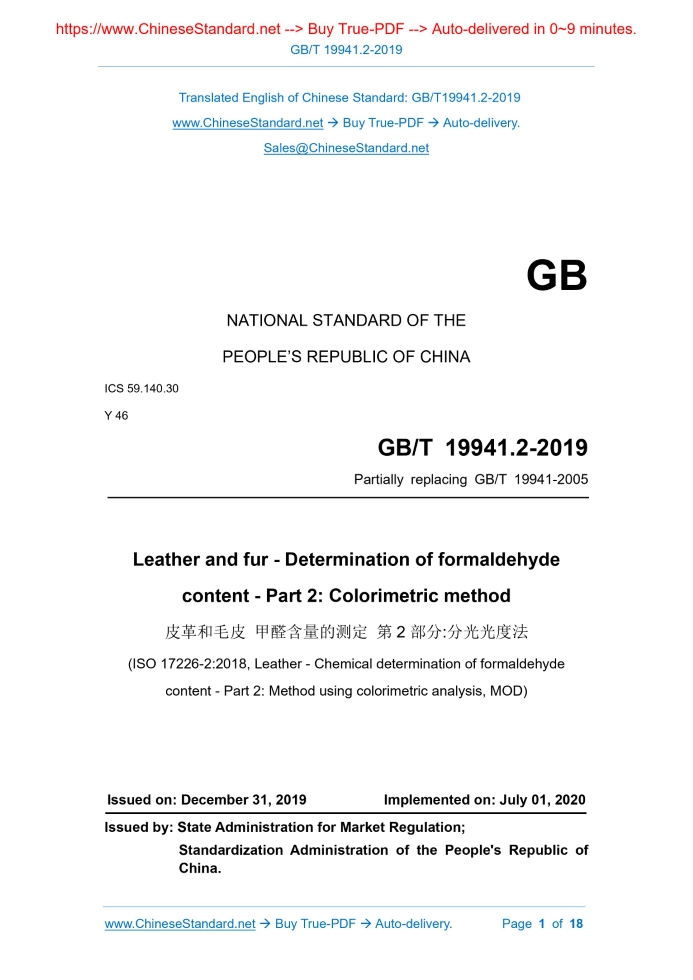
GB NATIONAL STANDARD OF THE PEOPLE’S REPUBLIC OF CHINA ICS 59.140.30 Y 46 Partially replacing GB/T 19941-2005 Leather and fur - Determination of formaldehyde content - Part 2.Colorimetric method (ISO 17226-2.2018, Leather - Chemical determination of formaldehyde content - Part 2.Method using colorimetric analysis, MOD) Issued on. DECEMBER 31, 2019 Implemented on. JULY 01, 2020 Issued by. State Administration for Market Regulation; Standardization Administration of the People's Republic of China.
Table of Contents
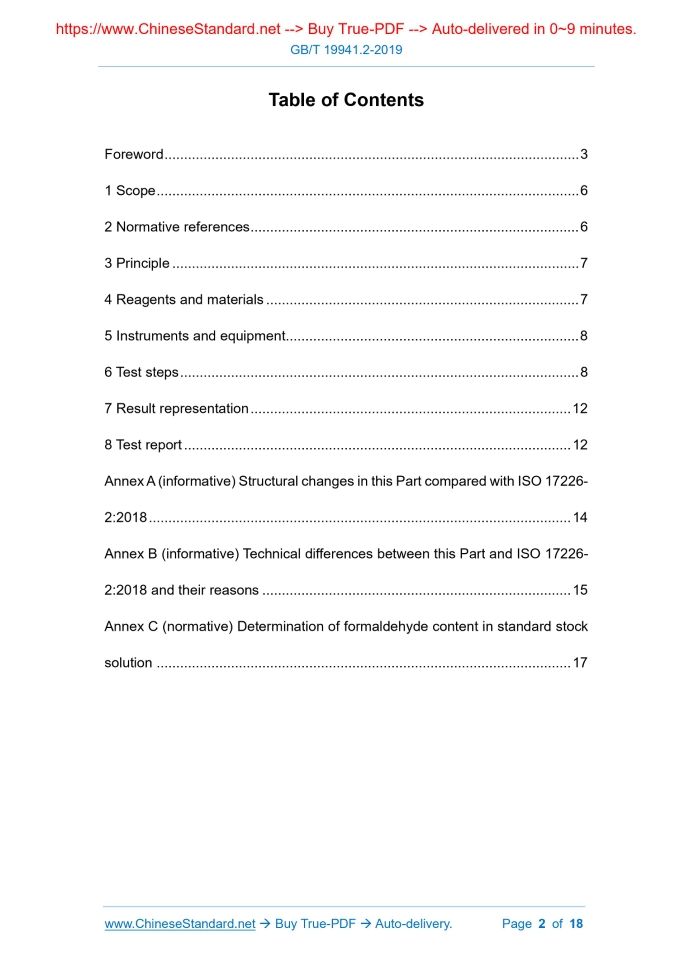
Foreword... 3 1 Scope... 6 2 Normative references... 6 3 Principle... 7 4 Reagents and materials... 7 5 Instruments and equipment... 8 6 Test steps... 8 7 Result representation... 12 8 Test report... 12 Annex A (informative) Structural changes in this Part compared with ISO 17226- 2.2018... 14 Annex B (informative) Technical differences between this Part and ISO 17226- 2.2018 and their reasons... 15 Annex C (normative) Determination of formaldehyde content in standard stock solution... 17Foreword
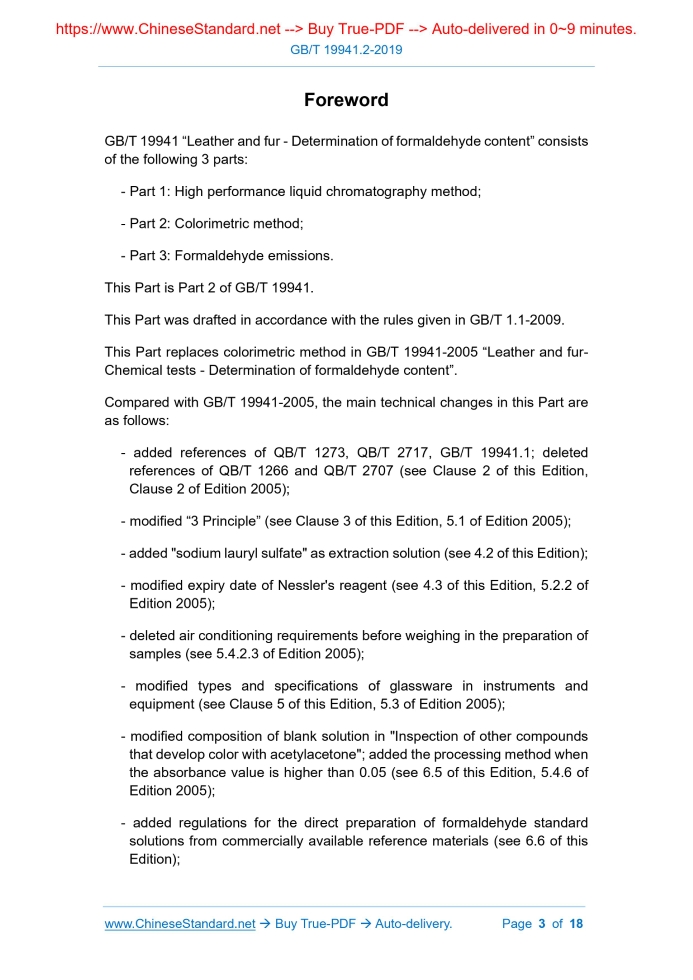
GB/T 19941 “Leather and fur - Determination of formaldehyde content” consists of the following 3 parts. - Part 1.High performance liquid chromatography method; - Part 2.Colorimetric method; - Part 3.Formaldehyde emissions. This Part is Part 2 of GB/T 19941. This Part was drafted in accordance with the rules given in GB/T 1.1-2009. This Part replaces colorimetric method in GB/T 19941-2005 “Leather and fur- Chemical tests - Determination of formaldehyde content”. Compared with GB/T 19941-2005, the main technical changes in this Part are as follows. - added references of QB/T 1273, QB/T 2717, GB/T 19941.1; deleted references of QB/T 1266 and QB/T 2707 (see Clause 2 of this Edition, Clause 2 of Edition 2005); - modified “3 Principle” (see Clause 3 of this Edition, 5.1 of Edition 2005); - added "sodium lauryl sulfate" as extraction solution (see 4.2 of this Edition); - modified expiry date of Nessler's reagent (see 4.3 of this Edition, 5.2.2 of Edition 2005); - deleted air conditioning requirements before weighing in the preparation of samples (see 5.4.2.3 of Edition 2005); - modified types and specifications of glassware in instruments and equipment (see Clause 5 of this Edition, 5.3 of Edition 2005); - modified composition of blank solution in "Inspection of other compounds that develop color with acetylacetone"; added the processing method when the absorbance value is higher than 0.05 (see 6.5 of this Edition, 5.4.6 of Edition 2005); - added regulations for the direct preparation of formaldehyde standard solutions from commercially available reference materials (see 6.6 of this Edition); - modified calculation formula of formaldehyde content (see 6.7 of this Edition, 5.4.8 of Edition 2005); - added relevant regulations, method detection limits and dispute resolution methods for calculating test results in a dry state (see Clause 7 of this Edition); - deleted requirements for "Explanation of test samples and packaging methods", "Applied analysis methods", "Test personnel and date" in "8 Test report" (see Clause 7 of Edition 2005); - made preparation of formaldehyde stock solution, determination of formaldehyde mass concentration and adjustment of related reagents and instruments to Annex C; added the number of titrations of blank solution in formaldehyde stock solution; modified the molar mass of formaldehyde to 30.02g/mol (see Annex C of this Edition, Clause 3 of Edition 2005). This Part uses redrafting method by adopting ISO 17226-2.2018 “Leather - Chemical determination of formaldehyde content - Part 2.Method using colorimetric analysis”. Compared with ISO 17226-2.2018, this Part has more structural adjustments. Annex A gives a list of comparisons between this Part and ISO 17226-2.2018 on chapter numbers. Compared with ISO 17226-2.2018, there are technical differences in this Part. Annex B gives a list of corresponding technical differences and their reasons. This Part also made the following editorial modifications. - changed the standard name to “Leather and fur - Determination of formaldehyde content - Part 2.Colorimetric method”; - added the notes on measured formaldehyde in “3 Principle”; - deleted the example of diluting filtrate in "8.2.3 Reaction with dinitrophenylhydrazine" in ISO 17226-2.2018; - deleted the informative Annex A in ISO 17226-2.2018. This Part was proposed by China National Light Industry Council. This Part shall be under the jurisdiction of National Technical Committee on Leather Industry of Standardization Administration of China (SAC/TC 252). The drafting organizations of this Part. Shaanxi University of Science and Technology, Chongqing Testing and Certification (Group) Co., Ltd., Shenzhen Yingbo Testing Technology Co., Ltd., China Leather and Footwear Research Institute Co., Ltd., Jihua 3514 Leather and Shoes Co., Ltd., Dongguan Huikeda Footwear Company Limited. Main drafters of this Part. Ma Jianzhong, Li Xiaolong, Chen Yuegang, Lyu Bin, Li Shiqi, Cai Baixue, Bu Qiaoqiao, Li Guozi, Huang Jianping. Version of standard substituted by this Part is. - GB/T 19941-2005. Leather and fur - Determination of formaldehyde content - Part 2.Colorimetric method1 Scope
This Part of GB/T 19941 specifies the method for determination of free and hydrolyzed formaldehyde content in leather and fur by colorimetric method. This Part is applicable to determination of formaldehyde content in various leathers, furs and their products.2 Normative references
The following referenced documents are indispensable for the application of this document. For dated references, only the edition cited applies. For undated references, the latest edition of the referenced document (including any amendments) applies. GB/T 6682, Water for analytical laboratory use - Specification and test methods (GB/T 6682-2008, ISO 3696.1987, MOD)3 Principle
Under the specified conditions, use the extraction solution to extract the sample. Mix the resulting extract with acetylacetone. Through the reaction, a yellow compound (3,5-diacetyl-1,4-dihydrolutidine) is produced. Determine the absorbance of the compound at the specified wavelength.4 Reagents and materials
Unless otherwise specified, all reagents used are analytical reagents, and all solutions are aqueous solutions.5 Instruments and equipment
Spectrophotometer. wavelength is 412nm, equipped with suitable cuvette. It is recommended to use 20mm cuvette; 40mm or 50mm cuvette can also be used.6 Test steps
The preparation of leather samples is carried out in accordance with QB/T 2716. The preparation of fur samples is carried out in accordance with QB/T 1272. In order to determine the absorbance of the filtrate (6.2) itself, transfer 5mL of filtrate into a 25mL Erlenmeyer flask (5.2). Add 5mL of ammonium acetate solution (4.4).7 Result representation
The free formaldehyde content in the sample is expressed in mg/kg, to the nearest of 0.1mg/kg.8 Test report
Annex A
(informative) Structural changes in this Part compared with ISO 17226-2.2018 Compared with ISO 17226-2.2018, this Part has more structural adjustments. See Table A.1 for the comparison of specific chapter numbers.Annex B
(informative) Technical differences between this Part and ISO 17226-2.2018 and their reasons ......Source: Above contents are excerpted from the full-copy PDF -- translated/reviewed by: www.ChineseStandard.net / Wayne Zheng et al.