GB/T 19630.2-2011 PDF English
Price & Delivery
US$95.00 · In stock · Download in 9 secondsGB/T 19630.2-2011: Organic products -- Part 2: Processing
Delivery: 9 seconds. True-PDF full-copy in English & invoice will be downloaded + auto-delivered via email. See step-by-step procedure
Status: Obsolete
GB/T 19630.2: Historical versions
| Standard ID | USD | BUY PDF | Delivery | Standard Title (Description) | Status |
| GB/T 19630.2-2011 | 95 | Add to Cart | Auto, 9 seconds. | Organic products -- Part 2: Processing | Obsolete |
| GB/T 19630.2-2005 | 359 | Add to Cart | 3 days | Organic Products -- Part 2: Processing | Obsolete |
Click to Preview this PDF
Similar standards
GB/T 19630.2-2011: Organic products -- Part 2: Processing
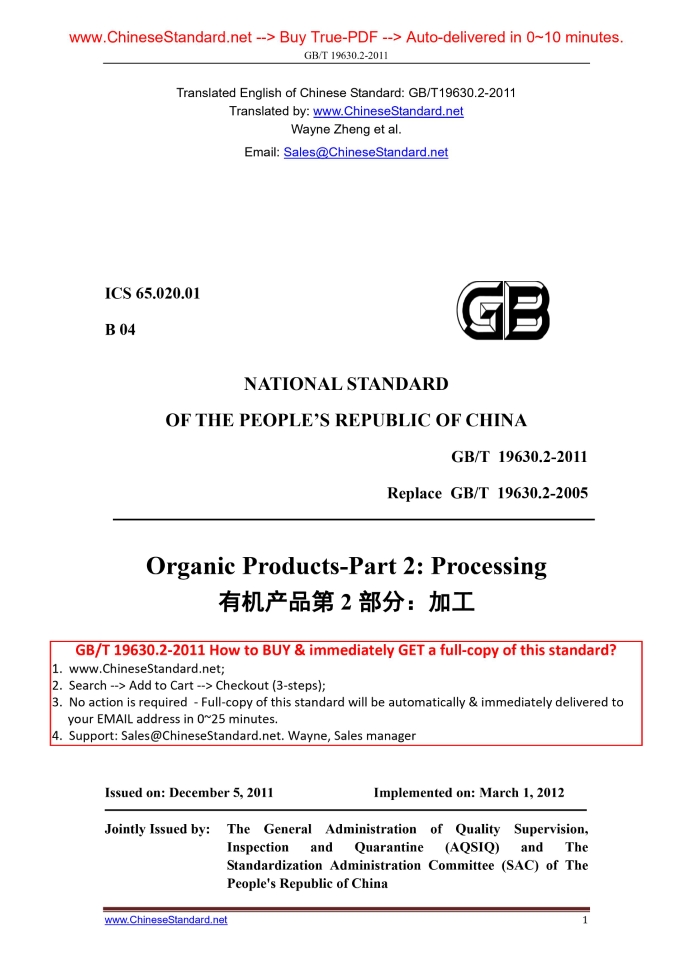
---This is an excerpt. Full copy of true-PDF in English version (including equations, symbols, images, flow-chart, tables, and figures etc.), auto-downloaded/delivered in 9 seconds, can be purchased online: https://www.ChineseStandard.net/PDF.aspx/GBT19630.2-2011ICS 65.020.01 B 04 NATIONAL STANDARD Replace GB/T 19630.2-2005 Organic Products-Part 2.Processing Issued on. DECEMBER 5, 2011 Implemented on. MARCH 1, 2012 Jointly Issued by. The General Administration of Quality Supervision, Inspection and Quarantine (AQSIQ) and The Standardization Administration Committee (SAC) of The People's Republic of China
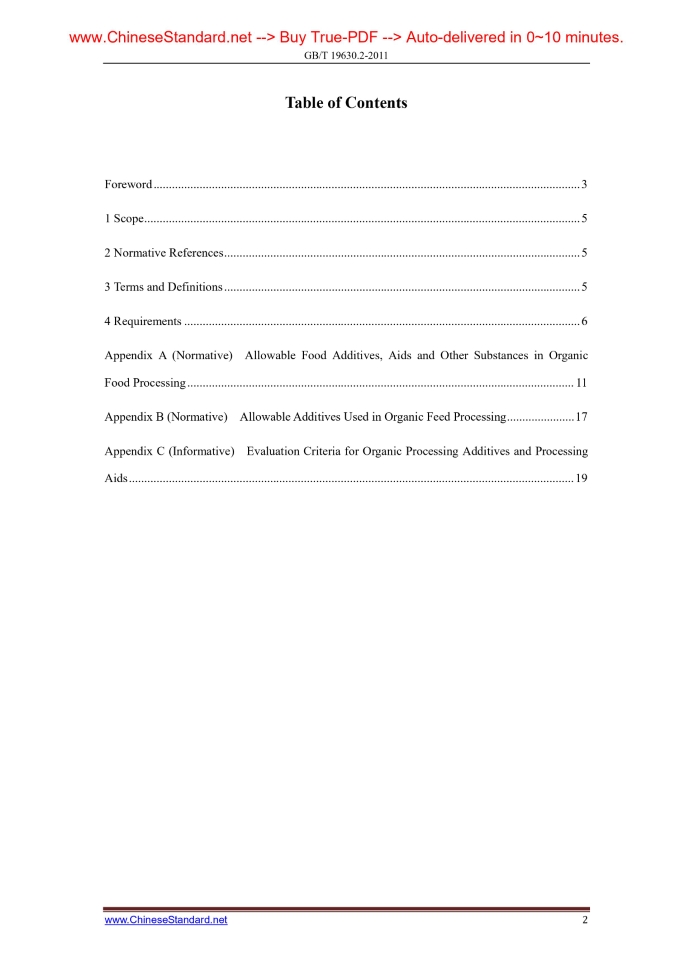
Table of Contents
Foreword... 3 1 Scope... 5 2 Normative References... 5 3 Terms and Definitions... 5 4 Requirements... 6 Appendix A (Normative) Allowable Food Additives, Aids and Other Substances in Organic Food Processing... 11 Appendix B (Normative) Allowable Additives Used in Organic Feed Processing... 17 Appendix C (Informative) Evaluation Criteria for Organic Processing Additives and Processing Aids... 191 Scope
This part of GB/T 19630 specifies the general specification and requirements of organic processing. This part is applicable to the whole process of processing, packaging, storage and transportation of the raw products (as raw materials), including foods, feed and textiles, produced according to GB/T 19630.1.2 Normative References
The following documents are indispensable for the application of this document. For dated references, only the dated edition applies. For undated references, the latest edition (including all the amendments) of the normative document applies. GB 2721 “Hygienic Standard for Food Grade Salt” GB 2760-2011 “National Food Safety Standard-Application Standard of Food Additives” GB 4287 “Discharge Standard of Water Pollutants for Dyeing and Finishing of Textile Industry” GB 5749 “Standards for Drinking Water Quality”3 Terms and Definitions
For the purpose of this standard, the following terms and definitions apply. 3.1 Ingredients All the substances that are used during the manufacturing or processing of products and also exist (including the existence in a modified form) in the product, including additives. 3.2 Food additives Artificially synthesized or natural substances added into foods for the purpose of improving the quality, color, smell, taste, corrosion protection, preservation and processing technology of foods.4 Requirements
4.1 General rules 4.1.1 The processing involved in this part and the following process shall be controlled effectively to keep organic completeness of the processed products, the control is detailed in the followings. 4.1.3 Organic products processing shall cause no negative effect on the environment or minimize the negative effect. 4.2 Foods and feeds 4.2.1 Ingredients, additives and processing aids 4.2.1.8 In the following cases, mineral substances (including microelements), vitamin and amino acid may be used. 4.2.1.9 Transgenic ingredients, additives processing aids shall not be used. 4.2.2 Processing 4.2.2.1 The main nutritional ingredients of foods and feeds shall not be damaged, and treatment methods such as machinery, frozen storage, heating, microwave and fumigating may be adopted; and extraction, concentration, precipitation and filter technology may be adopted, but the extraction solvents are limited to water, ethyl alcohol, animal and vegetable oils, vinegar, carbon dioxide, nitrogen or carboxylic acid, other chemical reagents shall not be added in extraction and concentration technology. 4.2.3 Prevention of injurious organisms 4.2.4 Packaging 4.2.4.1 The packaging materials made of wood, bamboo, plant stem leaf and paper are advocated to use. Other packaging materials meeting the hygiene requirements may be used. 4.2.4.2 All materials used for food packaging shall be the packing materials of food grade; packing shall be simple and practical, excessive packing shall be avoided and the biodegradation and recycle of the packing materials shall be considered for usage. 4.2.4.3 Carbon dioxide and nitrogen may be adopted as the packing filling agent. 4.2.6 Transportation 4.2.6.1 The transportation vehicles shall be cleaned before loading the organic products. 4.2.6.2 In the transportation process, organic products shall be protected from being mixed with or polluted by the conventional products. 4.2.6.3 In the process of transportation, loading and unloading, the organic product certification mark and relevant instructions on the external package shall not be polluted or damaged. 4.3 Textiles 4.3.1 Raw materials 4.3.1.1 The fibrous raw materials of textiles shall be 100% organic raw materials. 4.3.2 Processing 4.3.2.1 Appropriate production methods shall be adopted during the textile processing and the influence towards environment shall be reduced as much as possible. 4.3.2.2 Substances which are harmful for human and environment shall not be used; the auxiliaries used shall not contain carcinogenic, teratogenic, mutagenic and sensitized substances; the oral toxicity for mammals, LD50, shall not be greater than 2,000mg/kg. 4.3.2.3 Substances which easily generate biological accumulation, or are difficult to be biodegraded shall not be used. 4.3.2.4 During the processing of textiles, the energy consumption shall be minimized and renewable energy shall be used as much as possible. 4.3.2.7 Environment management and improvement plan shall be formulated and implemented in the production process. 4.3.2.8 The surface active agent used for cocoon cooking or wool scouring process shall be selected with the type which is easy for biodegradation. 4.3.2.9 The seriflux shall be easy to degrade or at least 80% of it can be cyclically utilized. 4.3.2.10 During the mercerization process, sodium hydroxide or other or other alkaline matters may be used but shall be utilized with maximal-cycling. 4.3.2.11 The textile oil and knitting oil (needle oil) shall be easy to carry out biodegradation or shall be the oiling agent which is extracted from vegetables. 4.3.3 Dye and finishing 4.3.3.1 The dye shall come from vegetable or mineral source. 4.3.3.2 Harmful dye or substance which is banned in GB/T 18885 shall not be used. 4.3.3.3 Natural painting and dyeing thickening material may be used. 4.3.3.4 Softener which is easy to be biodegradation may be used. 4.3.3.5 Substances which will generate organohalogen compounds in the waste water shall not be used for washing the dyeing and printing equipments. 4.3.3.6 The content of heavy metal in the dye shall not exceed the index specified in Table 1. 4.3.4 Finished products 4.3.4.1 Auxiliary materials (for example. lining, ornamental, button, zipper and thread, etc.) shall be environmentally harmless and natural materials shall be used as much as possible. 4.3.4.2 During the manufacturing process of finished products (for example. sand washing and washing), harmful auxiliaries towards human and environment shall not be used. ......Source: Above contents are excerpted from the full-copy PDF -- translated/reviewed by: www.ChineseStandard.net / Wayne Zheng et al.