GB/T 19230.2-2003 PDF English
Price & Delivery
US$70.00 · In stock · Download in 9 secondsGB/T 19230.2-2003: Test method for evaluating gasoline detergent in use -- Part 2: Test method for demulsibility of gasoline detergent
Delivery: 9 seconds. True-PDF full-copy in English & invoice will be downloaded + auto-delivered via email. See step-by-step procedure
Status: Valid
| Standard ID | USD | BUY PDF | Delivery | Standard Title (Description) | Status |
| GB/T 19230.2-2003 | 70 | Add to Cart | Auto, 9 seconds. | Test method for evaluating gasoline detergent in use -- Part 2: Test method for demulsibility of gasoline detergent | Valid |
Click to Preview this PDF
Similar standards
GB/T 19230.2-2003: Test method for evaluating gasoline detergent in use -- Part 2: Test method for demulsibility of gasoline detergent
---This is an excerpt. Full copy of true-PDF in English version (including equations, symbols, images, flow-chart, tables, and figures etc.), auto-downloaded/delivered in 9 seconds, can be purchased online: https://www.ChineseStandard.net/PDF.aspx/GBT19230.2-2003
GB NATIONAL STANDARD OF THE PEOPLE’S REPUBLIC OF CHINA ICS 75.140 E 49 Test method for evaluating gasoline detergent in use - Part 2. Test method for demulsibility of gasoline detergent Issued on. JULY 01, 2003 Implemented on. DECEMBER 01, 2003 Issued by. General Administration for Quality Supervision Inspection and Quarantine of PRC
Table of Contents
Foreword... 3 1 Scope... 4 2 Normative references... 4 3 Terms and definitions... 4 4 Method overview... 6 5 Instruments... 6 6 Reagents... 6 7 Instrument preparation... 6 8 Preparation of test gasoline... 7 9 Test steps... 7 10 Report... 8Foreword
GB/T 19230-2003 "Test method for evaluating gasoline detergent in use" is divided into six parts. - Part 1.Test method for rust-preventing characteristics of gasoline detergent; - Part 2.Test method for demulsibility of gasoline detergent; - Part 3.Test method for evaluating gasoline detergent produced effect for electronic port fuel injector (PFI) fouling; - Part 4.Test method for influence of induction system deposit (ISD) tendencies of gasoline detergent; - Part 5.Engine dynamometer test method for influence of intake valve and Combustion chamber deposit tendencies of gasoline detergent (Ford 2.3L method); - Part 6.Engine dynamometer test method for influence of intake valve and combustion chamber deposit tendencies of gasoline deter (M111 method). This Part was proposed by the Ministry of Communications of the People's Republic of China. This Part shall be under the jurisdiction of China Petrochemical Corporation. Drafting organizations of this standard. Highway Science Research Institute of Ministry of Communications, China Petroleum Lubricant Research and Development Center. The main drafters of this Part. Guo Donghua, Xu Xiaohong, Zhang Jun, Wu Wei, Peng Wei, Guo Yiming. Test method for evaluating gasoline detergent in use - Part 2. Test method for demulsibility of gasoline detergent1 Scope
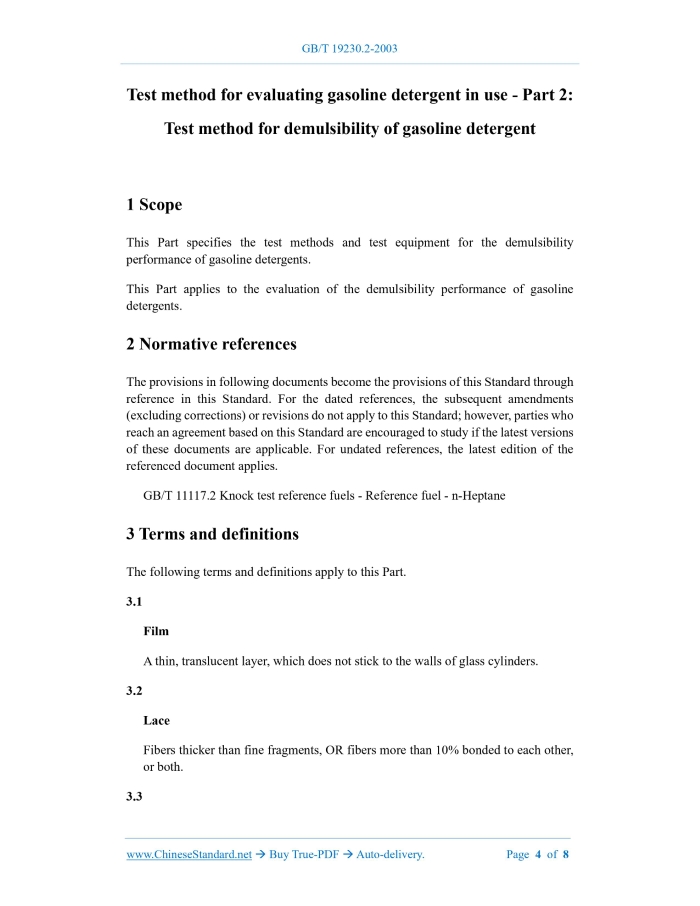
This Part specifies the test methods and test equipment for the demulsibility performance of gasoline detergents. This Part applies to the evaluation of the demulsibility performance of gasoline detergents.2 Normative references
The provisions in following documents become the provisions of this Standard through reference in this Standard. For the dated references, the subsequent amendments (excluding corrections) or revisions do not apply to this Standard; however, parties who reach an agreement based on this Standard are encouraged to study if the latest versions of these documents are applicable. For undated references, the latest edition of the referenced document applies. GB/T 11117.2 Knock test reference fuels - Reference fuel - n-Heptane3 Terms and definitions
The following terms and definitions apply to this Part. 3.1 Film A thin, translucent layer, which does not stick to the walls of glass cylinders. 3.2 Lace Fibers thicker than fine fragments, OR fibers more than 10% bonded to each other, or both. 3.3 Loose lace or slight scum, or both A rating that more than 10% but less than 50% lace or scum is covering at the gasoline/buffer solution interface, meanwhile the lace or scum does not enter one of the two layers. 3.4 Scum A layer which is thicker than the film, OR a layer that adheres to the walls of the glass cylinder, or both. 3.5 Shred Less than 10% of fine fibers, which are connected to each other.4 Method overview
At room temperature, put the test gasoline and phosphate buffer solution, into a clean stoppered glass graduated cylinder.5 Instruments
Stoppered glass graduated cylinder. 100 mL total scale, with 1 mL divisions. The distance from the 100 mL scale line to the mouth of the measuring cylinder is (50 ~ 60) mm.6 Reagents
6.1 n-heptane. Meet the requirements of GB/T 11117.2 for reference fuel. 6.2 Glass cleaning solution. Non-ionic detergent cleaning solution, if necessary, use chromic acid lotion (strong corrosiveness, harmful to health). 6.3 Distilled water. 6.4 Acetone. Analytically pure (flammable, harmful to health). 6.5 Anhydrous potassium hydrogen phosphate. Analytically pure.7 Instrument preparation
Wash the graduated cylinder thoroughly before testing. The cleaning process is as follows. 7.1 Rinse the graduated cylinder and stopper with hot tap water. Brush it if necessary. It can also be cleaned by n-heptane. Then rinse with acetone and then tap water. 7.3 Fully dry the graduated cylinder whose liquid has been poured.8 Preparation of test gasoline
8.1 Sample. Gasoline detergent tested. 8.2 Test gasoline. Base gasoline added to the sample. Prepare at least 100 mL of the test gasoline. Put the test gasoline into a clean container.9 Test steps
9.1 Pour 20 mL of phosphate buffer solution into a graduated cylinder at room temperature. Record the volume, accurate to 1 mL. Then add 80 mL of test gasoline. Apply a glass stopper. 9.3 Immediately place the graduated cylinder on a non-vibrating platform. Let it stand for 5 min. 9.4 Without picking up the graduated cylinder, observe under natural light and make the following records.10 Report
The report shall contain the following. ......Source: Above contents are excerpted from the full-copy PDF -- translated/reviewed by: www.ChineseStandard.net / Wayne Zheng et al.