GB/T 18107-2017 PDF English
Price & Delivery
US$940.00 · In stock · Download in 9 secondsGB/T 18107-2017: Hongmu
Delivery: 9 seconds. True-PDF full-copy in English & invoice will be downloaded + auto-delivered via email. See step-by-step procedure
Status: Valid
GB/T 18107: Historical versions
| Standard ID | USD | BUY PDF | Delivery | Standard Title (Description) | Status |
| GB/T 18107-2017 | 940 | Add to Cart | Auto, 9 seconds. | Hongmu | Valid |
| GB/T 18107-2000 | RFQ | ASK | 5 days | Hongmu | Obsolete |
Click to Preview this PDF
Similar standards
GB/T 18107-2017: Hongmu
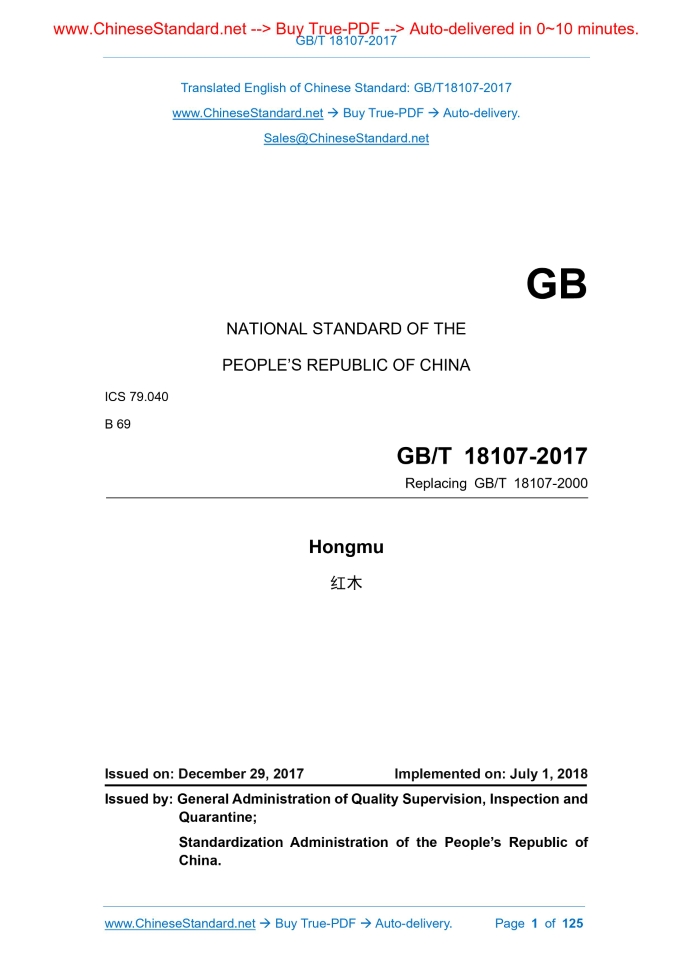
---This is an excerpt. Full copy of true-PDF in English version (including equations, symbols, images, flow-chart, tables, and figures etc.), auto-downloaded/delivered in 9 seconds, can be purchased online: https://www.ChineseStandard.net/PDF.aspx/GBT18107-2017NATIONAL STANDARD OF THE PEOPLE’S REPUBLIC OF CHINA ICS 79.040 B 69 Replacing GB/T 18107-2000 Hongmu Issued on. DECEMBER 29, 2017 Implemented on. JULY 1, 2018 Issued by. General Administration of Quality Supervision, Inspection and Quarantine; Standardization Administration of the People’s Republic of China.
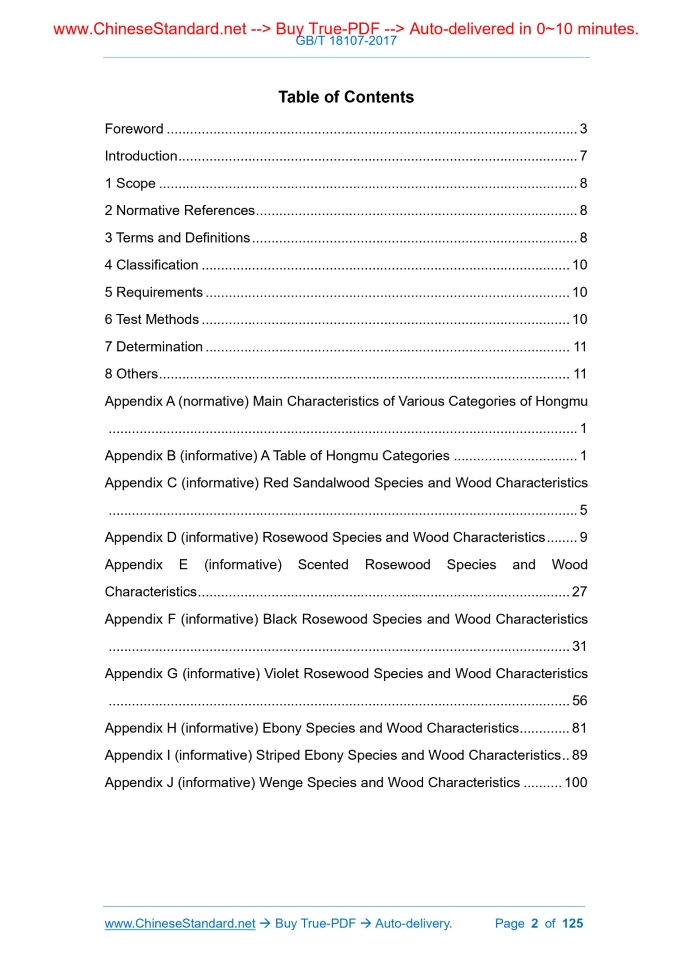
Table of Contents
Foreword... 3 Introduction... 7 1 Scope... 8 2 Normative References... 8 3 Terms and Definitions... 8 4 Classification... 10 5 Requirements... 10 6 Test Methods... 10 7 Determination... 11 8 Others... 11 Appendix A (normative) Main Characteristics of Various Categories of Hongmu ... 1 Appendix B (informative) A Table of Hongmu Categories... 1 Appendix C (informative) Red Sandalwood Species and Wood Characteristics ... 5 Appendix D (informative) Rosewood Species and Wood Characteristics... 9 Appendix E (informative) Scented Rosewood Species and Wood Characteristics... 27 Appendix F (informative) Black Rosewood Species and Wood Characteristics ... 31 Appendix G (informative) Violet Rosewood Species and Wood Characteristics ... 56 Appendix H (informative) Ebony Species and Wood Characteristics... 81 Appendix I (informative) Striped Ebony Species and Wood Characteristics.. 89 Appendix J (informative) Wenge Species and Wood Characteristics... 1001 Scope
This Standard stipulates the terms and definitions, classification, requirements, test methods, determination and others of Hongmu. This Standard is applicable to the production, operation, trade, inspection and identification of Hongmu and its products.2 Normative References
The following documents are indispensable to the application of this document. In terms of dated references, only the dated version applies to this document. In terms of undated references, the latest version (including all the amendments) applies to this document. GB/T 1933 Method for Determination of the Density of Wood LY/T 1788-2008 Standard Terminology Relating to Wood Properties3 Terms and Definitions
What is defined in LY/T 1788-2008, and the following terms and definitions are applicable to this document. 3.1 Hongmu Hongmu refers to heartwood of Pterocarpus, Dalbergia, Diospyros, Cliffords and Cassia species, and its structural characteristics, density and wood color (wood color darkened in the atmosphere) meet the requirements of this Standard. 3.2 Cross Section Cross section refers to a section perpendicular to the main axis of trunk. 3.5 Growth Ring Growth ring refers to wood generated within a growth period seen on the cross section. 3.6 Pore Pore refers to hole on the cross section of a vessel or vascular tracheid, i.e. a cell cavity. 3.7 Diffuse-porous Wood Diffuse-porous wood refers to evenly distributed broad-leaved trees with slightly equal pore diameter throughout the growth ring. 3.8 Axial Parenchyma Axial parenchyma refers to thin-walled cells with relatively thin cell wall, a long axis connected into a series, and generally with single pits. It is divided into two types. detachable and paratracheal. 3.9 Homogeneous Ray Tissue Homogeneous ray tissue refers to wood rays entirely composed of recumbent cells. 3.10 Heterogeneous Ray Tissue Heterogeneous ray tissue refers to wood rays entirely or partially composed of square or upright cells.4 Classification
Hongmu is classified into 8 types in total. red sandalwood, rosewood, scented rosewood, black rosewood, violet rosewood, ebony, striped ebony and wenge.5 Requirements
The main characteristics of red sandalwood, rosewood, scented rosewood, black rosewood, violet rosewood, ebony, striped ebony and wenge species shall comply with the stipulations in Appendix A.6 Test Methods
6.1 Wood Structural Characteristics 6.1.2 Macroscopic characteristics Observe and record the color, odor, texture, structure, pattern and hardness characteristics of wood samples. 6.1.3 Microscopic characteristics Place a wood sample into a container which contains water, ethanol-glycerin or ethylenediamine. Then, place it into an oven at about 60 °C to soften and exhaust the air from the sample, till the wood sample sinks to the bottom. After confirming that the wood sample is softened, then, take it out. T 6.2 Wood Color Under natural light, conduct visual inspection of wood color. 6.3 Odor Adopt the method of nasal sniffing for tests. 6.4 Air-dry Density 6.4.1 The test shall be conducted in accordance with the requirements in GB/T 1933. 6.4.2 When the size of wood sample cannot satisfy the stipulations in GB/T 1933, the sampling size should be not less than 5 mm 5 mm 5 mm. In terms of irregularly shaped sample, the method of drainage may be adopted to measure the volume.7 Determination
When the inspection result complies with the requirements of this Standard, the product may be determined as Hongmu. In addition, determine the category of Hongmu.8 Others
In production, operation and trade activities, the Chinese name, Latin name and place of origin of Hongmu categories shall be indicated. ......Source: Above contents are excerpted from the full-copy PDF -- translated/reviewed by: www.ChineseStandard.net / Wayne Zheng et al.