GB/T 17360-2020 PDF English
Price & Delivery
US$225.00 · In stock · Download in 9 secondsGB/T 17360-2020: Microbeam analysis - Method of quantitative determination for low contents of silicon and manganese in steels using electron probe microanalyzer
Delivery: 9 seconds. True-PDF full-copy in English & invoice will be downloaded + auto-delivered via email. See step-by-step procedure
Status: Valid
GB/T 17360: Historical versions
| Standard ID | USD | BUY PDF | Delivery | Standard Title (Description) | Status |
| GB/T 17360-2020 | 225 | Add to Cart | Auto, 9 seconds. | Microbeam analysis - Method of quantitative determination for low contents of silicon and manganese in steels using electron probe microanalyzer | Valid |
| GB/T 17360-2008 | 319 | Add to Cart | 3 days | Quantitative analysis method of low content Si and Mn in steel with electron probe microanalysis | Obsolete |
| GB/T 17360-1998 | 319 | Add to Cart | 3 days | Method of quantitative electron probe microanalysis on low contents of Si and Mn in steels | Obsolete |
Click to Preview this PDF
Similar standards
GB/T 17360-2020: Microbeam analysis - Method of quantitative determination for low contents of silicon and manganese in steels using electron probe microanalyzer
---This is an excerpt. Full copy of true-PDF in English version (including equations, symbols, images, flow-chart, tables, and figures etc.), auto-downloaded/delivered in 9 seconds, can be purchased online: https://www.ChineseStandard.net/PDF.aspx/GBT17360-2020
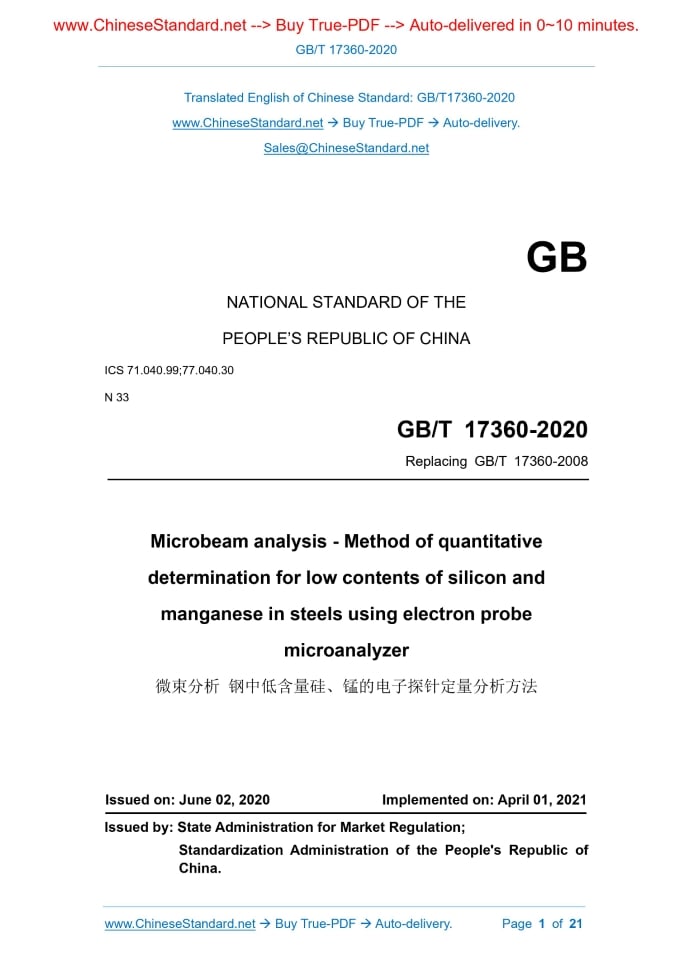
GB NATIONAL STANDARD OF THE PEOPLE’S REPUBLIC OF CHINA ICS 71.040.99;77.040.30 N 33 Replacing GB/T 17360-2008 Microbeam analysis - Method of quantitative determination for low contents of silicon and manganese in steels using electron probe microanalyzer ISSUED ON: JUNE 02, 2020 IMPLEMENTED ON: APRIL 01, 2021 Issued by: State Administration for Market Regulation; Standardization Administration of the People's Republic of China.
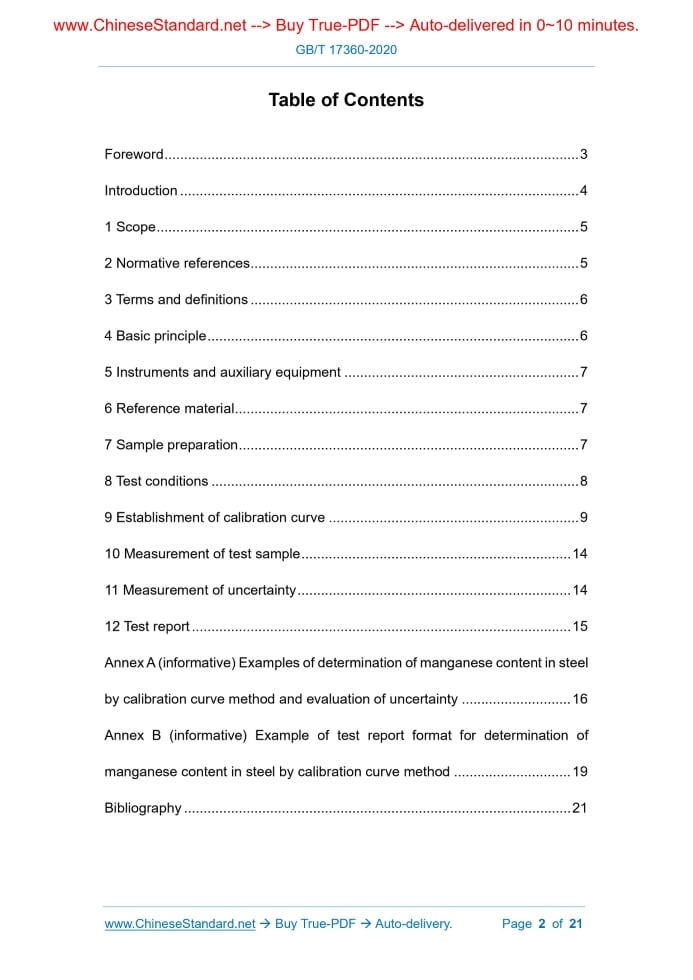
Table of Contents
Foreword ... 3 Introduction ... 4 1 Scope ... 5 2 Normative references ... 5 3 Terms and definitions ... 6 4 Basic principle ... 6 5 Instruments and auxiliary equipment ... 7 6 Reference material ... 7 7 Sample preparation ... 7 8 Test conditions ... 8 9 Establishment of calibration curve ... 9 10 Measurement of test sample ... 14 11 Measurement of uncertainty ... 14 12 Test report ... 15 Annex A (informative) Examples of determination of manganese content in steel by calibration curve method and evaluation of uncertainty ... 16 Annex B (informative) Example of test report format for determination of manganese content in steel by calibration curve method ... 19 Bibliography ... 21 Microbeam analysis - Method of quantitative determination for low contents of silicon and manganese in steels using electron probe microanalyzer1 Scope
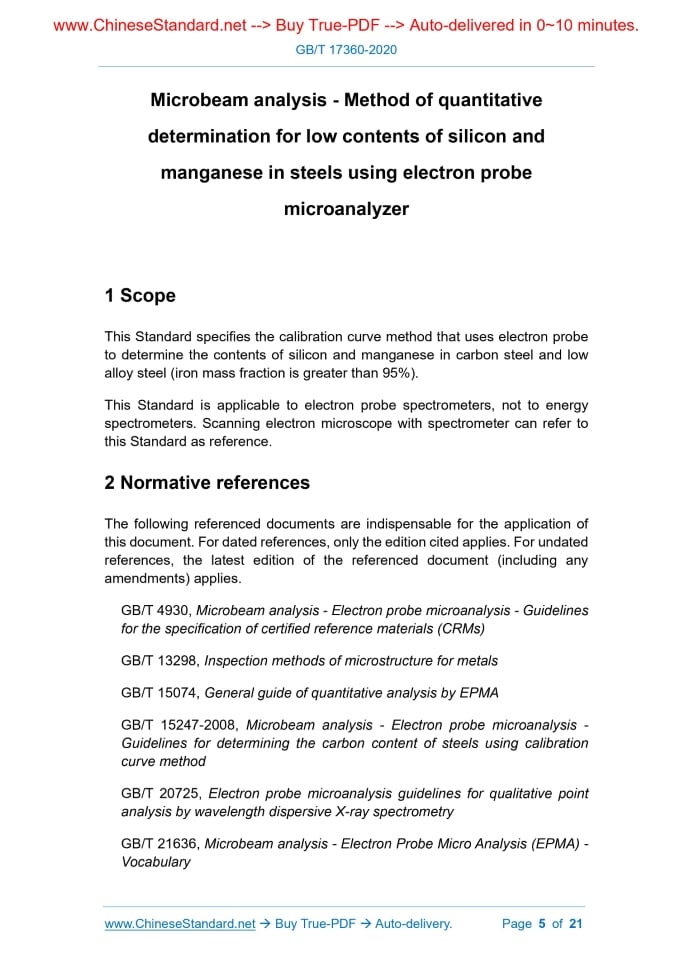
This Standard specifies the calibration curve method that uses electron probe to determine the contents of silicon and manganese in carbon steel and low alloy steel (iron mass fraction is greater than 95%). This Standard is applicable to electron probe spectrometers, not to energy spectrometers. Scanning electron microscope with spectrometer can refer to this Standard as reference.2 Normative references
The following referenced documents are indispensable for the application of this document. For dated references, only the edition cited applies. For undated references, the latest edition of the referenced document (including any amendments) applies. GB/T 4930, Microbeam analysis - Electron probe microanalysis - Guidelines for the specification of certified reference materials (CRMs) GB/T 13298, Inspection methods of microstructure for metals GB/T 15074, General guide of quantitative analysis by EPMA GB/T 15247-2008, Microbeam analysis - Electron probe microanalysis - Guidelines for determining the carbon content of steels using calibration curve method GB/T 20725, Electron probe microanalysis guidelines for qualitative point analysis by wavelength dispersive X-ray spectrometry GB/T 21636, Microbeam analysis - Electron Probe Micro Analysis (EPMA) - Vocabulary manganese) Kα line intensity ratio k and the silicon (or manganese) mass fraction w. As long as the intensity ratio of the silicon (or manganese) Kα line is measured on the test sample under the same test conditions, the mass fraction of silicon (or manganese) in the sample can be obtained from the calibration curve.5 Instruments and auxiliary equipment
5.1 Electron probe analyzer. 5.2 Metallographic microscope and sample preparation device. 5.3 Ultrasonic cleaning device.6 Reference material
6.1 The establishment of a calibration curve for the determination of silicon (or manganese) content REQUIRES at least 5 alloy reference substances with different silicon (or manganese) content and the content range covering the mass fraction of silicon (or manganese) element in the test sample. In addition, pure silicon (or manganese) reference materials are required. 6.2 For the selected series of alloy reference materials, in addition to meeting the requirements of GB/T 4930, the matrix composition shall be close to the chemical composition of the test sample. When the alloy elements other than silicon (or manganese) in the test sample do not have spectral interference and other factors that affect the quantitative analysis results of silicon (or manganese), Fe-Si (or Fe-Mn) solid solution can be selected as reference material. When there are other alloy elements that interfere with the measured spectrum of silicon (or manganese) in the test sample, the selected reference material shall also contain the same amount or content of these alloying elements.7 Sample preparation
7.1 The analysis surface of the sample shall be ground and polished. The operation method can be in accordance with GB/T 13298. Observe under a metallurgical microscope with a magnification of 200 ~ 500 times. There shall be no grinding defects such as wear marks on the surface of the sample. 7.2 Depending on the situation, the surface of the test sample and the reference material can be treated with the same degree of light corrosion, or neither is corroded. Reasonably set the pulse height analyzer parameters to eliminate the interference of high-order diffraction lines.9 Establishment of calibration curve
9.1 According to the requirements of GB/T 20725, conduct qualitative analysis of the test sample first. According to the analysis results, select the appropriate alloy reference material combination. 9.2 Under the same test conditions, on the series of alloy reference materials with different silicon content and the pure silicon reference materials, sequentially measure the peak intensity IP and background intensity IB of silicon Kα. The determination of background intensity is usually shown in Figure 1. At the appropriate positions BG-, BG+ on both sides of the spectrum peak (pay attention to avoid interference lines and absorption edges), respectively measure X-ray counting. Then use linear interpolation to calculate the background intensity. For nonlinear background, special background models are required. Using linear interpolation will bring additional errors. The intensities of the alloy reference material and pure silicon reference material silicon Kα peak can be calculated by formula (1) and formula (2) respectively: Where, Ii(Si) -- The intensity of the ith alloy reference material silicon Kα line (after background correction); -- The peak intensity of the silicon Kα line measured on the ith alloy reference material; -- The background intensity of the ith alloy reference material silicon Kα line; Ipure(Si) -- The intensity of pure silicon reference material silicon Kα line (after background correction); -- The peak intensity of the silicon Kα line measured on a pure silicon reference material; Where, wi -- The mass fraction of the ith data point element; -- The arithmetic mean of data column wi; ki -- The intensity ratio of the characteristic X-ray of the ith data point; -- The arithmetic mean of data column ki; n -- The total number of data points used to build the calibration curve. The correlation coefficient R of the calibration curve shall meet: R≥0.99, otherwise all links in the test process need to be checked. Ensure that the test requirements are met. And re-determine.10 Measurement of test sample
Use the same test conditions as when establishing the calibration curve. Measure and calculate the intensity ratio k of the silicon (or manganese) Kα line in the test sample. Substitute formula (7) to get the mass fraction of silicon (or manganese) in the sample.11 Measurement of uncertainty
Typical factors affecting the measurement of uncertainty include changes in environmental conditions, instruments, analytical testing procedures, and the state of the sample itself. Operator factors shall also be considered. For detailed sources of uncertainty, refer to Annex C of GB/T 17359-2012[4]. The uncertainty of the results measured by the calibration curve method can be evaluated by the method given in Annex A of GB/T 15247-2008. The repeatability of the test method shall be obtained by repeating the measurement of the same area in the sample in a short period of time by the same operator on the same instrument and the same test conditions. The reproducibility of the testing method shall be determined by repeating tests performed by different operators at different times. For the application example of determination of manganese content in steel by calibration curve method and evaluation of uncertainty, see Annex A. ......Source: Above contents are excerpted from the full-copy PDF -- translated/reviewed by: www.ChineseStandard.net / Wayne Zheng et al.