GB/T 1728-2020 PDF English
Price & Delivery
US$105.00 · In stock · Download in 9 secondsGB/T 1728-2020: Determination of drying time of coating and putty films
Delivery: 9 seconds. True-PDF full-copy in English & invoice will be downloaded + auto-delivered via email. See step-by-step procedure
Status: Valid
GB/T 1728: Historical versions
| Standard ID | USD | BUY PDF | Delivery | Standard Title (Description) | Status |
| GB/T 1728-2020 | 105 | Add to Cart | Auto, 9 seconds. | Determination of drying time of coating and putty films | Valid |
| GB/T 1728-1979 | 169 | Add to Cart | 2 days | Methods of test for drying time of coatings of paints and putties | Obsolete |
Click to Preview this PDF
GB/T 1728-2020: Determination of drying time of coating and putty films
---This is an excerpt. Full copy of true-PDF in English version (including equations, symbols, images, flow-chart, tables, and figures etc.), auto-downloaded/delivered in 9 seconds, can be purchased online: https://www.ChineseStandard.net/PDF.aspx/GBT1728-2020GB NATIONAL STANDARD OF THE PEOPLE’S REPUBLIC OF CHINA ICS 87.040 G 50 Replacing GB/T 1728-1979 Determination of drying time of coating and putty films ISSUED ON: NOVEMBER 19, 2020 IMPLEMENTED ON: OCTOBER 01, 2021 Issued by: State Administration for Market Regulation; Standardization Administration of the People’s Republic of China.
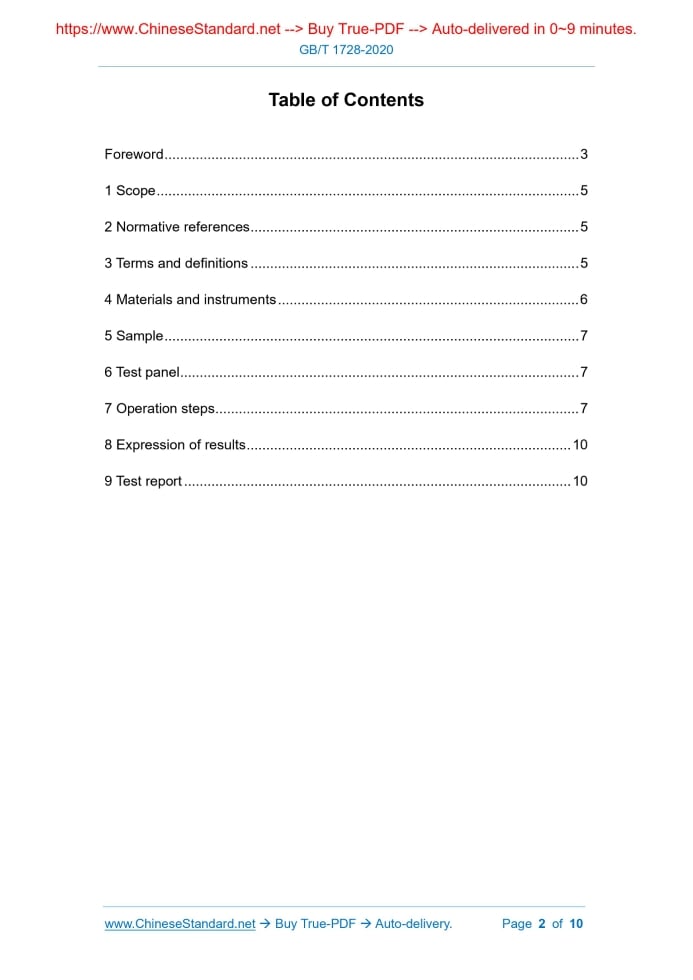
Table of Contents
Foreword ... 3 1 Scope ... 5 2 Normative references ... 5 3 Terms and definitions ... 5 4 Materials and instruments ... 6 5 Sample ... 7 6 Test panel ... 7 7 Operation steps ... 7 8 Expression of results ... 10 9 Test report ... 10 Determination of drying time of coating and putty films1 Scope
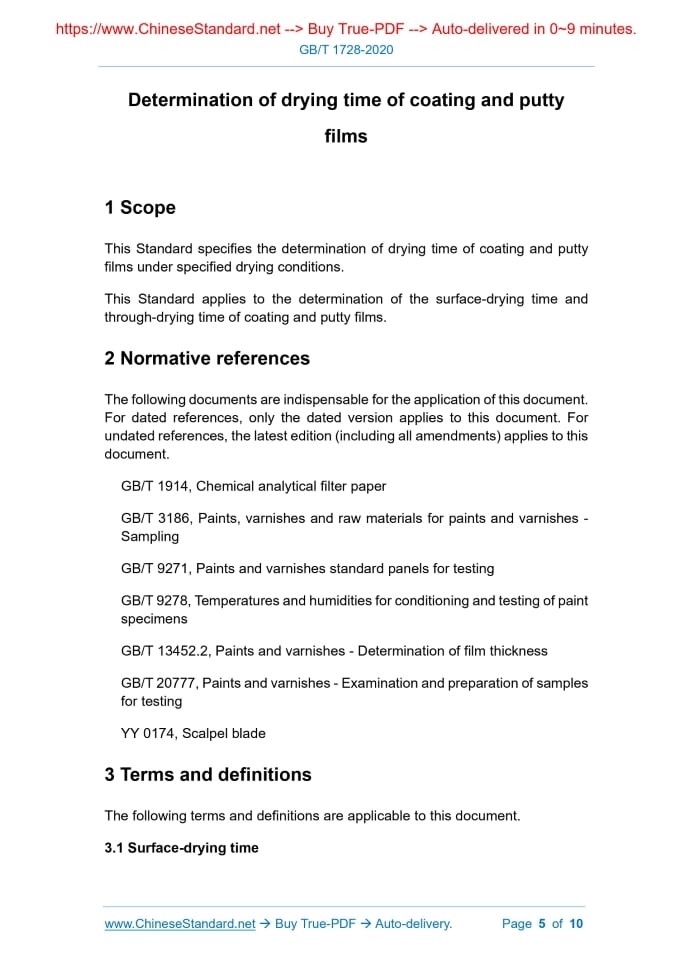
This Standard specifies the determination of drying time of coating and putty films under specified drying conditions. This Standard applies to the determination of the surface-drying time and through-drying time of coating and putty films.2 Normative references
The following documents are indispensable for the application of this document. For dated references, only the dated version applies to this document. For undated references, the latest edition (including all amendments) applies to this document. GB/T 1914, Chemical analytical filter paper GB/T 3186, Paints, varnishes and raw materials for paints and varnishes - Sampling GB/T 9271, Paints and varnishes standard panels for testing GB/T 9278, Temperatures and humidities for conditioning and testing of paint specimens GB/T 13452.2, Paints and varnishes - Determination of film thickness GB/T 20777, Paints and varnishes - Examination and preparation of samples for testing YY 0174, Scalpel blade3 Terms and definitions
The following terms and definitions are applicable to this document. 3.1 Surface-drying time Figure 1 -- Dimensions of the contact surface of the drying time tester5 Sample
According to the provisions of GB/T 3186, take representative samples of the tested product (or each product in the multi-coating system). According to the provisions of GB/T 20777, inspect and prepare test samples.6 Test panel
6.1 Substrate Unless otherwise specified, select substrates according to the provisions of GB/T 9271. The substrate shall be flat and not deformed. 6.2 Substrate processing and test panel coating Unless otherwise specified, process each piece of substrate according to GB/T 9271; then, apply coating of the test product or supporting system according to the specified method. 6.3 Thickness of coating and putty films The thickness of coating and putty films shall be specified or agreed; the dry film thickness of coating and putty films shall be measured according to one of the methods that are specified in GB/T 13452.2, in micrometers (μm); the wet film thickness of putty films can be controlled by a model frame of known thickness, in micrometers (μm) or millimeters (mm).7 Operation steps
7.1 General Unless otherwise agreed, the state conditioning of the test panel and the temperature and relative humidity of the test shall meet the requirements of GB/T 9278. Under the specified conditions, dry or bake the test panels and place them for a specified time. If applicable, each test panel should be placed horizontally in a ventilated position; interference from external airflow and direct sunlight shall be avoided. Every certain time or at the time that is specified in the product standard, within the range of not less than 1 cm from the edge of the coating film or putty film, test whether the coating film is surface-dry or through-dry. If there are no special instructions, when the product requires baking, take the film, the coating film is considered to be through-dry, while it shall be indicated “sticky” in the test report. 7.3.2 Method B (pressing cotton ball method) This method applies to determination of through-drying time of coating films. Put an absorbent cotton ball (4.1) on the surface of the coating film; then, gently place the drying time tester (4.9) on the absorbent cotton ball. At the same time, start the stopwatch (4.5); after 30 s, remove the drying time tester and the absorbent cotton ball; leave it for 5 minutes. If there are no traces of the cotton ball and loss of gloss on the surface of the coating film; if there are 1 ~ 2 cotton thread(s) on the coating film, which can be gently wiped off with a cotton ball, it is considered that the coating film is through-dry. 7.3.3 Method C (blade method) This method applies to the determination of through-drying time of thick coating and putty films. Use a medical scalpel blade (4.4) to cut through the coating film or putty film on the test panel; observe whether there is adhesion to the bottom layer and the film. For putty films, the surface also needs to be polished with an applicable waterproof abrasive paper (4.8). If there is no adhesion to the bottom layer and the film of the coating and putty films, and the putty film can form a uniform and smooth surface and does not stick to the sandpaper, it is considered that the coating film or putty film is through-dry. Under normal circumstances, for water-based products, it is recommended to use No. 120 or No. 180 waterproof abrasive paper to smooth the surface of the putty film to smooth and to remove floating dust; for solvent-based products, it is recommended to use No. 320, No. 400 or No. 500 waterproof abrasive paper to lightly polish the surface of the putty film to smooth. 7.3.4 Method D (thick layer drying method) This method applies to the determination of through-drying time of insulating varnish. Use absolute ethanol to wipe and dry the aluminum sheet box (4.2). According to the non-volatile matter content of the sample, weigh an appropriate amount of sample; ensure that the mass of the dried sample is about 10 g. If the non- volatile matter content of the sample is 50%, the sampling amount is about 20 g. Let the aluminum sheet box stand until there are no bubbles in the sample. If the bubbles do not disappear, use a needle to pick out the bubbles; place it horizontally into a forced convection oven (4.7) that is heated to a specified temperature. Dry according to the specified heating rate and baking time of the ......Source: Above contents are excerpted from the full-copy PDF -- translated/reviewed by: www.ChineseStandard.net / Wayne Zheng et al.