GB/T 1692-2008 PDF English
Price & Delivery
US$155.00 · In stock · Download in 9 secondsGB/T 1692-2008: Vulcanized rubber - Determination of the insulation resistivity
Delivery: 9 seconds. True-PDF full-copy in English & invoice will be downloaded + auto-delivered via email. See step-by-step procedure
Status: Valid
GB/T 1692: Historical versions
| Standard ID | USD | BUY PDF | Delivery | Standard Title (Description) | Status |
| GB/T 1692-2008 | 155 | Add to Cart | Auto, 9 seconds. | Vulcanized rubber - Determination of the insulation resistivity | Valid |
| GB/T 1692-1992 | 359 | Add to Cart | 3 days | Vulcanized rubber-Determination of the insuiation resistivity | Obsolete |
Click to Preview this PDF
Similar standards
GB/T 1692-2008: Vulcanized rubber - Determination of the insulation resistivity
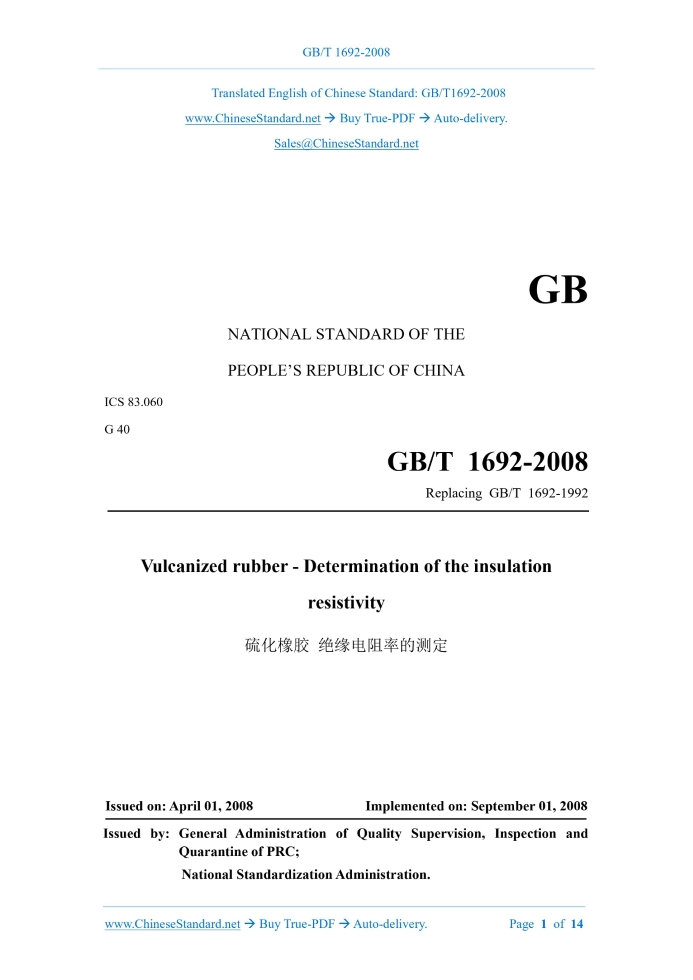
---This is an excerpt. Full copy of true-PDF in English version (including equations, symbols, images, flow-chart, tables, and figures etc.), auto-downloaded/delivered in 9 seconds, can be purchased online: https://www.ChineseStandard.net/PDF.aspx/GBT1692-2008GB NATIONAL STANDARD OF THE PEOPLE’S REPUBLIC OF CHINA ICS 83.060 G 40 Replacing GB/T 1692-1992 Vulcanized rubber - Determination of the insulation resistivity Issued on: APRIL 01, 2008 Implemented on: SEPTEMBER 01, 2008 Issued by. General Administration of Quality Supervision, Inspection and Quarantine of PRC; National Standardization Administration.
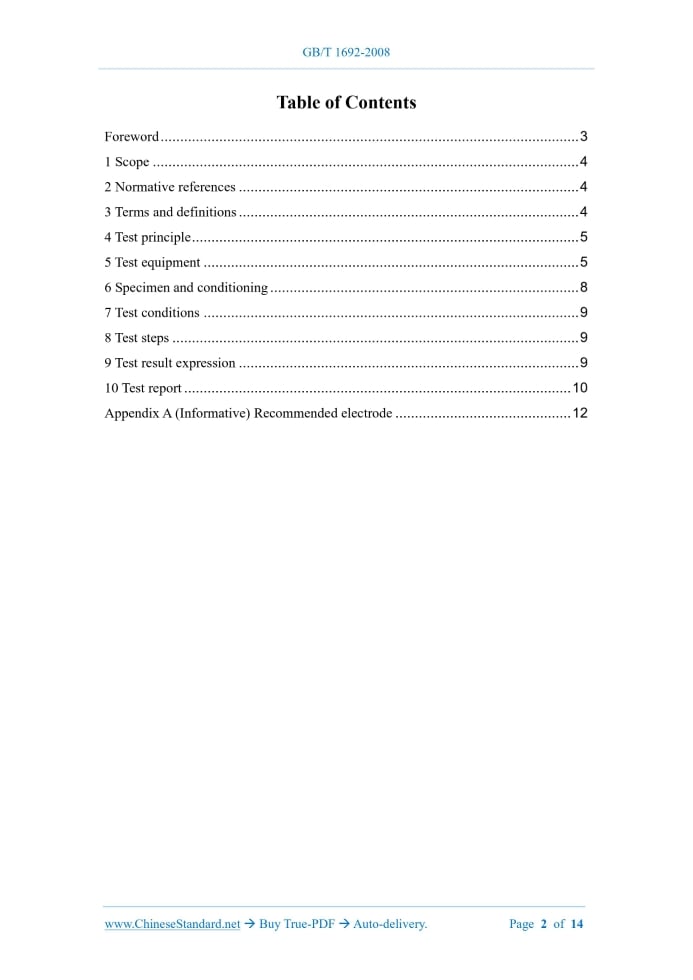
Table of Contents
Foreword... 3 1 Scope... 4 2 Normative references... 4 3 Terms and definitions... 4 4 Test principle... 5 5 Test equipment... 5 6 Specimen and conditioning... 8 7 Test conditions... 9 8 Test steps... 9 9 Test result expression... 9 10 Test report... 10 Appendix A (Informative) Recommended electrode... 12Foreword
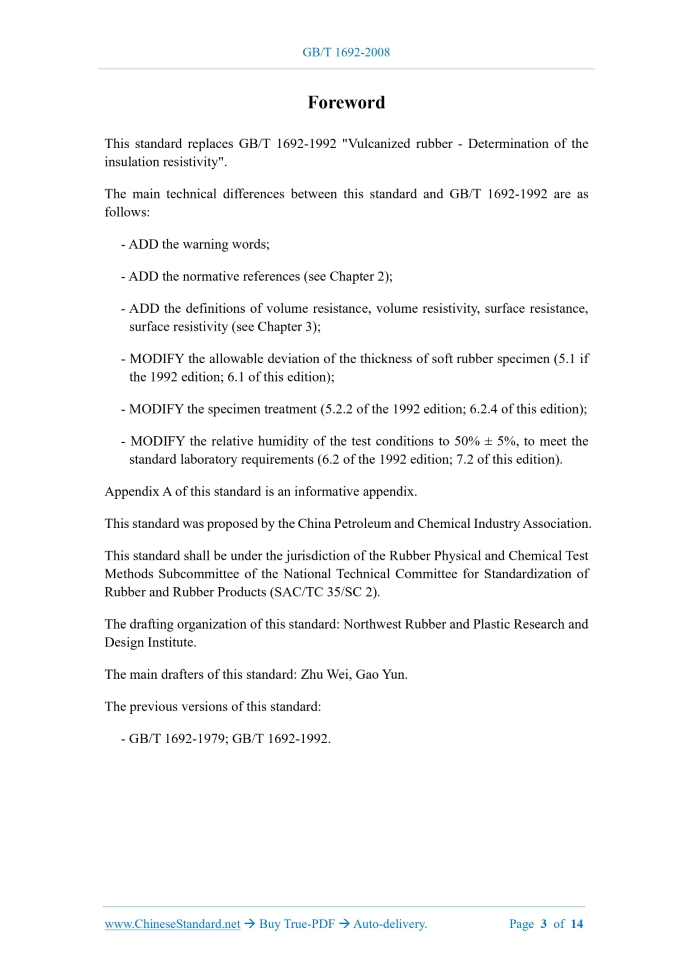
This standard replaces GB/T 1692-1992 "Vulcanized rubber - Determination of the insulation resistivity". The main technical differences between this standard and GB/T 1692-1992 are as follows. - ADD the warning words; - ADD the normative references (see Chapter 2); - ADD the definitions of volume resistance, volume resistivity, surface resistance, surface resistivity (see Chapter 3); - MODIFY the allowable deviation of the thickness of soft rubber specimen (5.1 if the 1992 edition; 6.1 of this edition); - MODIFY the specimen treatment (5.2.2 of the 1992 edition; 6.2.4 of this edition); - MODIFY the relative humidity of the test conditions to 50% ± 5%, to meet the standard laboratory requirements (6.2 of the 1992 edition; 7.2 of this edition). Appendix A of this standard is an informative appendix. This standard was proposed by the China Petroleum and Chemical Industry Association. This standard shall be under the jurisdiction of the Rubber Physical and Chemical Test Methods Subcommittee of the National Technical Committee for Standardization of Rubber and Rubber Products (SAC/TC 35/SC 2). The drafting organization of this standard. Northwest Rubber and Plastic Research and Design Institute. The main drafters of this standard. Zhu Wei, Gao Yun. The previous versions of this standard. - GB/T 1692-1979; GB/T 1692-1992. Rubber, vulcanized - Determination of electrical breakdown strength and voltage resistant at commercial power frequency Warning. People who use this standard shall have practical experience in formal laboratories. This standard does not point out all possible safety issues. Users are responsible for taking appropriate safety and health measures and ensuring compliance with relevant national laws and regulations.1 Scope
This standard specifies the method for determining the insulation resistivity of vulcanized rubber. This standard is applicable to the determination of the insulation resistivity of vulcanized rubber, which has a resistance greater than 108 Ω.2 Normative references
The provisions in following documents become the provisions of this Standard through reference in this Standard. For the dated references, the subsequent amendments (excluding corrections) or revisions do not apply to this Standard; however, parties who reach an agreement based on this Standard are encouraged to study if the latest versions of these documents are applicable. For undated references, the latest edition of the referenced document applies. GB/T 2941 Rubber - General procedures for preparing and conditioning test pieces for physical test methods (GB/T 2941-2006, ISO 23529.2004, IDT)3 Terms and definitions
The following terms and definitions apply to this standard. 3.1 Insulation resistance The ratio -- of the DC voltage on the specimen to the total current flowing through the specimen -- is called insulation resistance. It includes two parts. volume resistance and surface resistance. 3.2 Volume resistance The ratio -- of the DC voltage on the specimen to the current flowing through the specimen volume, which is expressed by Rv. 3.3 Volume resistivity The resistance value of the dielectric in the unit volume (cubic centimeters) of the specimen, which is expressed by ρV. 3.4 Surface resistance The ratio -- of the DC voltage on the specimen surface to the current flowing through the specimen surface, expressed as Rs. 3.5 Surface resistivity If a square of any size is taken on the specimen surface, meanwhile the current passes through the opposite sides of the square, the resistance value of the square is the surface resistivity, expressed as ρs.4 Test principle
Apply a DC voltage to the specimen; measure the leakage current perpendicular to the specimen or along the specimen surface; calculate the volume resistivity or surface resistivity of the specimen.5 Test equipment
The test equipment includes auxiliary electrodes and high resistance meters. 5.1 The auxiliary electrode materials are shown in Table 1. the specimen). 6.2.4 Place the wiped specimen in a container with a desiccant at a temperature of 23 °C ± 2 °C for 24 h. 6.2.5 If there are special requirements in the product standard, the handling of the specimen can be carried out in accordance with the product standard.7 Test conditions
7.1 The test voltage is 1000 V or 500 V; the voltage fluctuation deviation is not more than 5%. 7.2 The laboratory temperature is 23 °C ± 2 °C; the relative humidity is 50% ± 5%. 7.3 Where there are special requirements for specimen processing, the test can be carried out according to the requirements.8 Test steps
8.1 Connect the test instrument; connect the tested specimen to the instrument test end according to the test requirements, as shown in Figure 4. 8.2 Operate correctly according to the equipment instruction manual and operating procedures. When the resistance of the test meter is 1014 Ω or below, read the indication at 1 min. When the resistance is above 1014 Ω, read the indication at 2 min. Record the indication. 8.3 After each specimen is tested, turn the "discharge-test" switch to the "discharge" position; turn the input short circuit switch to the "short circuit" position; take out the specimen. If the test continues, replace the specimen according to the steps of 8.2 and 8.3. 8.4 When all the tests are completed, cut off the power supply. Restore the instrument to the initial state.9 Test result expression
9.1 The resistivity is calculated according to the formula in Table 5. ......Source: Above contents are excerpted from the full-copy PDF -- translated/reviewed by: www.ChineseStandard.net / Wayne Zheng et al.