GB/T 15911-2021 PDF English
Price & Delivery
US$145.00 · In stock · Download in 9 secondsGB/T 15911-2021: Monitoring and testing method for energy saving of industrial electro heat devices
Delivery: 9 seconds. True-PDF full-copy in English & invoice will be downloaded + auto-delivered via email. See step-by-step procedure
Status: Valid
GB/T 15911: Historical versions
| Standard ID | USD | BUY PDF | Delivery | Standard Title (Description) | Status |
| GB/T 15911-2021 | 145 | Add to Cart | Auto, 9 seconds. | Monitoring and testing method for energy saving of industrial electro heat devices | Valid |
| GB/T 15911-1995 | 199 | Add to Cart | 2 days | Monitoring and testing method for energy saving of electroheat device in industry | Obsolete |
Click to Preview this PDF
Similar standards
GB/T 15911-2021: Monitoring and testing method for energy saving of industrial electro heat devices
---This is an excerpt. Full copy of true-PDF in English version (including equations, symbols, images, flow-chart, tables, and figures etc.), auto-downloaded/delivered in 9 seconds, can be purchased online: https://www.ChineseStandard.net/PDF.aspx/GBT15911-2021
GB NATIONAL STANDARD OF THE PEOPLE’S REPUBLIC OF CHINA ICS 27.010 F 01 Replacing GB/T 15911-1995 Monitoring and Testing Method for Energy Saving of Industrial Electroheat Devices ISSUED ON: APRIL 30, 2021 IMPLEMENTED ON: NOVEMBER 01, 2021 Issued by: State Administration for Market Regulation; Standardization Administration of PRC.
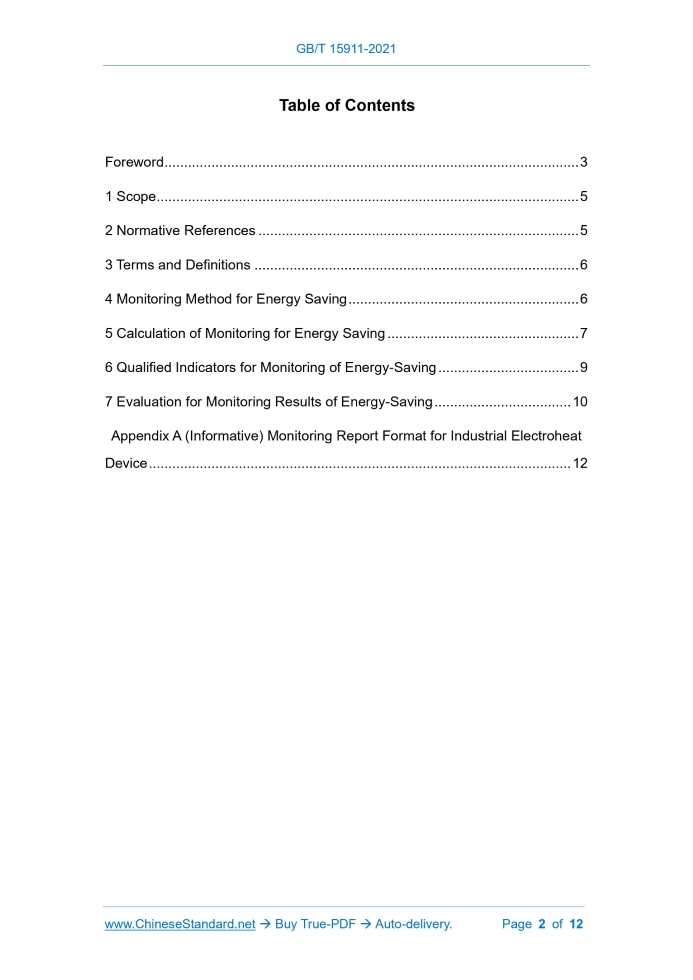
Table of Contents
Foreword ... 3 1 Scope ... 5 2 Normative References ... 5 3 Terms and Definitions ... 6 4 Monitoring Method for Energy Saving ... 6 5 Calculation of Monitoring for Energy Saving ... 7 6 Qualified Indicators for Monitoring of Energy-Saving ... 9 7 Evaluation for Monitoring Results of Energy-Saving ... 10 Appendix A (Informative) Monitoring Report Format for Industrial Electroheat Device ... 12 Monitoring and Testing Method for Energy Saving of Industrial Electroheat Devices1 Scope
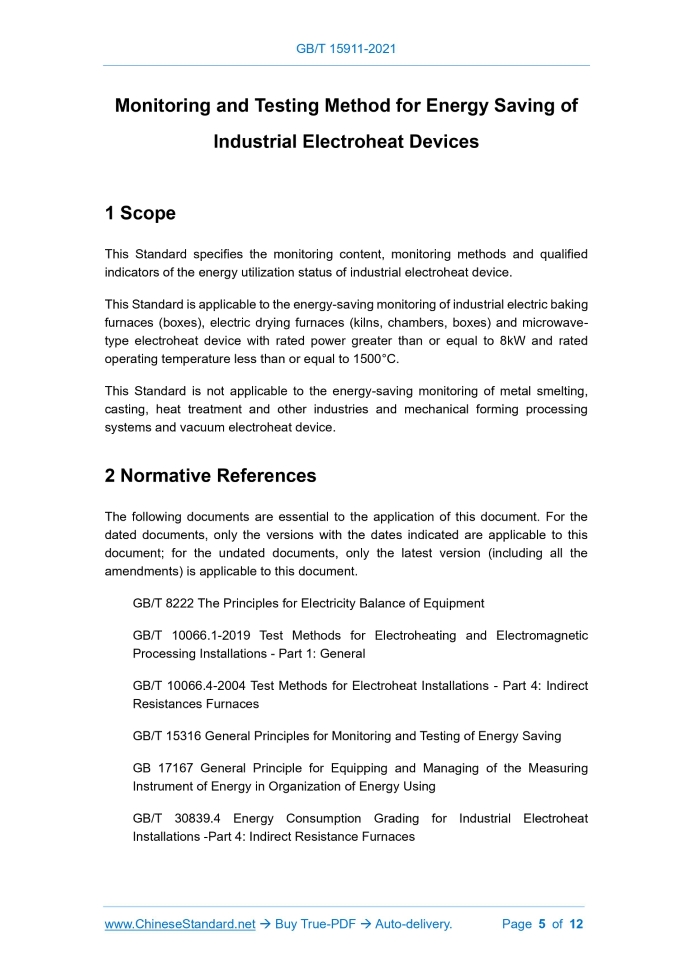
This Standard specifies the monitoring content, monitoring methods and qualified indicators of the energy utilization status of industrial electroheat device. This Standard is applicable to the energy-saving monitoring of industrial electric baking furnaces (boxes), electric drying furnaces (kilns, chambers, boxes) and microwave- type electroheat device with rated power greater than or equal to 8kW and rated operating temperature less than or equal to 1500°C. This Standard is not applicable to the energy-saving monitoring of metal smelting, casting, heat treatment and other industries and mechanical forming processing systems and vacuum electroheat device.2 Normative References
The following documents are essential to the application of this document. For the dated documents, only the versions with the dates indicated are applicable to this document; for the undated documents, only the latest version (including all the amendments) is applicable to this document. GB/T 8222 The Principles for Electricity Balance of Equipment GB/T 10066.1-2019 Test Methods for Electroheating and Electromagnetic Processing Installations - Part 1: General GB/T 10066.4-2004 Test Methods for Electroheat Installations - Part 4: Indirect Resistances Furnaces GB/T 15316 General Principles for Monitoring and Testing of Energy Saving GB 17167 General Principle for Equipping and Managing of the Measuring Instrument of Energy in Organization of Energy Using GB/T 30839.4 Energy Consumption Grading for Industrial Electroheat Installations -Part 4: Indirect Resistance Furnaces conditions. 4.3.5 Monitoring time Electroheat device for continuous production shall start monitoring when the thermal conditions reach normal working conditions; and the monitoring time shall be no less than 3h; the monitoring time of electroheat device for intermittent production shall be no less than 3 production cycles. 4.4 Determination of temperature-rise time 4.4.1 The determination of temperature-rise time shall comply with the relevant provisions of GB/T 10066.4-2004. 4.4.2 The electroheat device for continuous production (such as chains type, and tunnel type, etc.) may be exempted from the determination of temperature-rise time. 4.5 Determination of surface temperature-rise 4.5.1 The temperature measurement points on the outer surface of the electroheat device shall be separately on the outside of the furnace door, any optional 3~5 points on the insulation shell (side wall and top cover); but they shall not be located 120mm away from the furnace mouth (product entrance, heating element and thermocouple lead-out hole, vent hole, etc.) and the fastener penetrating the inner lining. 4.5.2 The measurement of ambient temperature shall comply with the provisions of 5.8 in GB/T 10066.1-2019. 4.5.3 The measurement of surface temperature-rise shall comply with the provisions of 6.17 in GB/T 10066.4-2004. 4.6 Determination of ratio of no-load power loss to rated power The measurement of ratio of no-load power loss to rated power, and the rated power shall be carried out respectively according to 6.11 and 6.8 of GB/T 10066.4-2004.5 Calculation of Monitoring for Energy Saving
5.1 Calculation of electric energy utilization The electric energy utilization rate shall be calculated according to Formula (1): Where: η – electric energy utilization rate; WG - supply of electric energy, in kW·h; WY - Effective electric energy, in kW·h. The effective electric energy shall be calculated according to Formula (2): Where: m1 - the mass of the product before processing, in kg; m2 - the mass of the product after processing, in kg; t1 - the temperature of the product before processing, in °C; t2 - the maximum working temperature of product heating, in °C; c2 - the average specific heat capacity of the product at t2 - t1, in [kJ/(kg·°C)]; c1 - the average specific heat capacity of the volatile (evaporated) matter in the product at t1 - t2, in [kJ/(kg·°C)]; r - the latent heat of the volatile (evaporated) matter in the product during the phase change, in kJ/kg; c1, c2, r — constants, available by checking related manuals. 5.2 Calculation for ratio of no-load power loss to rated power The ratio of no-load power loss to rated power shall be calculated according to Formula (3): Where: R – ratio of no-load power loss to rated power; P0 – no-load power loss, in kW; Pn – rated power, in kW. ......Source: Above contents are excerpted from the full-copy PDF -- translated/reviewed by: www.ChineseStandard.net / Wayne Zheng et al.